Development of Near-Infrared Phototransistor Using Circularly Polarized Light
High-Performance, Low-Cost Encryption Device Blocking Duplication and Eavesdropping
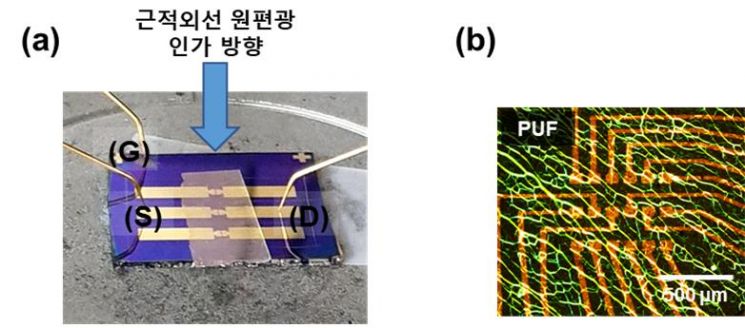 POM image of a near-infrared circularly polarized light-responsive phototransistor device combined with a chiral liquid crystal network film developed by the research team and a physically unclonable function (PUF) array
[Asia Economy Reporter Junho Hwang] Domestic researchers have developed a device that implements a Physical Unclonable Function (PUF) by utilizing the rotational (polarization) properties of light without changing the hardware structure. It is expected to be used as a powerful security solution for smartphones, home appliances, drones, and autonomous vehicles.
The research team from the Photonic Materials Research Group at the Korea Institute of Science and Technology (KIST), including Jeong-A Im and Hyun-Soo Joo, in collaboration with the research team of Professor Seok-Gyun Ahn from the Department of Polymer Engineering at Pusan National University, announced on the 20th that they have developed such a device, and the related research results were recently published in the international journal Advanced Functional Materials.
Device that Prevents Hacking Using Fingerprints Made of Light
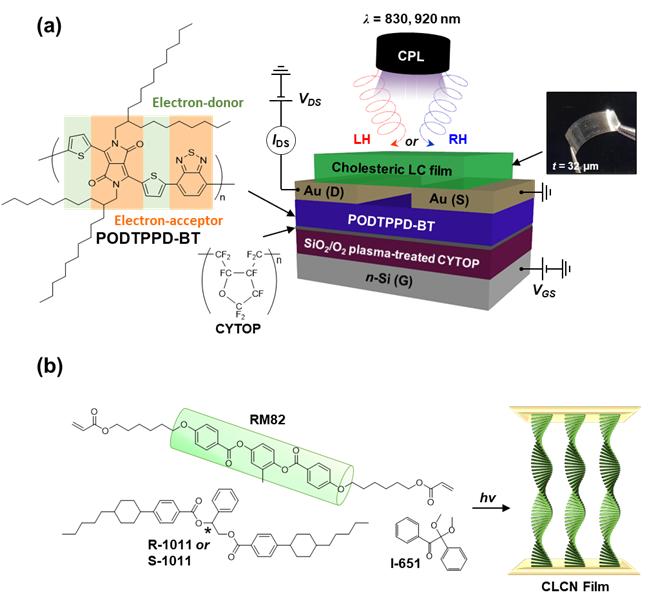 Structure and schematic diagram of a near-infrared circularly polarized light-responsive phototransistor device.
The researchers developed a device that encrypts and utilizes circularly polarized light, which spirals while drawing a circle. It is a device that combines a cholesteric liquid crystal film, which adjusts the amount of light reaching the device depending on the rotation direction of the light, with an organic phototransistor that detects near-infrared light.
The combined phototransistor reflects light rotating in the same direction as the liquid crystal helical structure and transmits light rotating in the opposite direction, allowing it to distinguish and detect the rotation direction of light progressing clockwise or counterclockwise. As a result, without changing the physical size of the device, the number of combinations used to generate encryption keys can be increased, fundamentally blocking hacking, wiretapping, and eavesdropping.
The research team stated that the developed device showed at least 30 times higher sensitivity than existing near-infrared circularly polarized light-sensitive organic phototransistors based on nanostructuring.
Potential for Various Next-Generation Photonic Device Systems
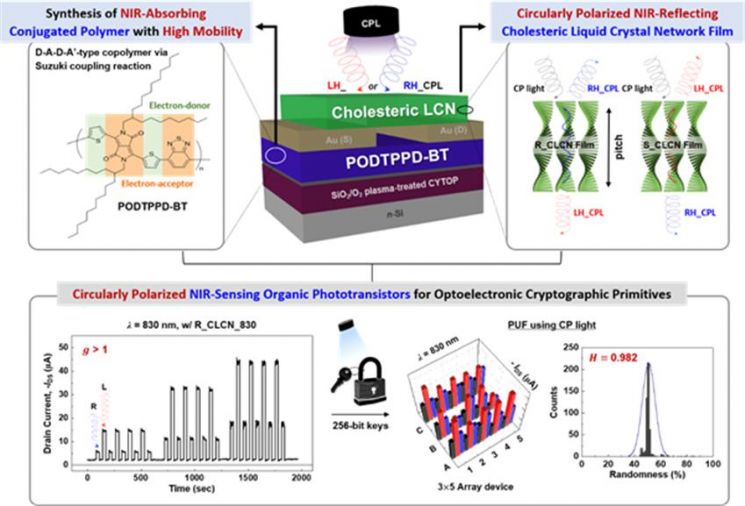 Schematic Diagram of the Main Strategy for Developing Near-Infrared Circularly Polarized Light-Responsive Phototransistors
Unlike existing organic phototransistor devices that could only detect visible circularly polarized light, this device can detect near-infrared circularly polarized light used in next-generation photonic devices such as optical communication and quantum computing, thus it is expected to have a wide range of future applications.
Dr. Jeong-A Im said, "We demonstrated that high-sensitivity near-infrared circularly polarized light-sensitive devices can be fabricated by a simple solution process without complex nanostructuring processes, and since near-infrared light is used, it is expected to be utilized in various next-generation photonic device systems in the future."
Professor Seok-Gyun Ahn added, "This result is significant as it is the first research achievement to apply the inherent chiral property of cholesteric liquid crystal polymers to encryption security technology, presenting a new application field for liquid crystal polymers."
© The Asia Business Daily(www.asiae.co.kr). All rights reserved.
![Clutching a Stolen Dior Bag, Saying "I Hate Being Poor but Real"... The Grotesque Con of a "Human Knockoff" [Slate]](https://cwcontent.asiae.co.kr/asiaresize/183/2026021902243444107_1771435474.jpg)


















