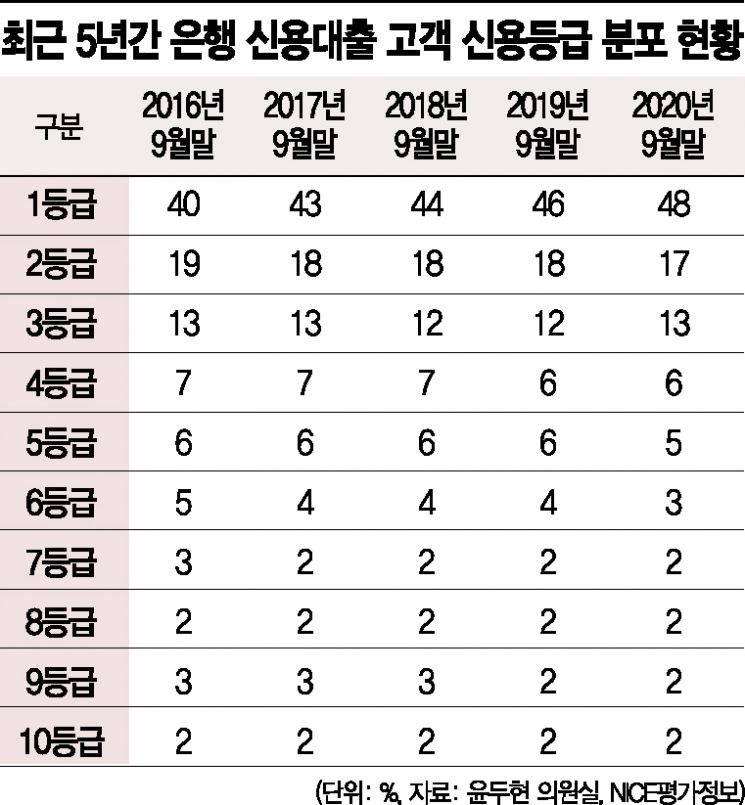
[Asia Economy Reporter Kangwook Cho] It has been revealed that half of the people who took out bank unsecured loans have a credit rating of grade 1. Eight out of ten borrowers were grade 3 or higher. Amid this, there are concerns that financial authorities, startled by the craze for 'Yeongkkeul' (borrowing to the limit) and 'Debt Investment,' may have rushed into tightening regulations without properly understanding the market situation.
They have already received a 'memorandum' to limit the total amount of unsecured loans at banks and are also preparing measures to strengthen the Debt Service Ratio (DSR) regulations. However, with half of the bank unsecured loan users being grade 1, there are worries that hasty regulations could raise the overall bank lending threshold, pushing self-employed individuals and ordinary citizens who need living expenses into a 'loan cliff.'
On the 19th, Yoon Doo-hyun, a member of the National Assembly's Political Affairs Committee from the People Power Party, analyzed data on the 'Distribution of Bank Loan Customers' Credit Ratings Over the Past Five Years' received from NICE Information Service. According to the analysis, as of the end of last September, among 6.46 million customers using unsecured loans, 3.11 million (48%) were grade 1. Grade 2 accounted for 17%, and grade 3 for 13%. Nearly 80% of those using bank unsecured loans were high-credit borrowers with grades 1 to 3. In particular, the proportion of grade 1 borrowers steadily increased from 40% in 2016 to 43% in 2017, 44% in 2018, 46% in 2019, and 48% in 2020, rising by 8 percentage points over four years.
Typically, the biggest factor affecting credit ratings is whether interest payments are made on time without delinquency. Therefore, an increase in credit rating is interpreted as meaning that interest was repaid promptly. However, Yoon pointed out that the financial authorities' crackdown on unsecured loans means that regulations have been imposed not only on high-credit borrowers but also on the entire bank customer base, including medium- and low-credit borrowers.
Earlier, according to Park Yong-jin of the Democratic Party, 18 domestic banks recently submitted plans to the Financial Supervisory Service to keep the monthly increase in unsecured loans at around 2 trillion won until the end of this year. These banks provided detailed data on last year's and this year's unsecured loan balances and growth management targets to the Financial Supervisory Service, effectively signing a 'memorandum' that fixed the increase target at 'around 2 trillion won' for October to December.
Additionally, financial authorities have announced plans to expand the Debt Service Ratio (DSR) regulations. Deputy Prime Minister and Minister of Economy and Finance Hong Nam-ki, Financial Services Commission Chairman Eun Sung-soo, and Financial Supervisory Service Chairman Yoon Seok-heon all mentioned 'DSR expansion' during the National Assembly audit, drawing attention to the scope and method of expansion. The DSR is the ratio of the total principal and interest of all loans a borrower must repay to their annual income. Currently, a DSR of 40% applies when borrowing against a house priced over 900 million won in speculative or overheated speculation areas.
Financial authorities are reportedly considering expanding the regions where DSR is applied per borrower or lowering the house price criteria to broaden the scope of regulation. Strengthening DSR regulations will affect most household loans, including mortgage loans, unsecured loans, and jeonse (key money deposit) loans.
The problem is that with limits on total loan amounts and the disappearance of preferential interest rates, the overall bank loan threshold has risen. According to the Bank of Korea's Financial Institution Loan Behavior Survey, the loan attitude index for general household loans changed from 9 in the third quarter to -9 in the fourth quarter of this year. This means banks will scrutinize loans more strictly in the fourth quarter.
In fact, the interest rates on unsecured loans at major banks, which had been steadily falling this year, reversed to an upward trend last month. If the DSR is tightened, loan supply will decrease, causing interest rates to rise further, raising concerns that vulnerable groups may face greater difficulties. In particular, low-income earners, low-credit borrowers, and elderly people without pension income are likely to be unable to obtain loans from banks and be pushed toward secondary financial institutions.
The financial authorities' shift from initially cautious loan regulation is said to have occurred after the Blue House directly instructed 'measures' on unsecured loans in August to 'control real estate.' However, a full expansion of the DSR 40% is considered premature, and a targeted approach is more likely.
A financial industry official said, "While it is true that managing household debt risk is necessary if unsecured loans with high default risk surge, limiting the total amount of unsecured loans in the current prolonged COVID-19 situation could sever the lifeline of ordinary people who really need loans," adding, "Rather than forcibly reducing banks' unsecured loan limits, it is urgent to continuously ease anxiety about housing shortages and other concerns."
© The Asia Business Daily(www.asiae.co.kr). All rights reserved.

















