Domestic ESG Bond Issuance Scale of 48.653 Trillion KRW from January to October
KB Financial to Issue 500 Billion KRW ESG Bonds on the 20th
[Asia Economy Reporter Park Sun-mi] The issuance of environmental, social, and governance (ESG) bonds by domestic financial companies and institutions is rapidly increasing. Amid an atmosphere emphasizing corporate social responsibility, the spread of the novel coronavirus infection (COVID-19) has heightened the need for financial companies to secure funds to support affected businesses. Additionally, successful cases of low-interest issuance have emerged one after another, leading to a surge in ESG bond issuance in both domestic and overseas bond markets.
According to the Korea Exchange and financial authorities on the 19th, the scale of domestic ESG bond issuance from January this year to date amounted to 48.653 trillion won issued by 14 institutions. During the same period last year, ESG bond issuance was only 15.083 trillion won issued by 11 institutions, meaning the issuance scale has more than tripled in one year. If the current pace of ESG issuance continues, the total issuance amount this year is expected to exceed twice last year's total issuance of 25.68 trillion won.
The overseas situation is similar. From January to July this year, global ESG bonds were issued amounting to 172.6 billion dollars, a 5% increase compared to the same period last year. The issuance scale has been steadily increasing, with 161 billion dollars in 2017, 170.6 billion dollars in 2018, and 278.6 billion dollars in 2019.
ESG bonds refer to bonds issued to raise funds related to improvements in Environment (E), Social (S), and Governance (G). They are categorized into green bonds, social bonds, and sustainability bonds, and are collectively referred to as socially responsible investment bonds.
KB Financial to Issue 500 Billion Won ESG Bonds on the 20th
Domestic financial institutions are experiencing a surge in ESG bond issuance in both domestic and overseas bond markets. KB Financial Group plans to issue ESG bonds in the form of perpetual bonds worth 500 billion won on the 20th of this month. This is the first time a domestic financial holding company is issuing won-denominated ESG bonds.
Initially, KB Financial planned to issue 270 billion won worth of 5-year maturity ESG bonds, but just before the issuance date, the amount was nearly doubled to 500 billion won. The interest rate is expected to be set at around 3%, lower than the rate of previously issued perpetual bonds. A KB Financial official said, "We confirmed explosive investor interest in ESG bonds during the demand forecast on the 13th, which ultimately led to the increase in issuance size," adding, "KB Financial is currently promoting 'KB Green Way 2030,' aiming to expand ESG-related products, investments, and loans from about 20 trillion won to 50 trillion won."
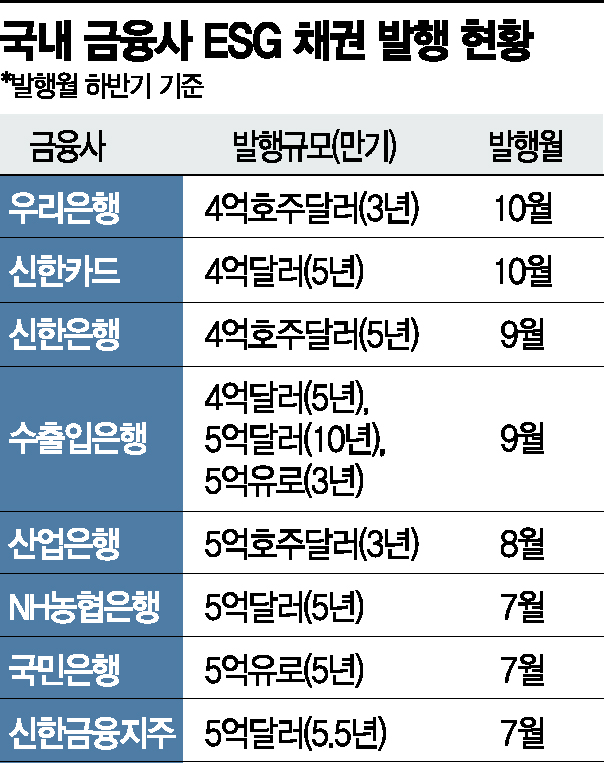
Woori Bank also issued ESG bonds worth 400 million Australian dollars (approximately 327 billion won) in the Australian bond market this month. The funds are intended to support businesses affected by COVID-19 and align with the 'Korean New Deal' policy, targeting sustainable activities such as job creation and eco-friendly projects. The issuance conditions were divided into 3-year maturity floating rate bonds (250 million Australian dollars) and fixed rate bonds (150 million Australian dollars). The interest rate for the floating rate bonds was set at 3-month BBSW (Australian dollar floating rate bond benchmark) plus 72 basis points, and the fixed rate bonds at 0.839% per annum. The bonds were issued at an interest rate 8 basis points lower than initially proposed.
Shinhan Card also issued ESG bonds worth 400 million dollars with a 5-year maturity. This is the first foreign currency ESG bond issued by a domestic card company, attracting orders exceeding 1.5 billion dollars from 100 global institutional investors, about 3.8 times the amount offered, marking a successful issuance.
Why the Surge in ESG Bond Issuance?
The Export-Import Bank of Korea made a historic achievement by issuing its first euro-denominated ESG bonds in the overseas market with a negative interest rate. Among the total 1.5 billion dollars of overseas bonds issued by the bank last month, the 3-year maturity 500 million euro ESG bonds recorded the lowest issuance rate among Korean institutions at -0.118%.
Recently, financial companies have actively issued ESG bonds in the capital market partly due to the increased need for funding supply to self-employed individuals, small business owners, and low-income groups amid the COVID-19 pandemic. Additionally, as global awareness of ESG bonds rises, financial companies can raise capital at even lower interest rates. Securing an image as a 'good company' actively engaged in ESG management is an added benefit.
According to the corporate ESG rating released by the Korea Corporate Governance Service, KB Financial, Shinhan Financial Group, BNK Financial Group, DGB Financial Group, and JB Financial Group received A+ ratings in the integrated ESG grade for various ESG-related activities including ESG bond issuance. Samsung Fire & Marine Insurance, Hyundai Marine & Fire Insurance, Hyundai Motor Securities, Mirae Asset Daewoo, Hana Financial Group, and Hanwha Life Insurance also earned A grades.
Lee Hwa-jin, an analyst at Hyundai Motor Securities, said, "Institutional investors are actively participating in ESG bond investments issued for public interest purposes, creating an environment where premiums are reflected," adding, "Following COVID-19, ESG investment is expected to continue expanding due to social bonds (support for SMEs and vulnerable groups) and New Deal-related issues (eco-friendly, electric vehicles, bio, healthcare)."
© The Asia Business Daily(www.asiae.co.kr). All rights reserved.

















