Ministry of Industry Holds Regulatory Special Cases Committee Meeting... Approves 10 Regulatory Sandbox Projects
Integrated Hydrogen Stations Enable Charging for All Hydrogen Mobility Including Construction Machinery
Reuse of EV Batteries and QR Code Parking Technology Granted Demonstration Exceptions
'Disinfectant Sterilization' Medical Waste Shredder, Total of 10 Units Approved for Demonstration Testing
[Asia Economy Reporter Kim Bo-kyung] Korea’s first hydrogen electric tram is undergoing pilot operation, and used electric vehicle batteries are being transformed into camping energy storage systems (ESS). Additionally, autonomous patrol robots are monitoring industrial complexes 24/7 to detect any leakage of harmful gases. These developments are made possible thanks to the regulatory sandbox system, which temporarily relaxes related regulations to foster innovative industries.
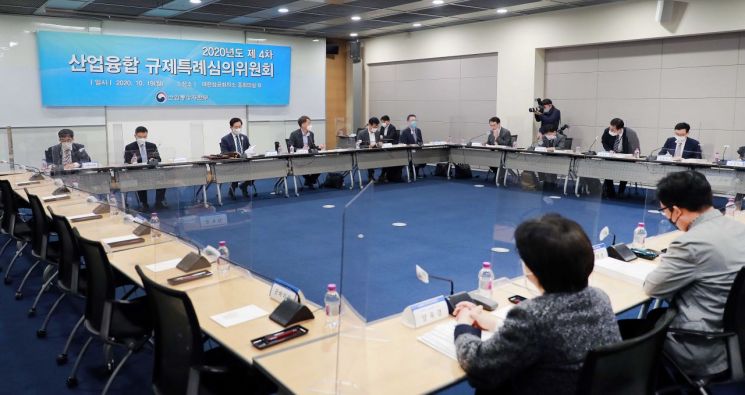
On the morning of the 19th, the Ministry of Trade, Industry and Energy held the 4th Industrial Convergence Regulatory Special Committee at the Korea Chamber of Commerce and Industry in Seoul, reviewing and approving a total of 10 regulatory sandbox projects, including 9 demonstration exceptions and 1 temporary permit. The committee’s role is to approve sandbox projects that exempt (defer) existing regulations for new products and services.
On this day, Hyundai Rotem received approval for a demonstration exception to produce and operate a test vehicle converted from an existing electric tram to a hydrogen electric tram. The hydrogen electric tram is eco-friendly as it does not emit fine dust or harmful gases. It is economical because it allows mass transportation like a subway without the need for excavation work, and it operates without overhead wires, offering urban aesthetic advantages compared to conventional wired trams. An official from the Ministry of Trade, Industry and Energy said, "Through this demonstration project, Korea’s first hydrogen electric tram will be piloted," adding, "It will serve as a stepping stone for commercialization as a next-generation urban transportation means."
The Changwon Industrial Promotion Agency applied for a demonstration exception to build an integrated hydrogen charging station capable of charging various hydrogen mobility devices, including hydrogen vehicles, hydrogen construction machinery, hydrogen two-wheelers, and hydrogen drones. Under current regulations, hydrogen charging stations can only charge hydrogen vehicles, and charging for construction machinery including hydrogen electric trams is not allowed. This demonstration project is expected to contribute to revitalizing the hydrogen economy by establishing an integrated charging station capable of charging all hydrogen mobility devices. This opens the door for hydrogen electric forklifts and excavators to emerge.
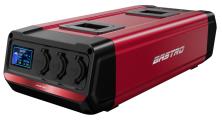 Goodbye Car 'Camping Power Bank'
Technology utilizing used electric vehicle batteries will also receive a two-year demonstration exception. Goodbye Car repurposes batteries discarded after use in electric vehicles into camping power banks. By splitting battery packs into cell units, one battery can produce 30 power banks. They can be used for up to 10 years and are over 30% cheaper. Under current law, batteries must be returned to local governments when electric vehicles are scrapped, but this regulatory exception allows local governments to purchase batteries they hold (currently about 200 units). According to the Korea Energy Economics Institute, the number of used electric vehicle batteries in Korea is expected to reach about 78,000 by 2029. Hyundai Motor Company is also demonstrating an ESS container linked with solar power generation using used electric vehicle batteries. The ESS container stores electricity generated by solar power.
Hyundai Glovis is conducting a battery rental business targeting electric taxi companies (KST Mobility) using its own batteries. Since electric taxis travel longer distances than regular vehicles and require battery replacement within 2-3 years, this model is considered suitable for battery rental. Through this business model, taxi companies can purchase taxis at a lower price excluding the battery, and improve operational efficiency through real-time battery management systems. LG Chem is conducting a demonstration to verify the feasibility of manufacturing ESS for electric vehicle rapid charging using used batteries.
The Ministry of Trade, Industry and Energy stated, "Used electric vehicle batteries can have adverse environmental effects if discarded, but when reused, they become valuable resources that can create various business models."
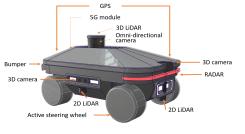 Autonomous Patrol Robot
An "outdoor autonomous patrol robot" that detects harmful gas leaks around industrial complexes in real time has also been granted a two-year regulatory exception. Six robots will be deployed near Jeonju’s 2nd industrial complex and residential areas. Residents near the industrial complex had continuously reported complaints about gas odors, leading a large company (LG) and a startup (Dogoo Space) to collaborate on developing the robot, but it could not operate due to legal restrictions. Under the Road Traffic Act, autonomous robots are classified as vehicles and are prohibited from operating on sidewalks or crosswalks. There were also limitations on data collection by autonomous robots under the Personal Information Protection Act.
Going forward, patrol robots monitoring six types of harmful gases including sulfur dioxide and nitrogen dioxide 24 hours a day are expected to alleviate residents’ concerns near industrial complexes.
A medical waste sterilization and crushing device for hospitals (Mecobi) also received a demonstration exception. It processes various medical wastes such as syringes, IV sets, and surgical tools by crushing and sterilizing them with disinfectants. This method is superior to the previously allowed steam method and can be used immediately indoors such as in operating rooms, reducing infection risks. The committee recognized effects such as reducing medical waste disposal costs and alleviating backlogs, approving a two-year demonstration exception for 10 units.
Additionally, the committee granted regulatory exceptions to the "smart parking robot service (Macro Robot Tech)," which recognizes parking locations and routes via QR codes, citing benefits such as reduced parking lot installation costs and alleviation of parking difficulties. Demonstration tests will be conducted in Bucheon and Bupyeong District, Incheon. Korea Electric Power Corporation’s "Intelligent Digital Power Plant Platform" was recognized for improving power generation efficiency and preventing accidents. LS Cable & System applied for temporary permits for seven types of wiring devices including high-end audio equipment cord sets and eco-friendly high-efficiency multi-taps, and the committee approved them on the condition of safety verification.
© The Asia Business Daily(www.asiae.co.kr). All rights reserved.

















