Hyundai Glovis, LG Chem, and KST Mobility to Promote Battery Rental Business
Approved by Ministry of Trade, Industry and Energy's Regulatory Special Cases Deliberation Committee on the 19th
[Asia Economy Reporter Suyeon Woo] Hyundai Motor Group and LG Chem are promoting a battery rental and reuse service business for electric vehicles used as taxis. By reusing electric vehicle batteries, they aim to establish a virtuous cycle system for resources, and the introduction of battery rental services is expected to reduce the price of electric taxis to about half.
The Ministry of Trade, Industry and Energy approved three demonstration exemption cases related to the "used electric vehicle battery utilization business" at the 4th Industrial Convergence Regulation Special Committee held on the 19th. Through this approval, Hyundai Glovis, LG Chem, and KST Mobility will promote a battery rental business targeting electric taxis.
Hyundai Motor Group-LG Chem Promote Battery Rental Business
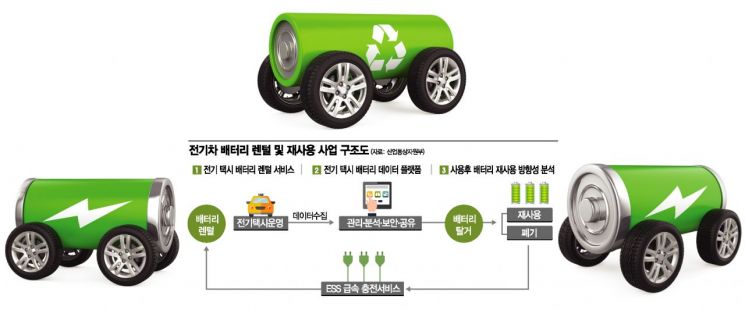
First, Hyundai Glovis will conduct a battery rental business targeting the franchise taxi call platform "Macaron Taxi," operated by KST Mobility. A data platform will be established to monitor and manage batteries in real time, while the ownership of the batteries will remain with Glovis. LG Chem will manufacture energy storage systems (ESS) for electric vehicle rapid charging using used batteries and build a system that reuses these for electric vehicle charging. Additionally, Hyundai Motor plans to reuse electric vehicle batteries by reprocessing them into large-capacity solar power ESS.
This project has the advantage of lowering vehicle costs through electric vehicle battery rental while managing the entire battery lifecycle from distribution to use and disposal via a real-time data management system. It is expected to form a virtuous cycle structure where reusable batteries are removed from vehicles to create ESS charging systems, and electric vehicles are recharged from these ESS systems.
Electric taxis that drive more than about 70,000 km annually have longer driving distances than regular vehicles, leading to faster battery consumption and shorter battery replacement cycles. Therefore, by introducing battery rental services, taxi companies can purchase vehicles more cheaply and reduce the burden of battery repair costs. Moreover, real-time management by rental companies can maintain and manage batteries in optimal condition.
Automakers Face 'Half-Price Electric Vehicle' Challenge... Exploring Battery Cost Reduction Measures
Batteries account for 30-40% of the price of electric vehicles. For example, the Kia Niro EV, which is gaining popularity as an electric taxi, currently has a taxi delivery price of 46.8 million KRW (after tax benefits), and with the maximum subsidy of 18.2 million KRW based on Seoul city standards, it can be purchased for 28.6 million KRW. The industry expects that with the introduction of this rental business, the price of electric taxis will drop to the current actual purchase price level (late 28 million KRW range) even without subsidies.
The current challenge for automakers is to supply electric vehicles at prices accessible to the public without subsidies through cost reduction. Tesla, considered a leader in the industry, has already declared plans to launch a "half-price electric vehicle" in the 20 million KRW range within three years by improving battery production process productivity to lower battery prices.
Hyundai Motor Group is seeking solutions for such half-price electric vehicles through battery rental businesses and the introduction of electric vehicle-dedicated platforms. Last month, Hyundai Kia Motors strengthened cooperation with SK Innovation in battery leasing, rental, reuse, and recycling in the electric passenger car sector, and in the commercial taxi sector, Hyundai Motor’s affiliate Glovis will directly participate in the battery rental business.
Also, under current regulations, electric vehicles receive national subsidies, so when scrapped, used batteries must be returned to local governments. However, when used electric vehicles are exported overseas, they are exempt from the return regulation, and there are no established performance and safety standards for reuse or disposal, causing confusion in the field.
Based on the demonstration results of this project, the Ministry of Environment and the National Institute of Technology and Standards plan to establish value assessment for used electric vehicle batteries and performance and safety standards for products made by reusing batteries. Through this, they intend to actively prepare measures to protect the environment and secure key raw materials for electric vehicles such as cobalt, lithium, and nickel.
An industry official said, "Countries like Japan and China have already completed systems and platform development to measure the performance of used batteries, so Korea must accelerate the establishment of standards." He added, "Through this, we must actively manage to prevent the outflow of expensive key battery resources overseas."
© The Asia Business Daily(www.asiae.co.kr). All rights reserved.

















