Market Forecasts Negative Growth Rate for Q4... Concerns Over Consumer Sentiment Worsening Due to Resurgence

[Asia Economy Reporter Jeong Hyunjin] As concerns over the resurgence of the novel coronavirus infection (COVID-19) grow in Europe, the possibility of a 'double-dip' recession deepening is gaining momentum. European countries are once again restricting some economic activities to curb the spread of COVID-19, increasing the likelihood of a blow to consumer sentiment and other factors. Initially, the Eurozone was expected to recover in the fourth quarter, but recent forecasts suggest it may record a 'negative growth rate.'
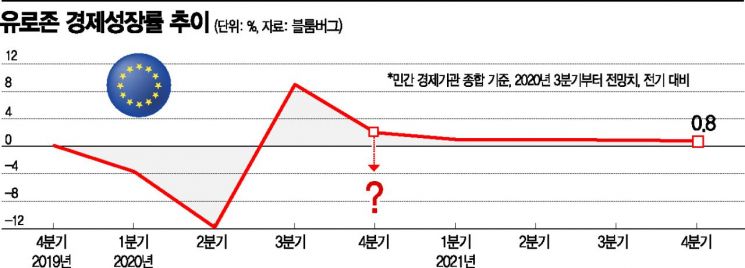
According to Bloomberg and other sources on the 18th (local time), the market is considering revising down the Eurozone's GDP growth forecast for the fourth quarter of this year to negative. This is due to the explosive increase in COVID-19 cases, making economic damage inevitable.
Originally, the Eurozone economy was expected to record 'positive' growth in the fourth quarter. A Bloomberg survey of 58 private economic institutions showed the quarter-on-quarter GDP growth forecast for the Eurozone was 9.0% for the third quarter and 2.0% for the fourth quarter. This was based on the expectation that the weakened economic growth caused by aggressive lockdown measures in the first and second quarters would recover in the third quarter after the spread of COVID-19 was halted.
Katarina Utterm?ller, Chief Economist at Allianz, said, "It is uncertain how quickly the resurgence will occur," and predicted, "Some countries will see negative growth rates in the fourth quarter, and another recession is possible." Lena Komileva, Chief Economist at G Plus Economics, stated, "The pattern of virus resurgence and the resulting business closures, along with the hit to confidence in economic recovery, have made a double-dip recession the main scenario," and she expects the economy to worsen further due to the recent difficulties surrounding Brexit (the United Kingdom's withdrawal from the European Union (EU)).
With temperatures dropping, the resurgence of COVID-19 in Europe has already become a reality. According to the World Health Organization (WHO), on the 16th, the number of new COVID-19 cases in Europe was 162,370, surpassing that of the United States. New COVID-19 cases in Europe were in the 10,000 range during June and July but surged sharply from last month, recently exceeding 100,000 daily. Belgium decided to close all bars and cafes for four weeks starting that day, and Switzerland made mask-wearing mandatory. France implemented a four-week nighttime curfew in the metropolitan area and major provincial cities starting the previous day.
The area expected to suffer the most significant impact among economic activities is consumption. Consumer sentiment did not show a clear recovery even during the summer when the spread of COVID-19 slowed significantly, and the resurgence is expected to further dampen consumer sentiment. In August, the Eurozone Consumer Price Index (CPI) inflation rate recorded -0.2%, marking deflation for the first time in four years and three months. Eric Nielsen, Chief Economist at UniCredit, analyzed, "If people stay home, precautionary savings will increase again, which will act as one of the factors pulling GDP into negative territory."
Countries are scrambling to respond. France has released 1 billion euros (about 1.3 trillion won) in additional support promised to businesses. However, the dilemma is greater because the conditions do not allow for economic lockdown measures like those in the first half of the year.
The market is expecting the European Central Bank (ECB) to respond. The ECB is expected to inject an additional 500 billion euros into the emergency bond-buying program in December to support the Eurozone's economic recovery. ECB President Christine Lagarde attended a panel discussion that day and expressed concern about the service sector, which accounts for about 75% of employment in member countries, stating that the resurgence of COVID-19 and the resulting restrictions will increase uncertainty for businesses and households. She added, "Fiscal stimulus and monetary policy support must remain in place until they are no longer needed."
© The Asia Business Daily(www.asiae.co.kr). All rights reserved.


















