Resumption Starting November 4
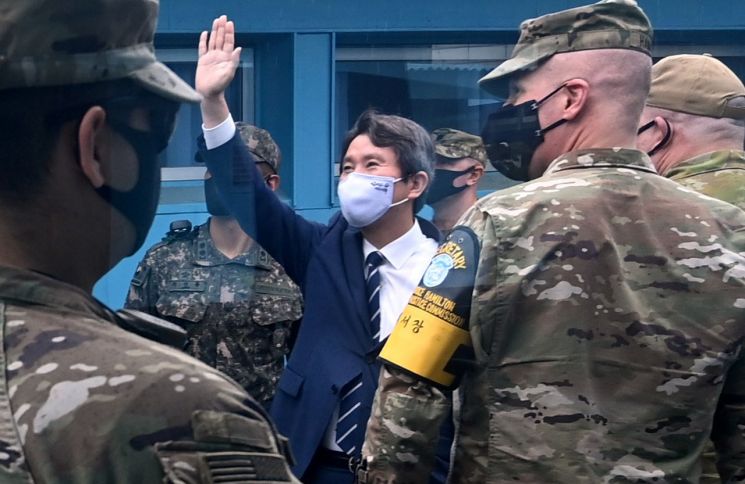 On September 16, Lee In-young, Minister of Unification, who visited Panmunjom, is waving his hand toward North Korea's Panmungak from the south side of the Military Demarcation Line in Panmunjom, Paju-si, Gyeonggi Province.
 The government has decided to resume tours of Panmunjom starting November 4. This comes about a year after the tours were suspended in October last year due to the impacts of African Swine Fever (ASF) and the novel coronavirus disease (COVID-19). Given the lingering tensions from incidents such as the shooting death of a public official in the West Sea and the demolition of the Kaesong Inter-Korean Joint Liaison Office, controversy surrounding this decision is anticipated.
On the 19th, the Ministry of Unification announced, "Tours of Panmunjom will resume under a new system starting November 4." The Ministry established the Panmunjom Tour Support Center to centralize the previously dispersed tour application channels, which were managed by various agencies including the Ministry of National Defense and the National Intelligence Service. Previously, only group applications of 30 to 40 people were accepted, but now individuals and families can also apply. The application period has been significantly shortened from at least 60 days in advance to two weeks prior, and the minimum age for applicants has been lowered from 10 years old to 8 years old, allowing even lower-grade elementary school students to participate.
However, concerns have been raised that resuming tours of Panmunjom amid the current situation?where North Korea shot and killed a South Korean public official in the West Sea in September and has refused joint investigations?could send the wrong signal to the North. Without a thorough investigation and assurances to prevent recurrence, Panmunjom tours could pose a threat to public safety.
The government stated that it will focus solely on quarantine measures related to the Panmunjom tours and will not consider the recent inter-Korean relations situation. The Ministry of Unification said, "The new system for Panmunjom tours is expected to serve as a cornerstone for realizing the demilitarization and free movement of Panmunjom as agreed upon in the 2018 Panmunjom Declaration and the Military Agreement."
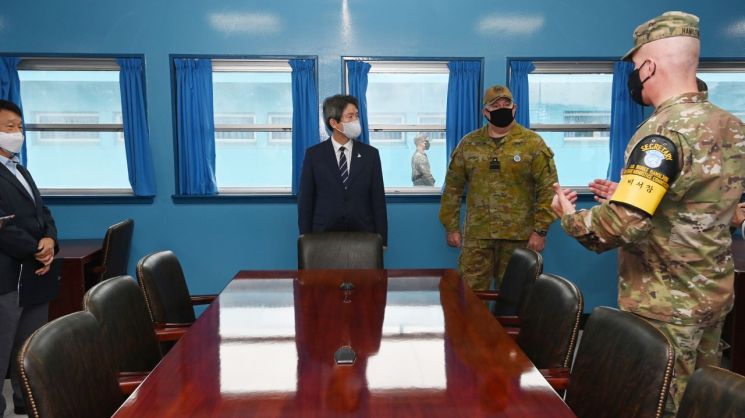 Lee In-young, Minister of Unification, who visited Panmunjom (center), is receiving an explanation from a JSA liaison officer in the Panmunjom Military Armistice Commission conference room.
Meanwhile, it has been confirmed that the Ministry of Unification has drastically reduced the budget and personnel for the Inter-Korean Joint Liaison Office, which North Korea demolished in June, maintaining it at a minimal level.
According to data submitted by the Ministry of Unification to the office of Assemblyman Cho Tae-yong of the People Power Party, a member of the National Assembly Foreign Affairs and Unification Committee, a budget of 310 million KRW has been allocated for the liaison office next year. This is a significant reduction compared to the 6.41 billion KRW budget allocated this year. The liaison office budget was 1.96 billion KRW in its inaugural year, 2018, and 8.25 billion KRW in 2019.
The personnel at the South Korean liaison office have also been halved. Initially, excluding Seo Ho, the Deputy Minister of Unification who also served as the South Korean chief, there were 29 staff members, but now the number has decreased to 15. Both personnel and budget have been organized at a minimal level necessary to maintain liaison operations based in Seoul, considering North Korea’s demolition of the liaison office building in the Kaesong Industrial Complex last June.
© The Asia Business Daily(www.asiae.co.kr). All rights reserved.


















