Trumpnomics VS Bidenomics
China's Hardline Policy Likely Unchanged... Differences in Approach
South Korea, with High Export Dependence on China, Faces Impact... Both Countries Treading Carefully
Biden Supports Multilateral Trade Order
But Has Not Released Detailed Plans
Biden Focuses on Green Policies
Positive Outlook for Solar and Electric Vehicle Industries... Carbon Tax May Emerge as a Trade Issue
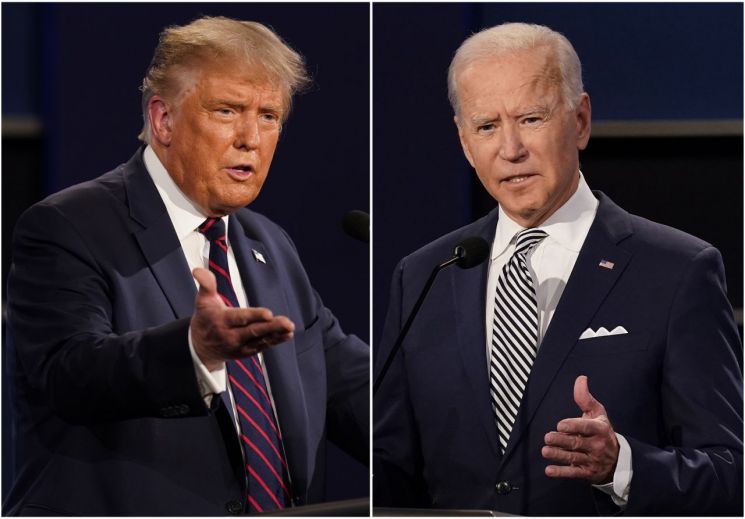 U.S. President Donald Trump (left) and Democratic presidential candidate Joe Biden (right) [Image source=AP Yonhap News]
[Asia Economy Reporters Eunbyeol Kim and Hyunjin Jung] With the U.S. presidential election just about two weeks away, attention is also focused on the impact that the major economic policies of the presidential candidates will have on South Korea. Among U.S. economic policies, trade and commerce policies play a crucial role for South Korea, where exports constitute the majority of the economy. Economic experts predict that regardless of which candidate wins, a tough stance against China is unlikely to disappear. This is because the economic downturn within the U.S. caused by the COVID-19 pandemic makes economic nationalism inevitable. This is not welcome news for South Korea, which has a high export ratio to China. However, if Democratic candidate Joe Biden is elected, industries in the 'Green New Deal' sector are likely to receive support, and the revival of multilateral trade policies is seen as a positive factor.
"Tough stance against China remains regardless of who wins"
On the 18th (local time), based on Biden's campaign and foreign media reports, it is expected that even if Biden wins, there will be little change in the U.S.'s economic nationalism and tough stance against China. Economic experts say that it is difficult to find significant differences between Biden's trade and commerce policies, which could greatly affect South Korea, and those of President Donald Trump.
Under the slogan "Build Back Better," Biden has introduced various economic policies and repeatedly stated that he will focus on rebuilding the domestic U.S. economy. His stance is to revive U.S. manufacturing and create jobs through initiatives like "Made in America" and "Buy American" to recover the domestic economy worsened by COVID-19. Although there are differences in degree, his overall position is similar to Trump's slogan "Make America Great Again."
The policy direction toward China is also expected to remain largely unchanged. Biden has stated that he will "correct China's unfair trade practices and reform China's structure that undermines the multilateral trade order."
If the U.S. pursues a tough stance against China, South Korea will inevitably suffer. Currently, about 25% of South Korea's exports go to China. South Korea exports intermediate goods to China, and China uses these intermediate goods imported from South Korea to produce finished goods for export, forming a solid industrial structure. If the U.S. takes a tough stance against China, China's imports of intermediate goods from South Korea will inevitably decrease. However, the fact that Korean products could emerge as substitutes by the U.S. avoiding Chinese products is an advantage.
Yoon Yeo-jun, Associate Research Fellow at the Korea Institute for International Economic Policy, said, "Even if Biden wins, the policy stance toward China is likely to be similar because Biden also acknowledges that China engages in unfair practices." He added, "South Korea will face pressure to choose between the U.S. and China regardless of who wins."
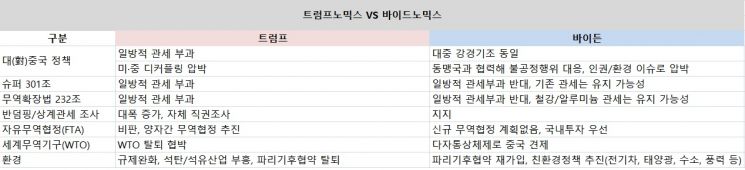
Biden differs from Trump in pressuring China through multilateral trade order
Biden's approach to pressuring China is expected to differ from that of President Trump. Biden has stated that he will work with allies to correct China's unfair trade practices and reform China's structure that undermines the multilateral trade order. This suggests that sudden trade sanctions triggered in a 'top-down' manner like under Trump are likely to be avoided. He is also expected to pressure China on human rights and environmental issues, which is a different approach.
Associate Research Fellow Yoon explained, "President Trump has so far taken a unilateral approach by imposing tariffs, but realizing that tariffs alone are insufficient, (Biden) is expected to respond by creating a public network between the U.S. and its allies."
However, ultimately, even if Biden wins, it is highly likely that tariffs against China will remain. Although Biden has expressed opposition to tariffs imposed under Section 232 and Section 301 of the Trade Expansion Act used by Trump, he has never mentioned withdrawing existing measures.
Although Biden has declared that he will lead reforms of the World Trade Organization (WTO) to reshape the multilateral trade order, the lack of concrete plans raises questions. The website E-IR (E-International Relations), which reports on international affairs, predicted negatively, stating that "WTO reform will be a very long and difficult task, as it has been so far." It also pointed out that although Biden supports multilateralism, the 'Buy American' clause promoting U.S. purchases violates WTO rules.
Green and low-carbon industries to gain momentum if Biden elected... Monetary and fiscal policies to remain
The biggest difference between the economic policies of the two candidates is environmental policy. Biden has declared that he will rejoin the Paris Climate Agreement on his first day in office. This agreement to combat global warming was controversial when Trump withdrew from it, and Biden's stance indicates a strong emphasis on environmental policies. Therefore, if the Biden administration takes office, carbon adjustment taxes are expected to emerge as a new trade issue.
From South Korea's perspective, Biden's environmental policies are expected to be favorable for domestic solar power and electric vehicle industries. Biden has expressed intentions to convert U.S. school buses and federal government vehicles to electric and hydrogen vehicles and to expand California-style fuel efficiency regulations nationwide. As demand for electric vehicles is expected to surge, domestic companies are likely to find more opportunities.
Overall monetary and fiscal policies are expected to be similar to the current ones. According to estimates by the U.S. Congressional Budget Office, both candidates are expected to significantly increase federal debt after election. If Trump wins, the federal debt is projected to rise from 98% of GDP currently to 125% by 2030, and under Biden, it is expected to increase to 128% during the same period. Since the fiscal stimulus amounts of both candidates are similar, monetary easing policies are expected to continue. As long as the U.S. maintains its zero interest rate policy, South Korea's low interest rate environment is also likely to be maintained.
© The Asia Business Daily(www.asiae.co.kr). All rights reserved.
![User Who Sold Erroneously Deposited Bitcoins to Repay Debt and Fund Entertainment... What Did the Supreme Court Decide in 2021? [Legal Issue Check]](https://cwcontent.asiae.co.kr/asiaresize/183/2026020910431234020_1770601391.png)

















