Unified Quarantine at Incheon Airport Causes 99% Drop in Regional International Airport International Flights
"Easing Needed for Passenger Convenience and Airline Survival"
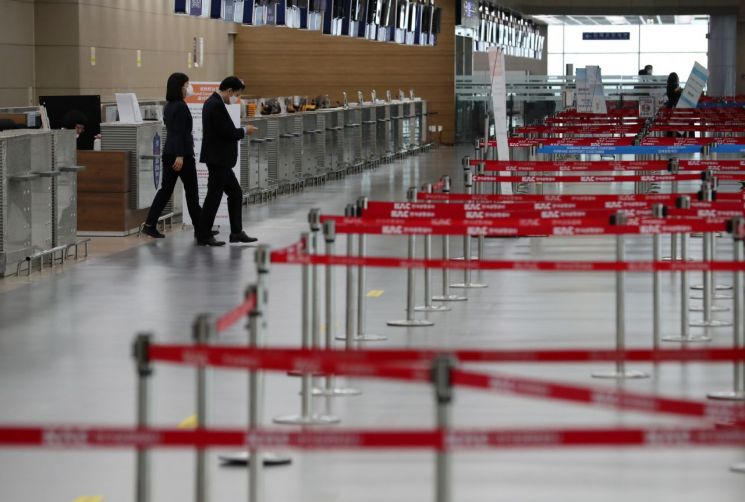
[Asia Economy Reporter Yoo Je-hoon] There are growing calls to ease the 'Incheon International Airport Entry Centralization' policy implemented after the outbreak of the novel coronavirus infection (COVID-19). According to the aviation industry on the 19th, since the Central Disease Control Headquarters and the Ministry of Land, Infrastructure and Transport announced the 'International Flight Incheon Concentration Plan' on April 6, the passenger performance at seven regional international airports nationwide, excluding Incheon Airport, from May to last month, was only 5,469, a 99.94% decrease compared to the same period last year.
Currently, the regional international routes operated by domestic airlines are limited to three routes: T'way Air's Daegu~Yanji (延吉), Jin Air's Jeju~Xi'an (西安), and Air Busan's Busan~Qingdao (靑島). All of these routes were established considering business demand such as students studying abroad and businesspeople. Although departure procedures are conducted at each regional airport, upon arrival, passengers only refuel at the regional airport and then arrive at Incheon Airport to complete related procedures.
Although regional international flights are gradually resuming, the prolonged entry centralization measure is causing difficulties for passengers, airports, and airlines alike. For passengers from non-metropolitan areas, even if they depart via regional international flights, they must stop at Incheon Airport upon arrival, which imposes significant burdens in terms of time and transportation costs. For example, Jeju residents living in China arrive at Incheon Airport and then travel via resident transport vehicles or taxis through Gimpo Airport to Jeju Airport, where they undergo COVID-19 diagnostic testing.
'
Airports are also facing challenges as they must continue operating in a 'halfway' resumed state. Korea Airports Corporation, which operates regional airports nationwide, recorded a deficit of 93.1 billion KRW in the first half of the year alone and estimates that the annual deficit will reach the 200 billion KRW range.
Airlines that have just reopened regional routes also face significant operational burdens. They are already suffering from poor demand and profitability, and the structure requires them to operate return flights with empty planes, increasing fixed costs. The Air Busan Pilots' Union issued a statement saying, "For the Busan~Qingdao route, after arriving in Busan, the plane must fly to Incheon and then return to Busan as an empty flight, with estimated round-trip costs of 20 million KRW," adding, "If such operations accelerate, the liquidity crisis will only worsen."
For these reasons, there are calls within and outside the aviation industry and airports to ease the Incheon Airport entry centralization policy, at least for some airports. Recently, many countries overseas have also been relaxing their entry centralization measures. Japan, for example, initially restricted the entry routes for Korean nationals to Tokyo (Narita) and Osaka (Kansai) airports but has recently decided to expand to Nagoya, Sapporo, Fukuoka, and other airports.
An industry official said, "For returnees residing in the southern region, the entry centralization means they must use private vehicles or public transportation after entry, which actually lengthens their travel routes," adding, "To improve travel convenience for southern region businesspeople and passengers and to enhance quarantine efficiency, it is necessary to somewhat ease the entry centralization measures."
However, the quarantine authorities are reportedly still negative about easing the entry centralization measures. An airport official said, "Although the aviation authorities have a positive stance, the quarantine authorities are still taking a cautious approach," he said.
© The Asia Business Daily(www.asiae.co.kr). All rights reserved.

















