Among 20 Projects, 6 Incurred 2.1 Billion KRW as Initial Costs and Are Sunk; Remaining 14 Haven't Started; Assemblyman Kim Young-joo Calls for More Detailed Planning from the Start
[Asia Economy Reporter Lim Cheol-young] Concerns have been raised that KOICA (Korea International Cooperation Agency) faces issues in planning and implementing aid projects, as some projects have been canceled without even starting.
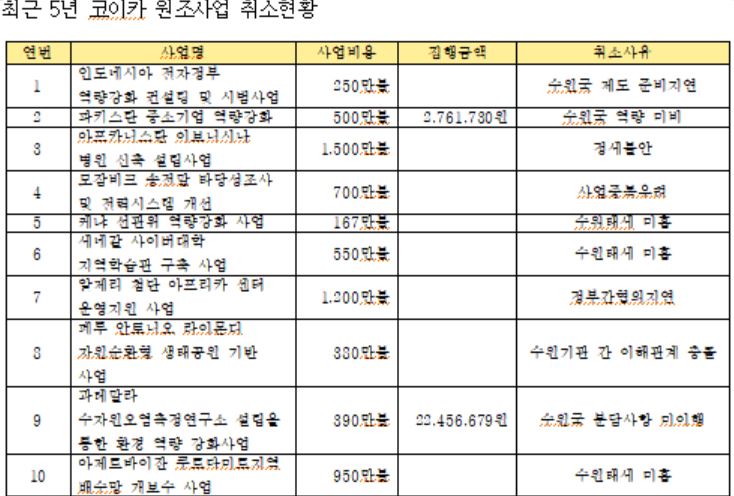
According to the "Recent 5-Year KOICA Aid Project Cancellation Status" submitted by KOICA to Kim Young-joo, a member of the National Assembly's Foreign Affairs and Unification Committee from the Democratic Party of Korea, 20 aid projects targeting 19 countries were either not initiated or canceled immediately after starting.
From 2016 to 2020, the canceled projects involved 19 countries including Indonesia, Pakistan, and Afghanistan, covering 20 projects such as SME capacity building, election commission capacity enhancement, support for operating advanced Africa centers, and establishment of regional learning centers for cyber universities. Most projects were ultimately canceled due to delays in preparation by recipient countries, lack of capacity in recipient countries, unstable political situations, concerns over overlapping projects, inadequate readiness of recipient countries, and changes in local circumstances and policies.
Among the 20 canceled projects, initial project funds were spent on six projects. Approximately 210 million KRW was spent initially: 2.7 million KRW for SME capacity building in Pakistan, 22.4 million KRW for environmental capacity building through the establishment of a water pollution measurement research institute in Guatemala, 671 million KRW for strengthening emergency medical systems in Kazakhstan, 285 million KRW for building a waste incineration plant in Sri Lanka, 56 million KRW for marine climate observation capacity enhancement in Peru, and 1.1 billion KRW for startup support in the knowledge-based city of Yachay in Ecuador.
Of the 2.1 billion KRW initially spent, 795 million KRW was recovered, but 1.34 billion KRW was not, leading to criticism that 1.3 billion KRW of taxpayers' money was wasted. It was confirmed that most of the initial project funds were spent on travel expenses, preliminary surveys, service fees, and consulting fees.
Assemblyman Kim argued that while budget waste is a problem, the continuous cancellation of projects could escalate into diplomatic issues with recipient countries, requiring caution. He also pointed out that the donor country's reputation could be damaged, emphasizing the need for careful consideration from the early stages of projects.
Kim Young-joo stated, "KOICA shifts responsibility to recipient countries, but it appears that problems existed from the project planning stage," adding, "It is necessary to conduct thorough reviews from the beginning to ensure that aid funds are provided timely and appropriately to developing countries so that projects can proceed smoothly."
© The Asia Business Daily(www.asiae.co.kr). All rights reserved.

















