Up to 91.5% Compared to the All-Time High at the End of October 2007
"Real Economy Uncertainty Remains"... Concerns Over Additional Upside Pressure
[Asia Economy Reporter Minwoo Lee] The market capitalization ratio of the KOSPI market to nominal Gross Domestic Product (GDP) has surpassed 86%. It has exceeded 90% of the previous peak. Analysts suggest that the bullish market since the COVID-19 pandemic has reached a level that could pose short-term pressure.
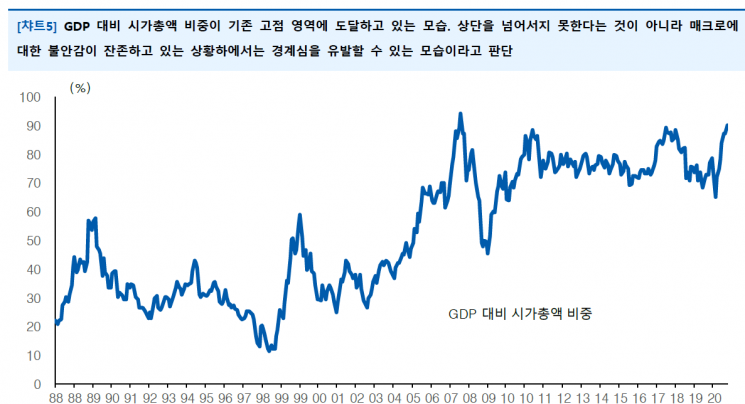
According to the financial investment industry on the 18th, as of the closing price on the 16th, the market capitalization was 1,604.041 trillion KRW, which is 86.7% of South Korea's nominal GDP forecast for this year of 1,849.954 trillion KRW. The size of the stock market has far exceeded 80% of the real economy.
This corresponds to 91.5% of the highest market capitalization-to-GDP ratio in history. Previously, this ratio reached its peak at 94.4% at the end of October 2007, just before the global financial crisis. At that time, GDP was 1,089.66 trillion KRW and market capitalization (end of month) was 1,029.274 trillion KRW. It was the first time the ratio exceeded 90% on a month-end basis. The ratio dropped to 63.7% in March when COVID-19 struck directly but rebounded afterward.
As the market capitalization-to-GDP ratio approaches the previous peak, there is analysis that the stock market may experience psychological pressure against further rises. There are concerns that resistance to index increases could emerge amid ongoing real economic uncertainties caused by COVID-19.
In fact, after the global financial crisis, the market capitalization-to-GDP ratio rose to 88.5% in April 2011. In October 2017, it increased to 89.4%, raising expectations of surpassing 90% for the first time in 10 years. However, due to growing pressure against further rises, it ultimately failed to exceed 90% and declined.
Byung-hyun Cho, a researcher at Yuanta Securities, explained, "Considering South Korea’s economy, industrial structure, and financial market have become more advanced compared to the past, and the massive liquidity injected during this crisis, there is clearly room to surpass previous highs. However, at least compared to the real economic conditions confirmed so far, the market capitalization ratio reaching previous peak levels could be seen as a burden until there is confidence in further recovery of the real economy."
© The Asia Business Daily(www.asiae.co.kr). All rights reserved.

















