Elderly Care Facilities Hit Hardest by COVID-19
Overcrowded Wards and Staff Shortages Worsen Crisis
Experts Say "Comprehensive Improvement of Elderly Health Rights Needed"
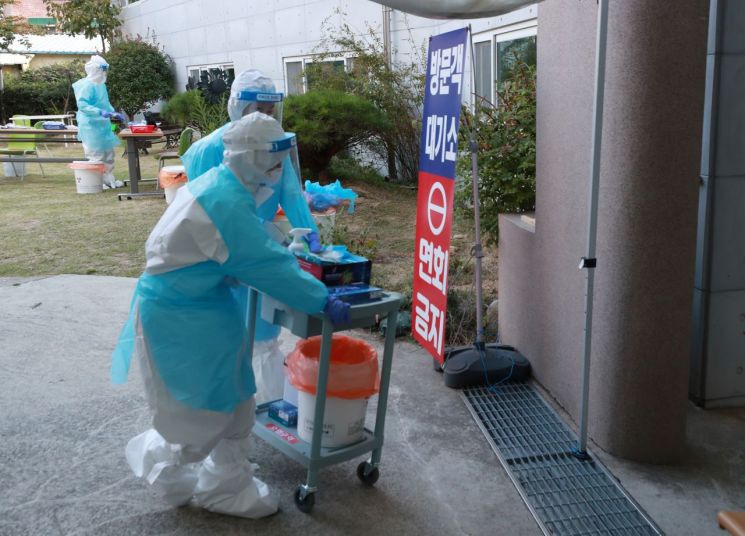 Medical staff are busily conducting comprehensive testing on the 15th at Haetteurak Nursing Hospital in Mandeok-dong, Buk-gu, Busan, where a group infection of 53 people occurred. / Photo by Yonhap News
[Asia Economy Reporter Lim Ju-hyung] Amid the ongoing global outbreaks of the novel coronavirus disease (COVID-19), elderly care facilities have been identified as the hardest hit. Due to outdated facilities and staff shortages, it is difficult to adhere to quarantine guidelines, and since most patients belong to high-risk groups, the fatality rate is high. This has led to criticism that COVID-19 has exposed the 'bare face' of our society's neglect of elderly health.
◆401 Elderly Care Facilities Nationwide with Over 10 Beds per Room... 'Weak Link' in COVID-19 Prevention
On the 14th, more than 50 COVID-19 cases were confirmed in a cluster at Haetteurak Nursing Hospital in Mandeok-dong, Buk-gu, Busan. The first confirmed case at the hospital was reported the previous day (13th). On that day, one nursing assistant tested positive, and after conducting a full investigation of 278 hospital staff and patients, COVID-19 virus was detected in samples from 53 individuals.
Notably, the hospital housed 165 elderly patients aged 60 to 80 suffering from stroke, dementia, and cerebral infarction, categorizing it as a high-risk COVID-19 facility. As of the 15th, two of the 53 confirmed cases in the hospital had died.
Consequently, concerns have arisen that elderly care hospitals and other elderly health facilities could become 'weak links' in COVID-19 prevention. According to health authorities, among 1,169 confirmed COVID-19 cases from the 19th of last month to the 2nd of this month, 142 cases (12.1%) were cluster infections in nursing hospitals.
The difficulty in mask-wearing due to many patients' cognitive impairments, poor facilities, and working conditions appear to be factors making nursing hospitals particularly vulnerable. On the 14th, Busan city explained in a COVID-19 briefing regarding the Haetteurak Nursing Hospital cluster infection, "About half of the inpatients have dementia symptoms and reduced cognitive ability," adding, "It was found that masks were not worn properly."
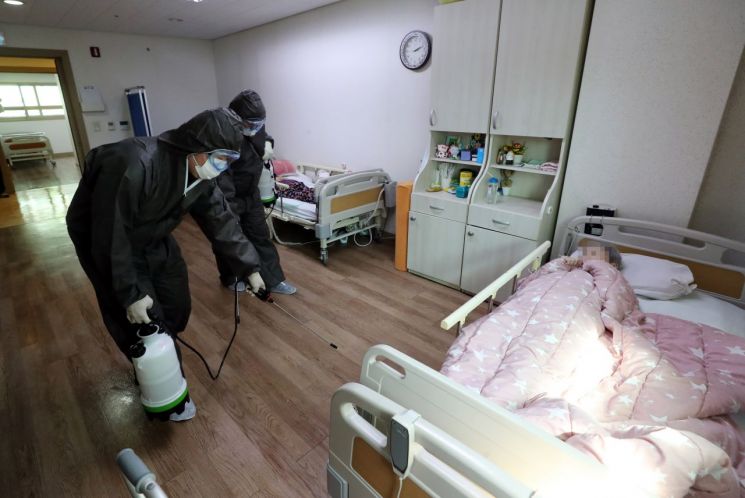 On March 18th, officials from the district office were conducting disinfection at a nursing hospital in Seongdong-gu, Seoul. / Photo by Yonhap News
The cramped hospital rooms where more than ten people live together are also problematic. According to a Ministry of Health and Welfare survey last year, 401 nursing hospitals nationwide have more than 14 beds per room. Under current medical law enforcement regulations, newly built nursing hospitals cannot have more than six beds per room, but existing facilities are not obligated to follow this standard.
Additionally, in most nursing hospitals, one caregiver is responsible for multiple patients. If even one caregiver or staff member infected from outside enters the facility, the virus can quickly spread to dozens of other patients.
◆Infection Crisis in Nursing Facilities in the US and Europe as Well... "This Place is Like a Graveyard"
South Korea is not the only country struggling with cluster infections in nursing hospitals. Advanced countries such as the US and Europe have also seen particularly high numbers of deaths due to infections in elderly care facilities.
In France, over 14,000 deaths?almost half of the total 30,000 deaths?occurred in nursing facilities, and in the UK, from March 2 to June 12, 18,562 COVID-19-related deaths were reported in nursing facilities.
According to The New York Times (NYT), as of the 16th of last month, about 77,000 nursing facility staff and patients in the US had been infected with COVID-19 and died, accounting for about 40% of total US deaths.
Regarding this, Betsy McCaughey, former Lieutenant Governor of New York State, told the NYT in an interview, "Nursing facilities were already at full capacity before COVID-19. Patients overflowed, but staff were severely lacking," adding, "If even one patient gets infected in a nursing facility, a carnage occurs. This place is like a graveyard."
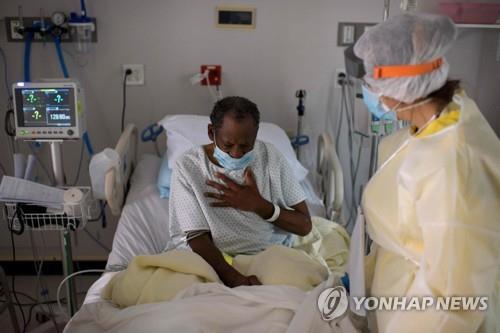 On July 2nd (local time), medical staff at United Memorial Medical Center in Houston, Texas, USA, are attending to a COVID-19 patient. / Photo by Yonhap News
Hans Kluge, Director of the World Health Organization (WHO) Regional Office for Europe, also stated at a press conference in May, "About half of the COVID-19 deaths in Europe occurred in nursing facilities. It is an unimaginable tragedy," urging, "Governments must now pay attention to nursing facilities."
◆Experts Call for Discussion on Elderly Care Costs Post-COVID-19
Experts note that nursing hospitals domestically and abroad have always been vulnerable to infectious diseases and suggest the need for long-term discussions on elderly health rights.
Professor Jung Hee-won of Seoul National University College of Medicine pointed out at the 'Aging Society Forum' hosted by the Ministry of Health and Welfare in June, "In the US, one-third of total deaths and in EU countries about half occurred in nursing homes," adding, "Domestic nursing homes and nursing hospitals overwhelmingly have multi-bed rooms with high population density, and one caregiver looks after multiple patients, making the environment vulnerable."
He continued, "Although many resources are concentrated on prevention and treatment after the COVID-19 outbreak, the elderly suffer the greatest damage in terms of reduced healthy life expectancy and quality of life, whether infected or not," emphasizing, "There is a need for a comprehensive review of elderly health rights and discussions on how to prevent the increase in social care burdens that will rise after COVID-19."
Meanwhile, the government plans to conduct full COVID-19 testing for workers in domestic nursing hospitals and facilities to promptly block the risk of additional cluster infections.
Son Young-rae, head of the Strategic Planning Division at the Central Disaster and Safety Countermeasures Headquarters, said at a briefing held at the Government Sejong Complex on the 15th, "We plan to conduct full testing for nursing hospital workers and daycare centers," adding, "We are urging local governments to start by next week at the latest."
He explained, "The testing targets are facility workers; inpatients are excluded from full testing because they are tested upon new admission," adding, "However, workers repeatedly commute between the community and the facility, so there is a risk of latent infection."
© The Asia Business Daily(www.asiae.co.kr). All rights reserved.
![User Who Sold Erroneously Deposited Bitcoins to Repay Debt and Fund Entertainment... What Did the Supreme Court Decide in 2021? [Legal Issue Check]](https://cwcontent.asiae.co.kr/asiaresize/183/2026020910431234020_1770601391.png)

















