Increased Interest in Environmental Issues... From Sustainable Consumption to Zero Waste Movement
8 out of 10 People "Willing to Purchase Sustainable Household Products"
Experts "Influence of SNS Use... Active Exchange of Opinions"
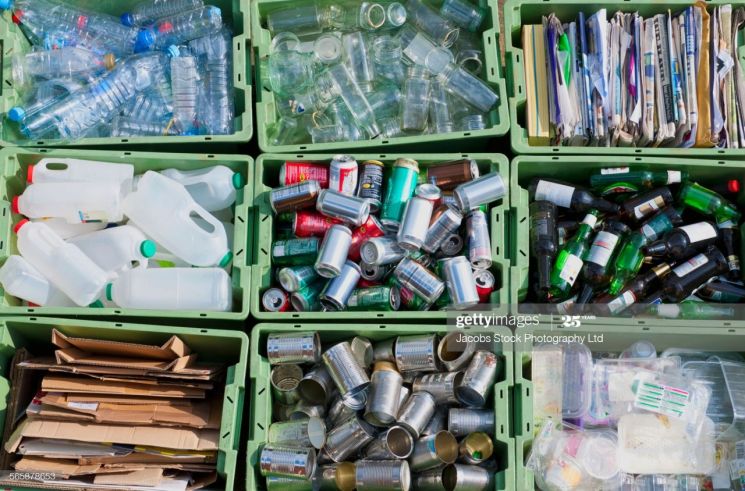 Recyclable waste stock footage. The photo is not related to any specific expression in the article. Photo by Getty Images
[Asia Economy Reporter Kim Ga-yeon] # Yu Mo (28), an office worker, recently purchased a bag made from recycled materials. After reading a book about environmental issues, she thought, "I should practice even small changes." Yu said, "I needed a bag anyway and was considering which one to buy, but I wanted to change even a small thing in my life, so I bought a bag made from recycled materials." She added, "When I showed it to my friends, they said, 'Next time, I should look for something like this.' Although this alone won't bring about a big change, it might have some influence on the people around me."
As environmental pollution and climate change have emerged as serious social issues, the number of millennials in their 20s and 30s (born from the early 1980s to early 2000s) pursuing sustainable and eco-friendly consumption is increasing. With growing interest in environmental issues, they are moving beyond reducing the use of disposable items like vinyl and plastic to consuming sustainable products such as recycled and eco-friendly goods.
On social media platforms like Twitter and Instagram, the 'zero-waste' movement is also active. The zero-waste movement aims to reduce waste generation in daily life and practice an eco-friendly lifestyle.
This can be seen as part of the millennial generation's consumption trend called 'Meaning Out.' A portmanteau of 'meaning' and 'coming out,' Meaning Out refers to the act of expressing one's political and social beliefs through consumption. Professor Kim Nan-do of Seoul National University selected this as a trend of the year in his book Trend Korea 2018.
According to a survey, most citizens recognize the seriousness of environmental issues.
The Resource Circulation Society Solidarity and Korea P&G surveyed 4,000 citizens aged 15 to 59 on 'Domestic consumers' awareness and practice behaviors regarding sustainability,' finding that 95.5% of consumers responded that "environmental pollution and waste problems are at a serious level."
Among them, 82.2% said they "are willing to purchase environmentally sustainable household products," and 73.3% answered that "even if it means sacrificing convenience when buying products or doing housework, they should choose methods that help the environment."
 A consumer is taking a credit card out of their wallet. The photo is not related to any specific expression in the article. Photo by Yonhap News.
Consumers unanimously agreed that "it is necessary to consume as sustainably as possible." University student Choi Mo (23) said, "Isn't this an era where even one meal produces a mountain of waste? Since disposable items have naturally become part of everyday life, I think it's inevitable," but added, "I believe we should actively act on at least the parts we can practice, even if not everything."
Choi said, "When ordering delivery food, I don't take disposable spoons, and I use tumblers or reusable straws instead of disposable cups. I can also buy items made from biodegradable vinyl or recycled materials." She added, "With this mindset, I try to use eco-friendly materials. I also want to practice the zero-waste movement."
As a result, companies releasing eco-friendly products or presenting environmental measures are increasing in response to changing consumer interests. SPA brands like 'H&M' and Polo are introducing eco-friendly products made from recycled materials.
IT company 'Apple' also announced on the 13th (local time) the 'iPhone 12,' stating that it will exclude the adapter and EarPods (wired earphones) from the package to protect the environment. Lisa Jackson, Apple's Vice President of Environment, stated at the online launch event, "To reduce carbon emissions and minimize the mining and use of precious resources, we decided to remove EarPods and chargers from the new product boxes."
Experts analyzed that this phenomenon has spread as consumers reveal their identities and interact with others through social media.
Professor Lee Eun-hee of Inha University's Department of Consumer Studies explained, "People express their beliefs through consumption, and the term 'concept consumption' is also used. Although socially desirable values and expressing them existed in the past, recently, with active SNS use, such consumption behaviors have become a means of self-expression."
Professor Lee added, "As people with similar opinions interact more actively through SNS, the spread is faster. It seems that this consumption movement is used as a way to express one's identity and values."
© The Asia Business Daily(www.asiae.co.kr). All rights reserved.


















