MOU Between Gyeonggi-do Gwangju Urban Management Corporation and...
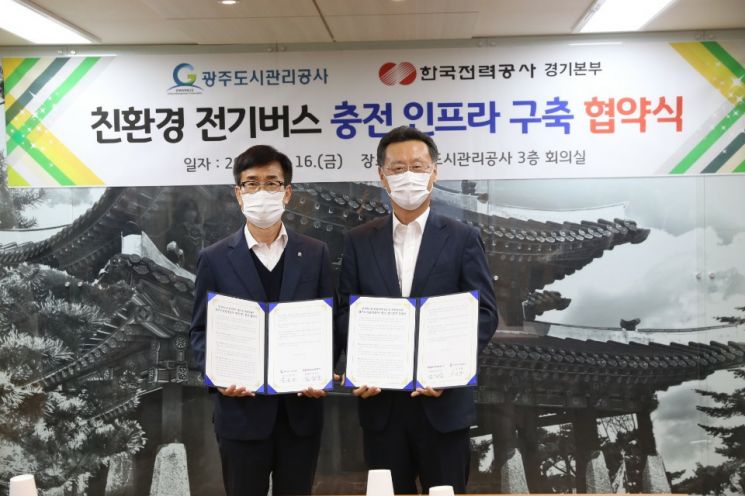 Kim Gap-sun, Head of KEPCO Gyeonggi Headquarters (right), and Yoo Seung-ha, President of Gwangju Urban Management Corporation in Gyeonggi (left), signing the "Agreement on Providing and Using Charging Infrastructure for Electric Buses" on the 16th. (Photo by Korea Electric Power Corporation)
[Asia Economy Reporter Moon Chaeseok] Korea Electric Power Corporation (KEPCO), accelerating the establishment of electric vehicle infrastructure, has also entered the electric bus business. It has taken its first step in supplying electric bus charging infrastructure in the Seoul metropolitan area, the center of transportation in South Korea.
KEPCO Gyeonggi Headquarters announced on the 16th that it signed an "Agreement on the Provision and Use of Charging Infrastructure for Electric Buses" with Gwangju Urban Management Corporation in Gwangju-si, Gyeonggi-do.
According to the agreement, KEPCO Gyeonggi Headquarters will install seven 100kW 2-channel fast chargers to provide charging services for 15 electric buses scheduled to be introduced by Gwangju-si.
Charging services will be provided for six years until the end of December 2026.
KEPCO plans to expand electric bus charging services nationwide. It aims to install 534 chargers by 2025.
The project will proceed in line with the government's Green New Deal policy, specifically the "Green Mobility Expansion including Electric Vehicles" policy.
Earlier, in July, the government announced in the "Korean New Deal Comprehensive Plan" that it will supply 1.13 million electric vehicles, including buses and trucks, by 2025.
For electric buses, the goal is to supply 3,000 units in 2022, focusing on local governments operating quasi-public city bus systems to actively introduce electric buses.
KEPCO is currently conducting pilot projects for electric bus charging services in Naju-si, Jeollanam-do; Gwangju Metropolitan City; and Sejong Special Self-Governing City.
In Naju, three 200kW chargers are in operation; in Gwangju, four 200kW chargers; and in Sejong, four 200kW chargers are each being operated.
In July, KEPCO signed a contract for the village bus charging infrastructure construction project (13 units of 100kW chargers) in Jeonju-si, Jeollabuk-do.
With the recent project in Gwangju-si, Gyeonggi-do (seven 100kW chargers), KEPCO is expanding electric bus charging services nationwide.
A KEPCO official said, "We will expand electric bus charging services nationwide to establish a foundation for promoting the introduction of eco-friendly vehicles in public transportation."
He added, "We will expand charging services to electric taxis and electric trucks, and actively participate in the government's Green New Deal policy to spread low-carbon and distributed energy."
© The Asia Business Daily(www.asiae.co.kr). All rights reserved.

















