RealClearPolitics, Trump-Biden Support Gap at 9.4%p
Post-Election Refusal to Accept Results Grows... Each Holds Town Hall Meetings and Campaigns
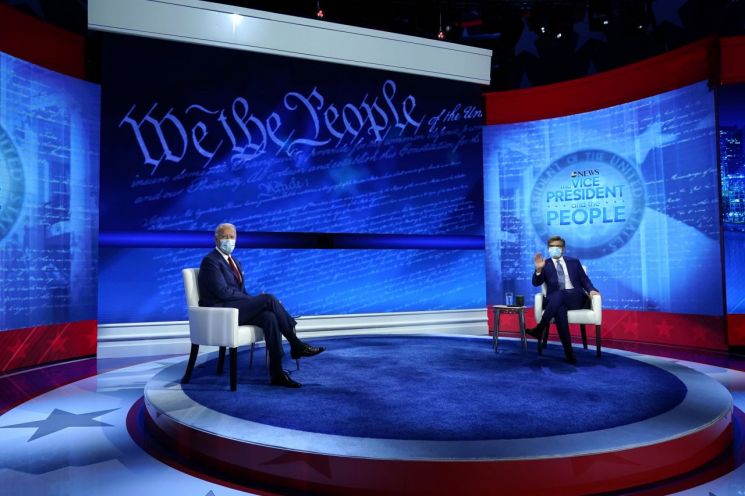
[Asia Economy New York=Correspondent Baek Jong-min] Democratic presidential candidate Joe Biden has formed a large legal team in anticipation of Donald Trump's refusal to concede the election after the November presidential vote. This move is interpreted as a proactive response to post-election scenarios as the gap in approval ratings has recently narrowed ahead of the election. Instead of a TV debate, both candidates held town hall events at the same time to appeal for support.
On the 15th (local time), a major foreign news outlet reported that the Biden campaign is encouraging early voting to prevent disputes over the election results while also seeking countermeasures against President Trump's refusal to concede. The outlet added that the Biden campaign is operating the largest election protection program in Democratic Party history, comprising thousands of lawyers and volunteers. The Democratic protection program includes former Attorney General Eric Holder and election law specialist Mark Elias.
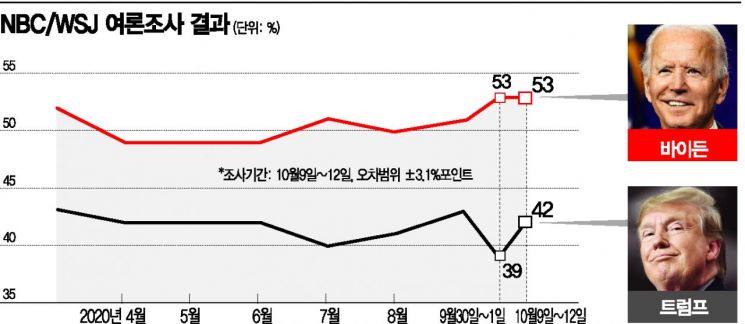
This move is because Biden cannot be complacent despite leading in the polls. The gap between the two candidates' approval ratings has recently narrowed. According to a poll conducted by The Wall Street Journal (WSJ) and NBC from the 9th to the 12th and released on the same day, Biden received 53% support, while President Trump received 42%. The difference in their approval ratings narrowed from 14 percentage points in the same poll conducted right after the first presidential TV debate at the end of last month to 11 points. NBC predicted that as President Trump resumed campaigning in earnest after testing positive for COVID-19, the gap between the two candidates could narrow further in the final stretch. In the 2016 presidential election, Trump was 11 percentage points behind Hillary Clinton in WSJ and NBC polls but focused his efforts on battleground states and ultimately won.
According to the RealClearPolitics average of nationwide polls, the gap between the two has shrunk to 9.4%. A poll conducted by The Hill from the 10th to the 13th showed the approval rating gap narrowed to 7 percentage points. In the key battleground state of Florida, the gap between the two candidates' approval ratings narrowed again to 2.7 percentage points. Considering the margin of error, they are virtually tied.
For this reason, although 17 million people across the United States have already participated in mail-in and early voting, the Democratic Party remains uneasy, recalling the nightmare from four years ago.
The scenario the Democrats fear most is a delayed vote count and failure to finalize the electoral college list, leading to the House of Representatives electing the president. If neither candidate secures the majority of 270 electoral votes, one federal House representative from each state votes to elect the president. The representative who votes is from the party holding the majority of House members in that state. Currently, the House is controlled by the Democrats, but by state, Republicans hold the majority in 26 states, and Democrats in 23 states. If it comes to this situation, it would be advantageous for President Trump. Trump has already emphasized that the House distribution is about 26 to 22 in favor of Republicans. This suggests that such a scenario is being considered. Lawrence Douglas, an election expert at Amherst College, expressed concern, saying, "We will be in uncharted territory."
Vice presidential candidate Kamala Harris's suspension of in-person campaigning is also a setback. Harris's communications director tested positive for COVID-19, leading Harris to cancel campaign events until the 18th. Separately, it was confirmed that Biden was on the same flight as an infected person. With 19 days left until the election, if Biden or Harris become infected or have close contact with confirmed cases, it could be a major adverse factor that shakes up the election landscape.
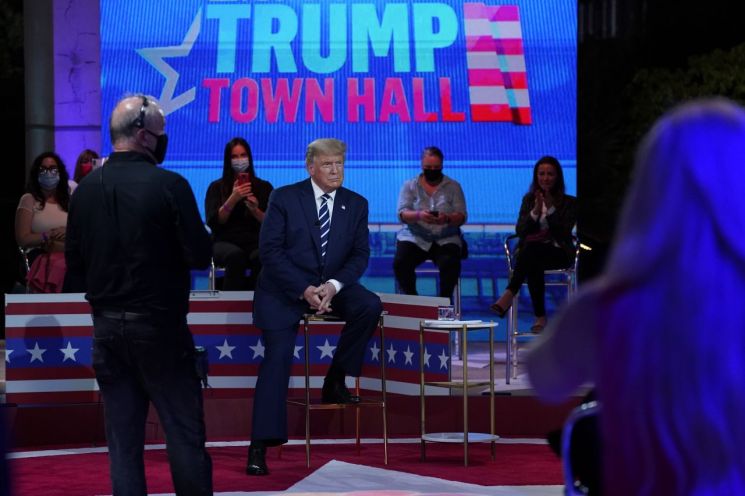
Instead of the canceled second TV debate that evening, Trump and Biden held separate town hall events and competed to capture viewers' attention. At the event held in the battleground state of Florida, when President Trump was asked if he could say that the conspiracy theories spread by the far-right group QAnon were not true, he refused to answer. Trump only said, "I don't know QAnon." Earlier, during the first TV debate, when asked if he could condemn the far-right group, he controversially responded, "Wait." Biden criticized Trump's tax cut policies at the town hall held in Pennsylvania, saying they only enriched the wealthy, not the middle class.
© The Asia Business Daily(www.asiae.co.kr). All rights reserved.
![User Who Sold Erroneously Deposited Bitcoins to Repay Debt and Fund Entertainment... What Did the Supreme Court Decide in 2021? [Legal Issue Check]](https://cwcontent.asiae.co.kr/asiaresize/183/2026020910431234020_1770601391.png)


















