Success in Quarantine, Growth Rates Vary Greatly by Country Depending on Fiscal Capacity
Industry Changes Divided by COVID-19
Global Extreme Poor Increase by 90 Million... Billionaires' Wealth Up 27.5%
Polarization and Social Gaps Accelerate
[Asia Economy Reporter Naju-seok] Amid the COVID-19 pandemic, the gap between countries, companies, and individuals is widening, solidifying a 'K-shaped recovery' pattern. Various models have been proposed regarding the speed of recovery from the COVID-19 shock, but ultimately, one arm of the 'K' trends upward while the other trends downward, indicating that recovery disparities will further expand through the crisis.
On the 16th, international credit rating agency S&P released a report titled 'K-shaped Recovery,' forecasting that "macroeconomic conditions and credit flows will show increasing divergence across regions and industries in the future." It predicts that polarization will become more pronounced in all sectors as the COVID-19 crisis continues.
After COVID-19, economists proposed recovery shapes such as V-shaped recovery (sharp rebound after recession), U-shaped recovery (gradual recovery after recession), L-shaped recovery (prolonged recession), and W-shaped recovery (rebound followed by another recession).
However, the recent pattern observed is K-shaped. It is not the speed of economic recovery but the situations of individual economic agents such as countries, companies, and individuals that are diverging into 'the rich get richer, the poor get poorer' during the COVID-19 crisis.
The economic recovery differences among countries during the COVID-19 pandemic are stark. According to the World Economic Outlook (revised) released by the International Monetary Fund (IMF) on the 13th, the United States is expected to have a GDP growth of -4.3% this year, while Europe is forecasted at -8.3%. Even within Europe, Germany's GDP growth rate is -6%, whereas Spain's is -12.8%, showing significant differences. Emerging countries show similar disparities. China is predicted to grow by 1.9%, but India is expected to contract by -10.3%.
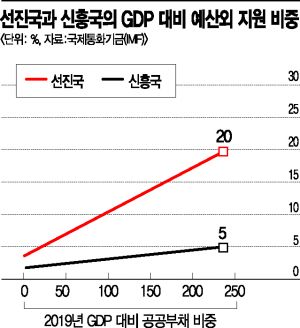
The large gap in expected economic growth rates is due to differences in COVID-19 containment measures and fiscal support capacity. Countries that successfully control the pandemic and reduce economic and social damage can accelerate recovery. Additionally, countries with high credit ratings and fiscal capacity can mobilize additional resources through budgets and bond issuance to support the economy. Conversely, countries with low credit ratings and poor fiscal conditions find it difficult to inject resources. The IMF estimates that advanced economies use about 20% of their budgets for economic stimulus through bond issuance, while developing countries allocate only about 5%. This fiscal capacity gap inevitably results in greater economic shocks for developing countries compared to advanced economies.
Kristalina Georgieva, Managing Director of the International Monetary Fund (IMF), emphasized the need to address disparities, stating, "Urgent action is required for low-income countries," and called for a joint agreement beyond the Debt Service Suspension Initiative (DSSI) that defers debt principal and interest repayments for low-income countries.
In the COVID-19 era, the industry to which a company belongs determined its survival. S&P analyzed that recovery speed will vary depending on the industry sector after COVID-19. In the Asia-Pacific region, S&P expects essential retail goods to recover to last year's levels by next year. In contrast, industries such as chemicals, hotels, and oil refining are expected to reach last year's levels by 2022, and the airline industry only after 2023.
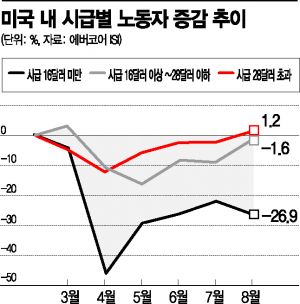
Disparities have also widened in individuals' lives. In the United States, after the COVID-19 crisis, the number of people earning more than $28 per hour (about 32,000 KRW) actually increased. Meanwhile, those earning less than $16 per hour experienced massive unemployment, decreasing by 26.9% (as of August). High-income jobs that could be done remotely increased, while low-income jobs decreased. The wealthy also gained substantial profits from stock investments in addition to salaries. This led to a paradoxical phenomenon in August in the U.S., where personal income fell by 2.7% after the government’s expanded unemployment benefits ended, yet consumer spending increased by 1%. Those with higher education or who were white experienced less employment impact, while those with lower education or people of color faced greater employment losses.
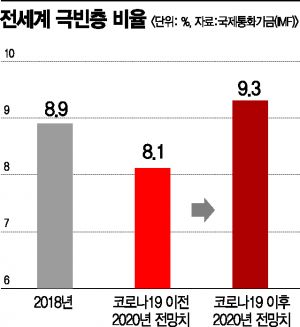
Globally, disparities have also widened. The IMF predicts that the number of people living in extreme poverty, earning less than $1.90 per day, will increase from 80 million to 90 million due to COVID-19. Although global extreme poverty had been declining annually due to development policies, the COVID-19 crisis reversed this trend. Conversely, billionaires with assets exceeding $1 billion have seen their wealth increase. According to UBS Bank, the wealth of global billionaires rose by 27.5% this year, driven by unprecedented gains in technology and healthcare industry entrepreneurs.
© The Asia Business Daily(www.asiae.co.kr). All rights reserved.
![User Who Sold Erroneously Deposited Bitcoins to Repay Debt and Fund Entertainment... What Did the Supreme Court Decide in 2021? [Legal Issue Check]](https://cwcontent.asiae.co.kr/asiaresize/183/2026020910431234020_1770601391.png)


















