Hong Nam-gi's Ministry of Land, Infrastructure and Transport Supplementary Measures After Sale Difficulties
Tenant Claim Rights to Be Included in Confirmation Explanation
Criticism That Policy Side Effects Are Shifted to Real Estate Agents
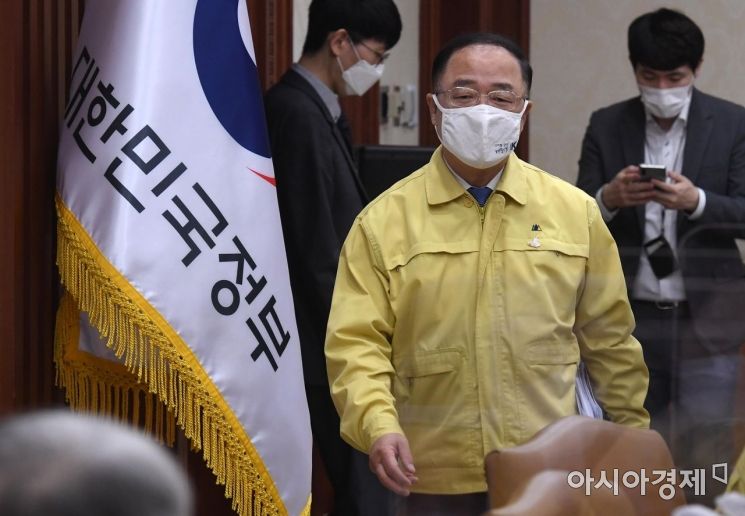 Hong Nam-ki, Deputy Prime Minister and Minister of Economy and Finance, is attending the 18th Emergency Economic Central Countermeasures Headquarters meeting held at the Government Seoul Office in Jongno-gu, Seoul on the 16th. Photo by Hyunmin Kim kimhyun81@
[Asia Economy Reporter Moon Jiwon] Controversy is arising over the revision of the Enforcement Rules of the Licensed Real Estate Agents Act, which requires licensed real estate agents to indicate whether tenants have exercised their right to request contract renewal in the 'Confirmation and Explanation of Brokerage Object' document.
The revision plan was announced abruptly right after it became known that an apartment in Uiwang, Gyeonggi Province, which Deputy Prime Minister and Minister of Strategy and Finance Hong Nam-ki was trying to sell, faced difficulties due to the tenant's contract renewal request. Critics argue that the government is trying to shift the responsibility for transaction uncertainties caused by the forced introduction of the contract renewal right system onto the brokerage industry.
According to sources inside and outside the government on the 16th, frontline brokerage firms are criticizing the Ministry of Land, Infrastructure and Transport's announcement of the revision plan for the Enforcement Rules of the Licensed Real Estate Agents Act, saying it attempts to shift the blame for flawed policies onto the brokerage industry. The revision mandates that when selling a house with a jeonse (long-term deposit lease), the 'Confirmation and Explanation of Brokerage Object' must specify whether the existing tenant has exercised or waived their right to request contract renewal.
In the market, the revision is being dubbed the 'Hong Nam-ki Prevention Act' because it was introduced immediately after it became known that the tenant of the apartment in Uiwang City, owned by Deputy Prime Minister Hong, exercised their contract renewal right, causing a disruption in the sale despite a sales contract having been recently signed.
Until now, despite the widespread conflicts between landlords and tenants caused by the implementation of the contract renewal right and the rent ceiling system for jeonse and monthly rent, the government had remained passive. The Ministry of Land, Infrastructure and Transport explained that the matter was "completely unrelated to the Deputy Prime Minister's housing sale case," but the market's response remains cynical.
The revision has been criticized for increasing the burden on real estate agents by requiring them to verify whether tenants have exercised their contract renewal rights. If agents record the exercise status based solely on the landlord's statement and the tenant later changes their position, the agent could be held liable for brokerage negligence, including damages. A representative of A Licensed Real Estate Agency in Anyang, Gyeonggi Province, criticized, "The government is shifting the responsibility for policy side effects solely onto real estate agents."
Some point out that the government's 'patchwork policies,' issued whenever the housing market becomes unstable, result in fragmented regulations and further confusion and conflict among the public. Despite the spread of the jeonse crisis and a decline in policy credibility due to repeated policy failures, the government continues to release measures first and then repeatedly prepare supplementary measures belatedly when problems arise.
In fact, 'patchwork policies' are repeatedly seen with every government measure. A representative example is the relaxation of income criteria for special supply to newlyweds announced at the real estate market inspection meeting of related ministers on the 14th.
Despite implementing a policy on the 29th of last month to relax income criteria by 10 percentage points for newlyweds purchasing private housing priced between 600 million and 900 million KRW under the special supply and newlywed hope town programs for the first time in their lives, the government quickly patched the income requirements again within just half a month after effectiveness concerns arose, effectively overriding the existing policy.
The industry points out that repeated patchwork measures waste unnecessary administrative resources and increase market confusion. An industry insider stated, "The government should now acknowledge its failures and reconsider its policy direction."
© The Asia Business Daily(www.asiae.co.kr). All rights reserved.
![Clutching a Stolen Dior Bag, Saying "I Hate Being Poor but Real"... The Grotesque Con of a "Human Knockoff" [Slate]](https://cwcontent.asiae.co.kr/asiaresize/183/2026021902243444107_1771435474.jpg)
















