CEO Koo Hyun-mo Aligns 탈통신 Strategy
Practicing Post-Corona Resilience
Successive Redevelopments on Former Telephone Office Land
Focusing on Securing Mid- to Long-Term Future Profitability
ICT-Integrated Contactless Room Service
Exploring New Businesses Such as Finance and OTT
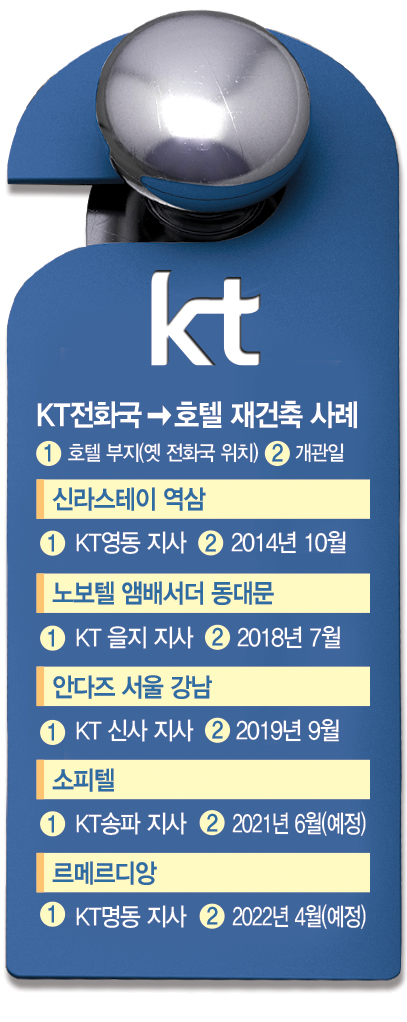
[Asia Economy Reporter Koo Chae-eun] KT is accelerating the hotel reconstruction projects on telephone exchange sites scheduled for 2021 (Songpa Telephone Exchange → Sofitel) and 2022 (Myeongdong Telephone Exchange → Le M?ridien).
Despite the direct hit to income-generating real estate businesses caused by the spread of COVID-19, there is optimism that the hotel industry will rebound after next year. This is noteworthy as a concrete solution to the 'post-telecom' strategy emphasized by CEO Koo Hyun-mo, and as an implementation of 'resilience' that global companies are focusing on in response to the 'post-COVID' era.
"Hotel business should be viewed from a mid- to long-term perspective"
According to industry sources on the 16th, KT CEO Koo Hyun-mo recently urged at an executive meeting to steadily promote the conversion of idle telephone exchange sites into hotels. CEO Koo reportedly stated, "The hotel business should be viewed from the perspective of securing mid- to long-term future profitability." KT owns about 440 telephone exchange sites nationwide. Their book value is around 3.3 trillion KRW, but their market value exceeds 8.3 trillion KRW. As advances in telecommunications technology have made it unnecessary to maintain many telephone exchanges, KT is monetizing the surplus land by constructing hotels and other commercial buildings. In June 2021, the Accor-affiliated luxury hotel 'Sofitel' will open on the site of the former KT Songpa branch in Jamsil, Seoul. In April 2022, the Marriott International luxury hotel brand 'Le M?ridien' will open in Myeongdong, Seoul, where the KT Central branch used to be.
If KT sells the idle telecommunications offices, it can secure short-term cash 'ammunition' to improve performance, but it would be a loss in the mid- to long-term. Given the declining profitability in the wireless sector due to 5G network investment costs, frequency reallocation fees, pressure to reduce 5G rates, and the expansion of the 45% selection discount, it is important to strengthen profitability in non-telecom sectors. This is why CEO Koo is focusing his efforts on the hotel business.
Differentiation through ICT technology integration
Most of the sites KT used as telephone exchanges in the past are located in excellent locations. However, during Chairman Lee Seok-chae’s tenure, KT faced criticism for 'selling 39 KT-owned real estate properties, including telephone exchanges, at rock-bottom prices.' Since 2014, KT has increased the profitability of its hotel business by reconstructing unused telephone exchanges into hotels but entrusting operations to hotel operators under consignment contracts.
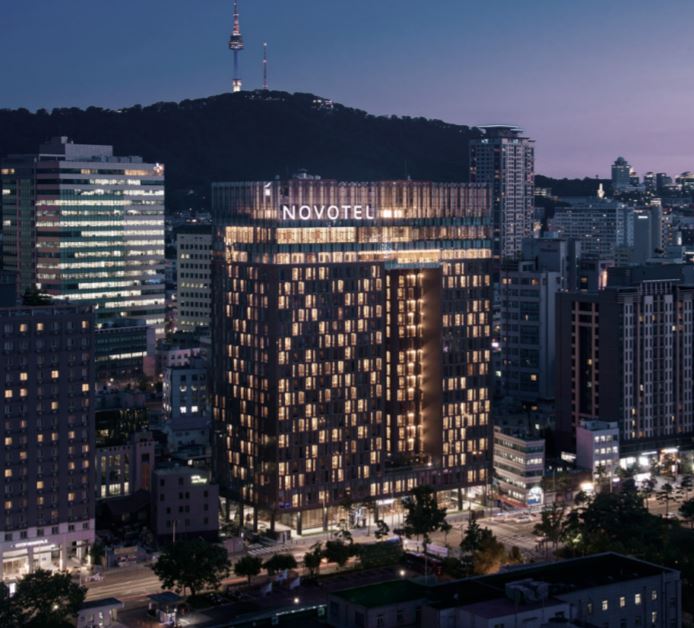
The first hotel KT built by demolishing a telephone exchange was Shilla Stay Yeoksam, opened in October 2014 on the site of the Yeongdong branch telephone exchange. This was followed by the opening of Novotel Ambassador Dongdaemun in 2018. Novotel Dongdaemun is Korea’s first AI hotel, introducing the non-face-to-face AI room service 'Giga Genie' in every room, integrating ICT technology into the hotel business. 'Andaz Seoul Gangnam (formerly KT Sinsa branch),' which opened in September last year, is a hotel with 241 rooms including 25 suites, and is the first Korean branch of Hyatt Hotels & Resorts’ luxury brand 'Andaz.'
Post-CEO Koo appointment, rapid progress in post-telecom strategy
Besides the hotel business, KT is expanding its post-telecom base into finance, AI, big data, and OTT sectors. Together with Woori Financial Group, a major shareholder of K-Bank, KT is actively utilizing technologies such as artificial intelligence (AI) and big data to jointly discover new businesses with the goal of 'leading the digital financial industry.' Additionally, KT is strengthening its media portfolio by securing more cable TV subscribers and platforms through the OTT service Season and the acquisition of Hyundai HCN.
KT’s non-telecom revenue (excluding wireless, wired, and internet businesses) in Q2 on a separate basis was 1.7482 trillion KRW, exceeding 40% of total sales (4.3396 trillion KRW). The share of non-telecom revenue, which was around 28% in 2011, surpassed 30% in 2017 and approached 40% at 39% in 2018. Since CEO Koo’s appointment, it has consistently exceeded 40% each quarter this year, establishing a stable portfolio.
© The Asia Business Daily(www.asiae.co.kr). All rights reserved.


















