Revised Edition of the Epic Trilogy Including 'Taebaeksanmaek' Published... Last Novel Three Years Later
Criticizing 'Arirang', Principal Lee Young-hoon Called "A New Traitor and National Betrayer"
[Asia Economy Reporter Park Byung-hee] "'Taebaek Sanmaek' was read thoroughly for the first time in 30 years since its completion."
Novelist Jo Jung-rae, marking the 50th anniversary of his debut, has published revised editions of his representative epic novel trilogy: Taebaek Sanmaek (10 volumes), Arirang (12 volumes), and Hangang (10 volumes). On the 12th, during the '50th Anniversary of Debut Commemorative Press Conference' held at the Korea Press Center in Jung-gu, Seoul, Jo explained the publication of the revised editions as his "final revision." It is, in a sense, the completion of the definitive "authorized edition."
The author also revealed the reason why he read the novels thoroughly for the first time during this final revision. "For every artist, the artwork they have created is the enemy of the new work they want to create."
He said, "Because humans are imperfect, all artworks are incomplete," and added, "I hope this final revision is seen as a sincere effort by the author to move toward perfection."
Taebaek Sanmaek is Jo’s representative work, which began serialization in the literary magazine Hyundae Munhak in 1983 and concluded in 1989. Afterward, the author successively published Arirang and Hangang, organizing Korea’s modern and contemporary history. The epic trilogy took 20 years to write and consisted of 51,500 manuscript pages. The trilogy features about 1,200 characters, and over 15 million copies have been sold, including 8.6 million copies of Taebaek Sanmaek.
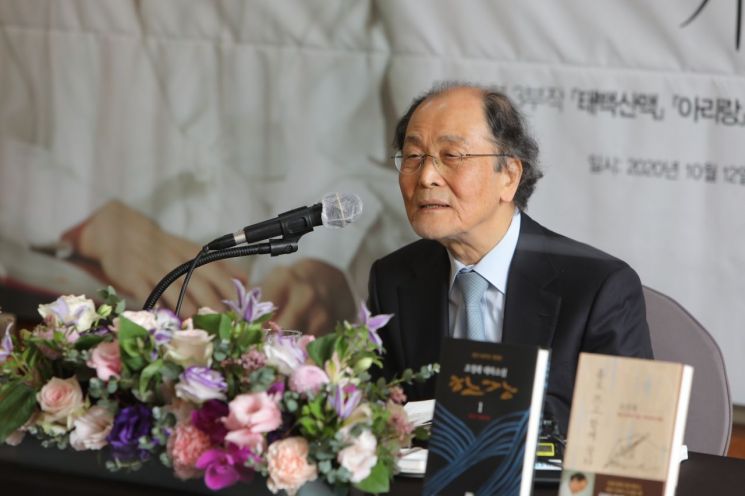 Novelist Jo Jung-rae is answering reporters' questions at the '50th Anniversary of Literary Debut Press Conference' held on the 12th at the Korea Press Center in Jung-gu, Seoul.
 [Photo by Haenaem]
The author also published a new essay collection titled Writing Alone, Living Together, reflecting on his life as a novelist. This book is a sequel to the 2009 book Ecstatic Literary Prison, which compiled responses to questions from about 250 young readers. It organizes answers to around 100 reader questions in a Q&A format. The book contains the author’s views on literature, history, and the world. Jo answered that the "basic requirement for a writer" is "to have a sense of history and social awareness."
Jo also mentioned Lee Young-hoon, principal of the Lee Seung-man Academy. Lee claimed in his book Anti-Japan Tribalism, published last year, that Jo’s Arirang is an absurd novel. Lee argued that the scenes in Arirang depicting the Japanese colonial government’s fanatical massacre of Koreans are baseless fabrications that never historically occurred.
Jo rebutted Lee, calling him "a new type of traitor and a national betrayer," and insisted that "the historical materials I wrote are objective." He claimed that his sources are clear materials mainly from the National Institute of Korean History and books written by people with progressive consciousness.
Jo was once investigated for 11 years on charges of violating the National Security Law after Taebaek Sanmaek was published, but was ultimately acquitted. Referring to that experience, he emphasized, "Arirang was written strictly based on historical materials."
Jo also stressed, "There is no future for the country without punishing pro-Japanese collaborators," and urged, "To correct distorted history, the 'Special Committee for Anti-National Activities' must be revived to punish about 1.5 million pro-Japanese collaborators."
As he did at the press conference for the publication of The Millennium Question last year, Jo said, "My wish is to die with my head down on my desk while writing." He added that he plans to conclude his career in writing novels with a long novel based on a Buddhist worldview that encompasses reality and the afterlife in three years, and afterward write short stories and essays.
© The Asia Business Daily(www.asiae.co.kr). All rights reserved.

















