[Asia Economy Reporter Bu Aeri] The famous phrase "Don't be evil," which Google once touted as its code of conduct, is now being completely shaken. The image of a "good company" that vowed not to take the wrong path for profit has been overshadowed by criticism that it is "being evil." This happened after Google announced its policy to enforce in-app payments and impose a 30% commission.
Anti-Google Movement
According to industry sources on the 13th, there is a growing global movement opposing Google's "power abuse." U.S. developer Epic Games and the world's largest music platform Spotify launched the "Coalition for App Fairness (CAF)" last month. In India, 150 startups formed an alliance and created a "Mini App Store" centered around Paytm to counter Google. Domestic developers in Korea have also announced collective action. The online joint litigation platform "Angry People" is recruiting app developers to report Google's excessive commission issues to the Fair Trade Commission.
This anti-Google coalition was formed in response to the policy Google announced on the 28th of last month. Google declared that starting from October next year, all payments made when using apps distributed through Google Play must use its own system (in-app payment), and a 30% commission will be charged. This policy, which had previously applied only to game apps, has now been extended to content areas such as music, video, and webtoons.
In response, the Korean government and National Assembly have also targeted Google. Kim Dae-ji, Commissioner of the National Tax Service, stated at a recent parliamentary audit that they are considering taxing Google's app commission revenue.
Why Has Google Become the Devil?

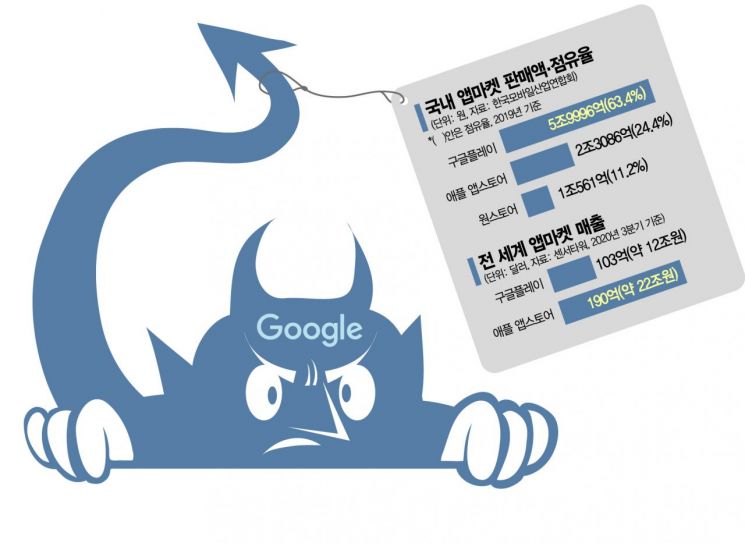
Especially in the domestic industry, there is a strong sense of betrayal toward Google. Google, which grew its app market business by advocating coexistence with many developers, is now abusing its market dominance and putting the "internet industry ecosystem" at risk. According to the Korea Mobile Industry Association, as of last year, Google Play's market share in the domestic app market was close to 63.4%, generating revenue of 5.9996 trillion KRW.
A source from the domestic internet industry lamented, "With Google imposing commissions, the only way to make a profit is to raise usage fees," adding, "This inevitably puts us at a disadvantage in global competition." For example, domestic webtoon and music platforms pay 70% of revenue to creators. If Google takes a 30% commission from this, the business operator ends up with zero profit. Ultimately, prices must be raised to sustain the business, which leads to a loss of price competitiveness. Notably, Google operates its own content service platforms such as YouTube Music Premium. This gives Google a strong advantage in platform competition.
Google's insistence on this policy appears to be largely driven by revenue considerations. According to app analytics firm Sensor Tower, in the third quarter of this year, global Apple App Store revenue was $19 billion (about 22 trillion KRW), while Google Play Store revenue was only $10.3 billion (about 12 trillion KRW). Unlike Google, Apple has applied a 30% commission on all apps and content payments. Ultimately, Google, which once emphasized coexistence, has chosen the same path as Apple.
Even a Parade of 'Outrageous Remarks'
As backlash intensified, Google attempted to justify the necessity of in-app payments and the 30% commission, but even this has sparked industry outrage. On the 29th of last month, just before the holiday, Google held a press conference and stated, "Naver and Kakao's success in the Japanese market is thanks to Google's in-app payment system." Their logic is that since Korean companies succeeded globally due to the convenience of their payment system, there should be a price to pay.
A domestic IT company official said, "If Google's claim is true, then all services using in-app payments should succeed overseas," adding, "Google's arrogance in wrapping up its greed for more money in such an absurd logic is simply ridiculous."
© The Asia Business Daily(www.asiae.co.kr). All rights reserved.
!["The Woman Who Threw Herself into the Water Clutching a Stolen Dior Bag"...A Grotesque Success Story That Shakes the Korean Psyche [Slate]](https://cwcontent.asiae.co.kr/asiaresize/183/2026021902243444107_1771435474.jpg)

















