Gongyu Beauty Salon and Customized Health Supplements
30 Companies in Industry Convergence Regulatory Sandbox Project
Investment Increased from 260 Million to 33.2 Billion Won in One Year
[Asia Economy Reporter Moon Chaeseok]
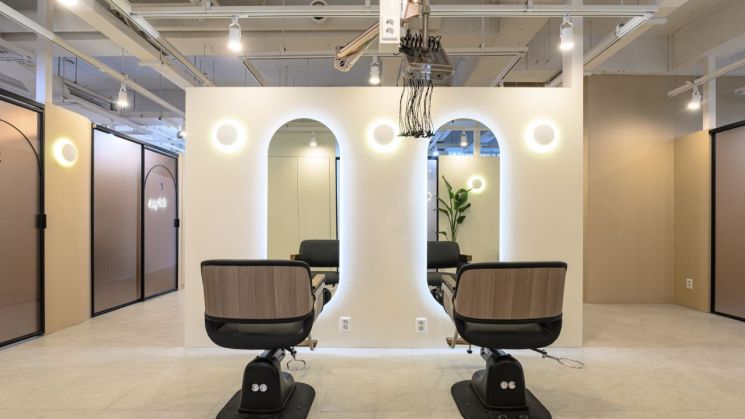
#Since August, A, a 20-year-old resident hairdresser who successfully started a shared hair salon business, was able to independently start a business with a monthly rent of about 2.5 million KRW at a shared hair salon, whereas opening a one-person shop in Gangnam required at least 200 million KRW. He said, "Opening a decent hair salon in Gangnam is every hair designer's dream, but it was difficult unless you were born with a silver spoon due to the initial costs close to several hundred million won."
#B, who has been running a glamping dome tent business in Jangseong-gun, Jeollanam-do since July. Under the Tourism Promotion Act, only camping facilities made of 'tents' were allowed, but through the Industrial Convergence Regulatory Sandbox, it became possible to set up dome-shaped tents made of eco-friendly plastic, which led to the start of the business. They are preparing to open at the end of this month.
On the 13th, the Ministry of Trade, Industry and Energy announced the major achievements of companies that received regulatory exemptions through the 'Industrial Convergence Regulatory Sandbox,' including investment attraction, sales, and job creation. This is an analysis of performance since September last year, when results began to appear in earnest after approval of the Industrial Convergence Regulatory Sandbox. According to the ministry, there were 7 businesses that started from January to August last year, but the number increased to 23 afterward. Since January last year, nine regulatory exemption review committees have been held, granting a total of 74 demonstration exemptions, temporary permits, and others.
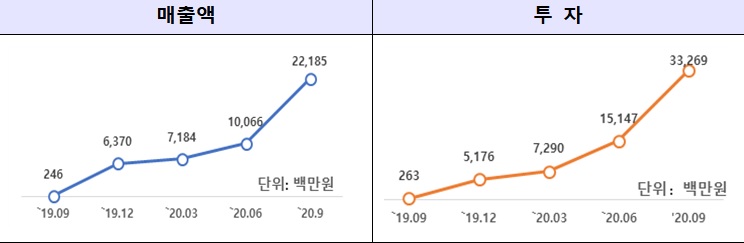
First, effects of investment activation and sales increase appeared. The amount of investment attracted by 30 companies that started business after the exemption increased by 126.7% in one year, from 260 million KRW in September last year to 33.2 billion KRW last month. Sales also increased 108.8 times during the same period, from 250 million KRW to 22 billion KRW. Notably, the 'electric vehicle charging fee-type outlet' business attracted 14 billion KRW in investment after receiving a temporary permit.
There was also an effect on job creation. The number of employees related to approved regulatory exemption projects was 649. Approved companies hired 69 new employees after receiving the regulatory sandbox exemption. Among the 69, there were 4 women with career interruptions, 10 young entrepreneurs, and 2 middle-aged entrepreneurs. For example, the 'highway rest area shared kitchen' business allowed about 20 entrepreneurs to participate after the exemption, including women with career interruptions and young entrepreneurs. There were also social cost reduction effects such as reduced air pollution, startup cost savings, and resource consumption reduction.
According to the ministry, after approval of regulatory exemptions, 10 laws including the 'Road Traffic Act' and 'Personal Information Protection Act' were formally revised. This means that the exemption contents apply not only to approved companies but also commonly to all companies working in related fields. Additionally, revision work on 5 more laws is currently underway with the relevant ministries. For example, 'hydrogen charging stations' could not be installed in quasi-residential and commercial areas until now, but after receiving demonstration exemptions, the Enforcement Decree of the 'National Land Planning Act' was amended, allowing installation of charging stations after safety confirmation in the future.
The ministry designated the Korea Chamber of Commerce and Industry as an additional secretariat following the Korea Institute for Advancement of Technology. For projects progressing successfully, the system is being reformed to allow continuation of business without interruption after the expiration of demonstration exemptions (up to 4 years) by converting them to temporary permits until laws are revised. Furthermore, the ministry plans to actively discover and improve regulatory issues in policy-important areas by proactively identifying tasks related to the 'Korean New Deal' announced by the government in July.
Jang Young-jin, Director of Industrial Technology Convergence Policy at the Ministry of Trade, Industry and Energy, said, "Through this survey, we confirmed that companies that received exemptions through the Industrial Convergence Regulatory Sandbox have actually entered the market and are doing their best to promote their businesses." He added, "Going forward, the ministry will strive not only to resolve corporate difficulties but also to promptly reflect various institutional improvements derived during the operation process, and will do its best to help companies in new industries overcome regulatory barriers and enter the market without difficulties."
© The Asia Business Daily(www.asiae.co.kr). All rights reserved.


















