Stalled for 11 Years Due to Medical Community Opposition
Both Ruling and Opposition Parties Support in the 21st National Assembly
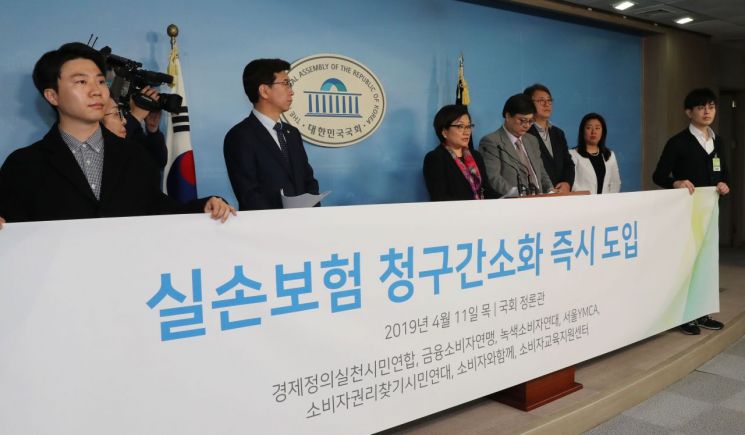
[Asia Economy Reporter Ki Ha-young] Momentum is building for the passage of the 'Simplification of Claims for Actual Medical Expense Insurance' bill in the National Assembly, which allows insurance claims for actual medical expenses to be made directly at the medical institution where treatment is received. Although it had been stalled for 11 years due to opposition from the medical community, both ruling and opposition parties in the 21st National Assembly have voiced a unified need for the bill, leading to successive proposals.
According to the National Assembly and industry sources on the 12th, Go Yong-jin, a member of the National Assembly's Planning and Finance Committee from the Democratic Party of Korea, officially proposed a partial amendment to the Insurance Business Act containing measures to simplify claims for actual medical expense insurance on the 8th. This is the third time such a bill has been proposed in the 21st National Assembly. Previously, in July, Jeon Jae-su of the Democratic Party and Yoon Chang-hyun of the People Power Party had consecutively introduced related bills.
The bill's core is that when requested by the insurance policyholder, the medical institution such as the hospital directly sends supporting documents like medical expense statements to the insurance industry through the Health Insurance Review and Assessment Service (HIRA) electronic network. Unlike the amendment proposed in the 20th National Assembly, the bill prohibits HIRA from using or storing the information for purposes other than document transmission. Additionally, it includes provisions to establish a committee involving the medical community regarding entrusted tasks. This measure reflects the medical community's concerns about HIRA accumulating information or reviewing non-reimbursable medical expenses in the future.
With both ruling and opposition parties proposing bills to simplify actual medical expense insurance claims in the 21st National Assembly, expectations are rising that the law will be amended without partisan disagreement. An industry official emphasized, "Claims for actual medical expense insurance that are not computerized cause inconvenience not only to consumers but also to hospitals and insurance companies," adding, "It is necessary to amend the Insurance Business Act to establish grounds for simplifying the claims process for actual medical expense insurance to enhance convenience for everyone, including consumers."
99% of Actual Medical Expense Insurance Claims Are Paper-Based... Needs Improvement for Consumer Convenience
Actual medical expense insurance is called the second national health insurance, with two-thirds of the nation enrolled, but there are frequent cases of consumers giving up on filing claims. This is due to the cumbersome procedure of submitting documents issued directly by hospitals and the fact that the insurance payouts are small amounts. Since 2009, following recommendations for system improvement by the Anti-Corruption and Civil Rights Commission, related legal discussions have continued in the 20th National Assembly but failed to pass due to opposition from the medical community.
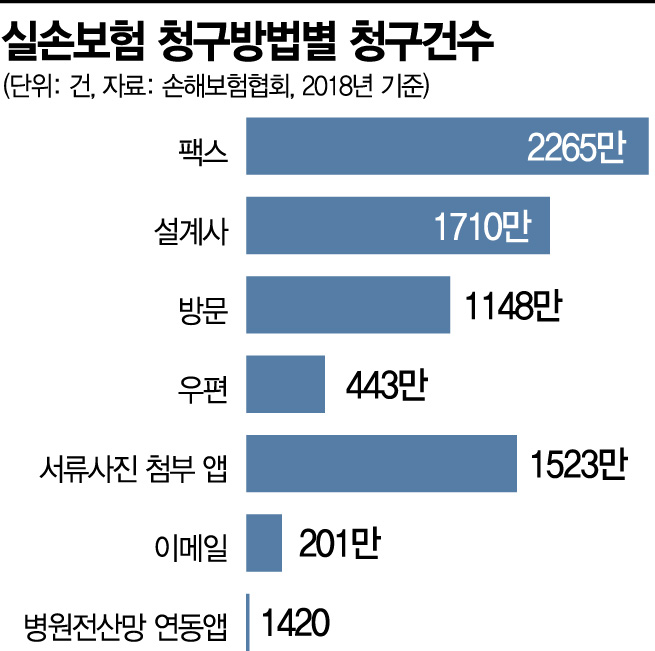
As of 2018, 76% of the 90 million annual actual medical expense insurance claims were made via fax, delivery by insurance planners, or visits to insurance agencies. The remaining 24% submitted paper documents via email or insurance company applications (apps). Even in these cases, insurance company staff must manually input the documents into the computer system. In reality, 99% of claims are based on paper documents.
However, opposition from the medical community remains a significant hurdle. The medical community argues that providing patient information to insurance companies raises the risk of personal information leakage and that insurers might use this information as a means to deny insurance enrollment or payment. They also consider it unreasonable to entrust medical institutions with the task of submitting detailed medical statements. Furthermore, fintech companies such as the Medical IT Industry Association oppose the legislation that would make HIRA an intermediary, citing issues such as liability in case of data transmission failure and avoidance of customer service responsibilities if insurance payments do not meet the insured's expectations.
© The Asia Business Daily(www.asiae.co.kr). All rights reserved.
![User Who Sold Erroneously Deposited Bitcoins to Repay Debt and Fund Entertainment... What Did the Supreme Court Decide in 2021? [Legal Issue Check]](https://cwcontent.asiae.co.kr/asiaresize/183/2026020910431234020_1770601391.png)

















