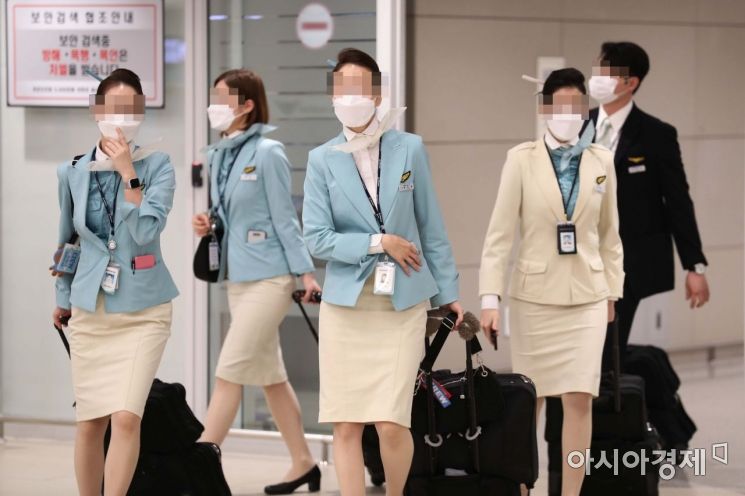
 On the 27th, Korean Air cabin crew wearing masks are leaving the gate at Terminal 2 of Incheon International Airport. Photo by Mun Ho-nam munonam@
[Asia Economy Reporter Junho Hwang] It has been pointed out that the average radiation exposure of flight crew members who operate aircraft and cabin crew members responsible for in-flight services is up to 5.8 times higher than that of workers in other radiation-related occupations. While crew members are exposed to radiation without protection, related laws are divided into two separate systems, highlighting the need for improvement.
On the 12th, Jo Jeong-sik, a member of the National Assembly's Science, Technology, Information and Broadcasting Committee from the Democratic Party of Korea (Siheung-eul, Gyeonggi), announced this after analyzing the national audit data received from the Nuclear Safety and Security Commission and the Ministry of Land, Infrastructure and Transport.
Flight Crew 4.3 Times, Cabin Crew 5.8 Times More at Risk
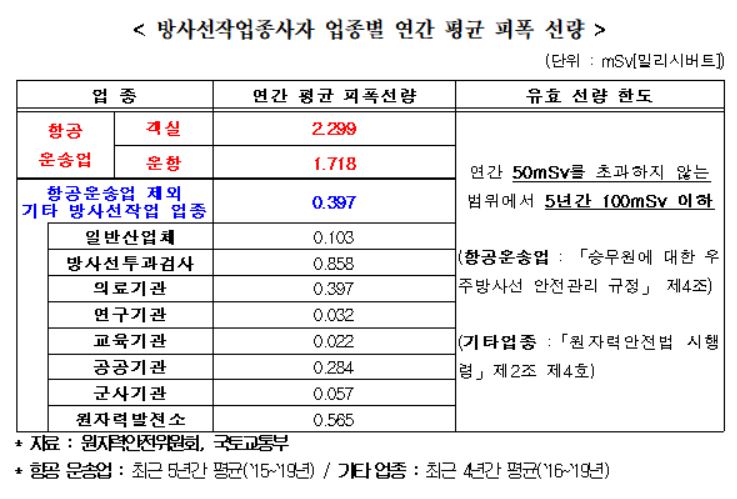
The annual average radiation exposure dose of crew members working in the air transportation industry was 4.3 times higher for flight crew and up to 5.8 times higher for cabin crew compared to other radiation-related occupations.
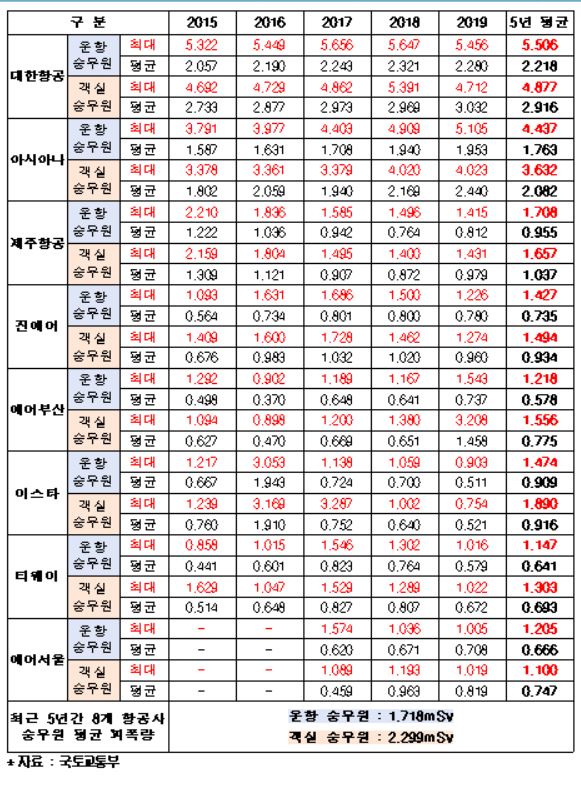
By airline, crew members working for large airlines with many long-haul routes had higher exposure levels than those working for low-cost carriers. Large airlines operating long-haul routes such as trans-Pacific and trans-European flights have longer flight times, resulting in longer exposure to cosmic radiation. Among them, the average exposure dose of Korean Air crew members reached up to 5.506 mSv, which is close to the '6 mSv' limit recommended by the Nuclear Safety and Security Commission for flight time reduction or route changes.
Legal Dual System Creates Blind Spots
Additionally, Representative Jo analyzed that the dual legal system has resulted in blind spots in exposure management. While the Nuclear Safety and Security Commission is the main agency responsible for safety measures and management of cosmic radiation exposure for flight crew, the Ministry of Land, Infrastructure and Transport is the practical agency responsible for investigating, analyzing, and recording cosmic radiation exposure doses of flight crew, creating a divided system.
Representative Jo stated, "It is necessary to establish a customized safety management system for the air transportation industry, which shows higher radiation exposure compared to other radiation-related occupations," and added, "The safety management of cosmic radiation exposure for flight crew should be integrated under the Nuclear Safety and Security Commission, which oversees radiation disaster prevention and management, and crew members should be protected under the same regulations as other radiation-related occupations."
© The Asia Business Daily(www.asiae.co.kr). All rights reserved.



















