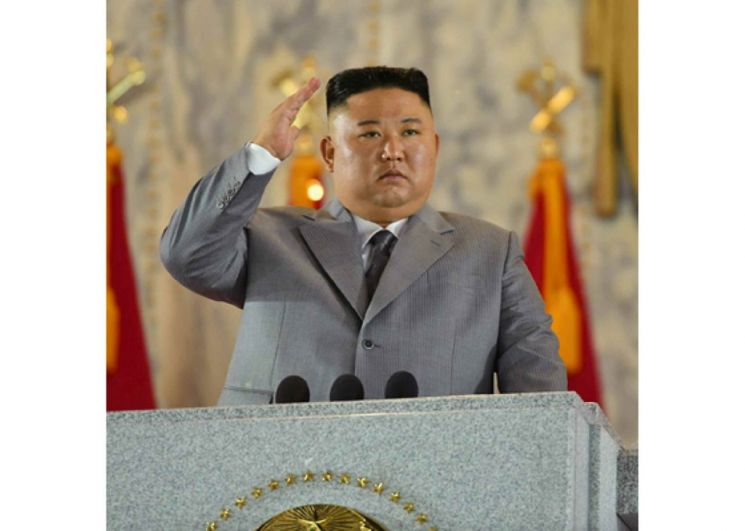
[Asia Economy Reporter Jeon Jin-young] Regarding North Korean Supreme Leader Kim Jong-un’s conciliatory message toward South Korea, mentioning “Namnyeokdongpo” at the Workers’ Party 75th anniversary military parade on the 10th, the ruling Democratic Party of Korea expressed expectations for improved inter-Korean relations.
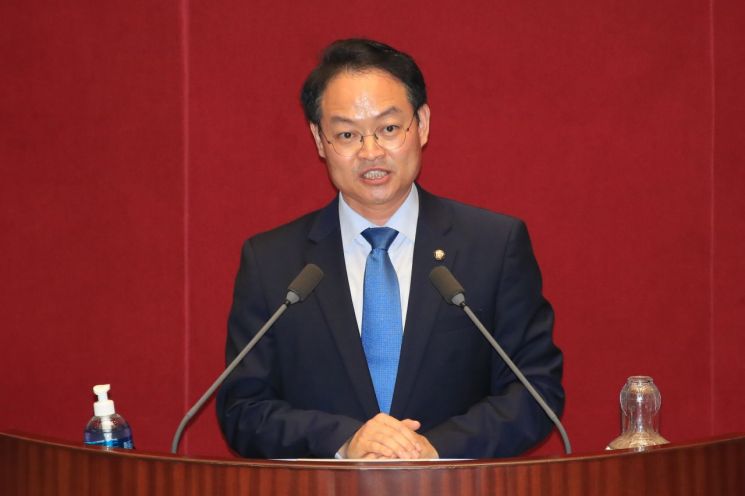
On the 11th, Democratic Party spokesperson Heo Young said in a written briefing that Kim’s message was an “unprecedented statement” and evaluated it as “a response to our will to restart the stalled Korean Peninsula peace process.”
Spokesperson Heo stated, “The beginning of the Korean Peninsula peace process should be a joint investigation into the West Sea shooting incident,” and urged, “We call on the North to actively engage in the joint investigation we requested and the restoration and reactivation of military communication lines.”
However, regarding the unveiling of the new ICBM, Heo added, “We express strong concerns that it could become an obstacle to peace on the Korean Peninsula and in the world.”
Song Young-gil, chairman of the National Assembly’s Foreign Affairs and Unification Committee and a Democratic Party lawmaker, posted on Facebook the same day under the title “Ultimately, the Declaration of the End of the War is the Answer,” saying, “It is a statement that raises expectations that the time for inter-Korean cooperation will come again after the COVID-19 pandemic.”
Chairman Song said, “The unveiling of North Korea’s ICBM suggests the urgent need for dialogue among South Korea, North Korea, and the United States. Ultimately, the North Korean nuclear issue can only be resolved through normalization of North Korea-US relations and the transition from an armistice agreement to a peace treaty,” adding, “The declaration of the end of the war is the gateway to denuclearization.”
Kim Min-seok, chairman of the National Assembly’s Health and Welfare Committee, also wrote on Facebook, “We must first put our heads together to overcome the health crisis,” and said, “The reality is that mutual vigilance and barriers have risen to dangerous levels due to fear of cross-border infections. The National Assembly of the Republic of Korea must also conduct necessary research.”
The party leadership appears to maintain a cautious stance. A key Democratic Party official told reporters on the day, “I think the message focused more on the domestic audience,” and added, “In the COVID-19 situation where external aid is needed, they could not take a strong stance, so the message toward South Korea and the United States was toned down.”
© The Asia Business Daily(www.asiae.co.kr). All rights reserved.


















