 On the afternoon of September 2nd, rainwater had pooled in the eyes of the statue of a girl in front of the former Japanese Embassy in Jongno-gu, Seoul. [Image source=Yonhap News]
[Asia Economy Reporter Choi Eun-young] As the Berlin authorities in Germany have issued a removal order for the 'Statue of Peace' erected in the city center and threatened forced enforcement if not removed within the deadline, Korean netizens who heard the news are expressing outrage, saying, "Let's boycott German cars."
The 'Statue of Peace' installed in Mitte District, Berlin, was set up by the local civic group 'Korea Verband' at the end of last month. It is the first statue installed in a public place in Germany, and after a complicated procedure, it received approval from the authorities in July.
To establish the statue, the artwork must have artistic value and social significance, and the consent of local residents is also required. The civic group Korea Verband has been pushing for the statue's establishment since last year. The plan was kept strictly confidential to avoid interference if the Japanese embassy found out.
However, on the 7th, the Mitte District Office suddenly sent an administrative order demanding the removal of the statue. The reason was that an explanatory plaque, which was not disclosed at the time of application, had been installed, creating tension between Germany and Japan. Initially, Mitte District had considered the statue a politically neutral artwork and approved its installation for one year, but later confirmed otherwise and decided on removal.
Steffen von Dassel, Mayor of Mitte District, stated, "Mitte is home to people from 100 countries who live with generosity, openness, peace, and respect for each other, and to preserve this unity, we must refrain from taking sides in historical conflicts," adding, "We reject the unilateral instrumentalization of public spaces."
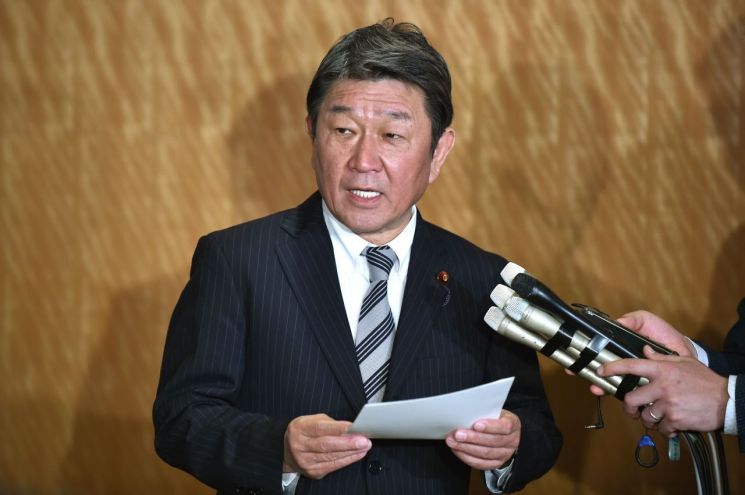 Japanese Foreign Minister Toshimitsu Motegi is speaking to reporters at the Ministry of Foreign Affairs in Tokyo after a trilateral video conference of foreign ministers from South Korea, China, and Japan on March 20.
 [Image source=Yonhap News]
This decision appears to have been influenced significantly by pressure from the Japanese government. Chief Cabinet Secretary Katsunobu Kato raised his voice on the 29th of last month, saying, "We will approach various parties to explain Japan's position for the removal." Japanese Foreign Minister Toshimitsu Motegi requested cooperation from German Foreign Minister Heiko Maas via video call on the 1st to ensure the Berlin statue's removal.
With the statue facing a removal crisis due to Japan's active diplomatic offensive, the Japanese government welcomed it as a "progressive move." On the 8th, Foreign Ministry spokesperson Kim In-chul showed a lukewarm attitude at a regular briefing, stating, "It is not desirable for the government to diplomatically intervene in voluntary actions by private individuals."
Han Jeong-hwa, the representative of the Korea Verband who led the statue's installation, said, "The association has been working hard in Germany to raise awareness about the comfort women issue and wartime sexual violence, so the criticism that we 'instrumentalized public spaces' is heartbreaking," and announced plans to seek joint responses with about 50 civic groups.
Meanwhile, netizens who heard the news showed somewhat strong reactions such as "We must confront Germany head-on. Let's boycott German cars!" while others expressed disappointment with the government's response, saying, "The government will look foolish if it stays silent," "I hope the government steps up to fight," and "It's unfortunate," showing a variety of reactions.
© The Asia Business Daily(www.asiae.co.kr). All rights reserved.


















