 On the 8th, the Lina Life Social Contribution Foundation, Lina Jeonseonggi Foundation, conducted a 'Media Literacy Survey' targeting 662 people nationwide aged 49 and older. As a result, 71% of all respondents answered that they had seen fake news.
[Asia Economy Reporter Oh Hyung-gil] A survey found that 7 out of 10 middle-aged people aged 50 and over have encountered fake news.
On the 8th, the LINA Life Social Contribution Foundation, LINA Jeonseonggi Foundation, conducted a 'Media Literacy Survey' targeting 662 people nationwide aged 49 and over. As a result, 71% of all respondents said they had seen fake news.
The main source of news and information for the 50 and older age group was television at 43%, followed by 39% who checked various news or information on portal sites using smartphones and other devices.
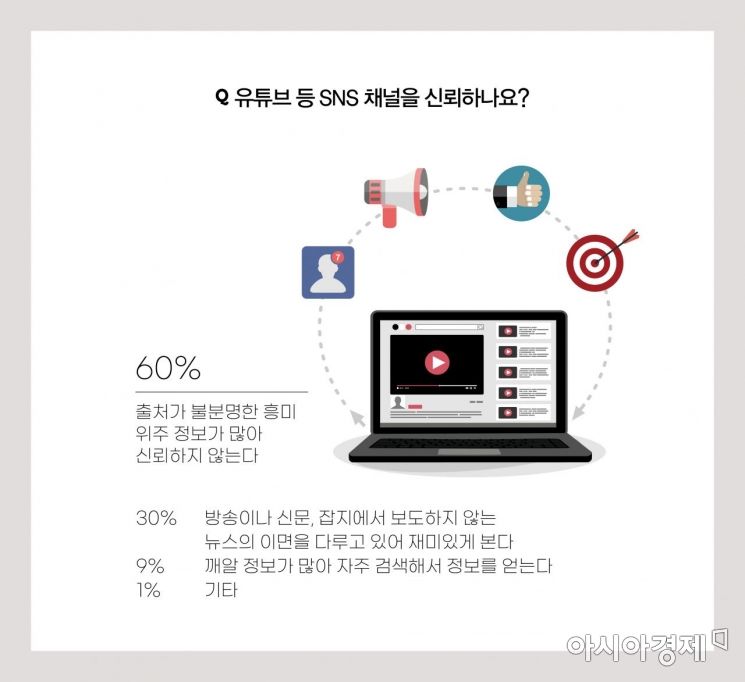
In particular, 9% obtained news or information through new media such as YouTube. They responded that YouTube covers aspects not reported by broadcasts, newspapers, or magazines, and some said they frequently search to get information because there is a lot of content.
The most viewed categories on YouTube were economy (17%), politics (15%), cooking (15%), and health (14%).
Especially among the middle-aged group, 52% pointed to YouTube as the channel with many incorrect news when asked about 'channels with many false news.' In a question about the reliability of SNS (social network service) channels such as YouTube, 60% said they do not trust them due to 'providing information focused on entertainment.'
Additionally, middle-aged people answered that after encountering fake news, they should actively make efforts themselves to verify the facts.
When asked about 'how to distinguish real news from fake news,' 37% said they discern facts through 'media-related news fact-checking.'
Other answers included judging it as fake because 'the content itself is absurd' (30%), 'discovering it through related article searches' (14%), and 'learning about it through family or acquaintances' (9%).
As a way to prevent fake news, 46% of respondents prioritized 'legal regulation.' They also answered that 'active interest and participation in society' (24%) and 'individual efforts to verify facts' (21%) are necessary.
© The Asia Business Daily(www.asiae.co.kr). All rights reserved.

















