Bank of Korea 'August 2020 Balance of Payments (Preliminary)'
[Asia Economy Reporter Kim Eun-byeol] Despite the spread of the novel coronavirus infection (COVID-19), the current account balance recorded a surplus for four consecutive months in August.
According to the "Preliminary Balance of Payments for August 2020" announced by the Bank of Korea on the 8th, the current account balance recorded a surplus of $6.57 billion in August. The current account, which recorded a deficit in April, has maintained a surplus streak for four consecutive months since May (+$2.29 billion). However, the surplus in August decreased compared to July (+$7.45 billion). The current account surplus in July was the largest in nine months since October 2019.
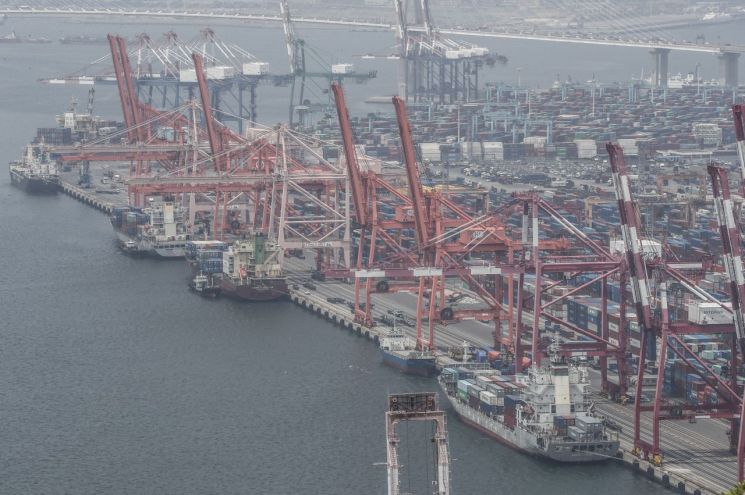
Exports continued to show a declining trend. Exports in August amounted to $40.67 billion, marking a decrease for six consecutive months compared to the same month last year. The decline continued mainly due to petroleum products and automobile parts, decreasing by 10.3% year-on-year.
However, imports fell more sharply than exports. With energy prices weakening, the decline continued mainly in raw materials. Imports in August were $33.65 billion, decreasing for six consecutive months year-on-year. As a result, the goods balance recorded a surplus of $7.01 billion, expanding by $2.38 billion compared to the same month last year.
Park Dong-jun, head of the Bank of Korea's Balance of Payments team, said, "Following last month, the goods balance recorded a positive (+) year-on-year figure for two consecutive months, and looking at customs-based exports in September, exports finally improved compared to last year," adding, "Since the goods balance is improving followed by exports, it has a positive effect on the balance of payments." Earlier, on the 1st, the Ministry of Trade, Industry and Energy announced that exports in September (based on customs clearance) were $48.05 billion, and imports were $39.17 billion, increasing by 7.7% and 1.1% respectively compared to the same month last year. The trade balance, calculated by subtracting imports from exports, recorded a surplus of $8.88 billion.
Regarding concerns that the large decrease in imports compared to exports might indicate a "recession-type surplus," Park explained, "It is true that imports decreased more than exports, but 70-80% of the recent decline in imports is due to the drop in crude oil prices, so it is difficult to consider it a recession-type surplus."
The services balance recorded a deficit of $800 million, reducing the deficit to about half of the same month last year (-$1.56 billion). The sharp decline in overseas departures due to the COVID-19 situation has contributed to reducing the services balance deficit.
The travel balance deficit was $470 million, narrowing the deficit by $510 million compared to the same month last year. The transportation balance recorded a surplus of $390 million as air cargo transportation income increased. Compared to the same month last year (+$40 million), the surplus expanded by $360 million.
The dividend income balance turned to a deficit, shrinking by $1.49 billion year-on-year. This was because dividend income from domestic companies' overseas subsidiaries decreased to $970 million compared to +$2.61 billion in the same month last year. Therefore, the primary income balance recorded a surplus of $630 million, down by $1.39 billion compared to +$2.02 billion in the same month last year.
Meanwhile, domestic investors continued their overseas stock investments. In August, domestic investors' overseas stock investments amounted to $2.57 billion, increasing for 54 consecutive months since March 2016. Including bonds, domestic investors' overseas securities investments totaled $2.83 billion, increasing for five consecutive months.
Foreign investors' domestic stock investments turned to a decrease (-$240 million) after three months since May. Foreign investors' domestic bond investments amounted to $2.67 billion, increasing for eight consecutive months since January this year.
© The Asia Business Daily(www.asiae.co.kr). All rights reserved.

















