Ramen Export Value Up 37% Until August This Year
Nongshim Targets $950 Million Overseas Sales
World's Best Ramen Praised 'Shin Ramyun Black'
[Asia Economy Reporter Lee Seon-ae] Due to the novel coronavirus infection (COVID-19), K-Ramen (the Korean ramen wave) is gaining global attention. This is not about the Chapaguri story that gained huge attention along with the Oscar win. Nongshim's Shin Ramyun Black has been highly praised as the best ramen in the world in the United States, and Samyang Foods' Buldak Bokkeum Myun has become a must-eat food in Southeast Asia. Paldo Dosirak has claimed the title of the national ramen in Russia.
Ramen exports rapidly increasing every year
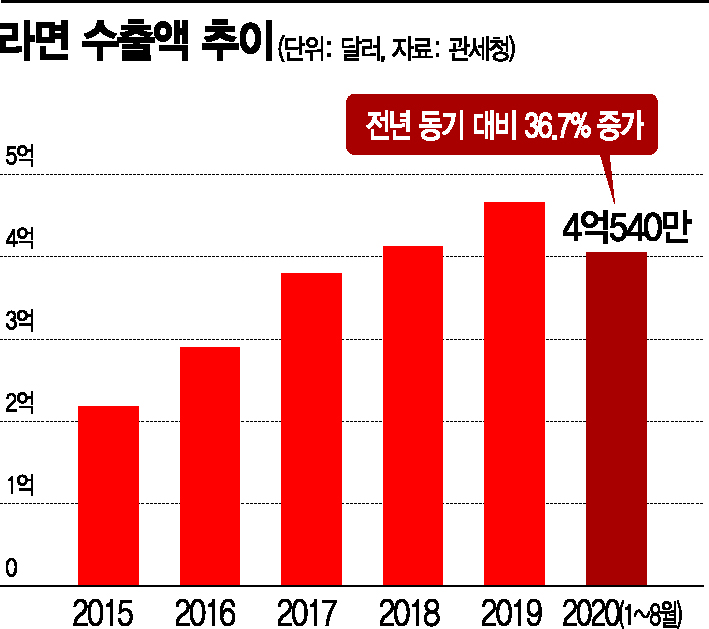
According to the Korea Customs Service export-import trade statistics on the 7th, ramen exports by weight increased about threefold from 55,037 tons in 2015 to 137,284 tons last year. The export value reached $467 million last year, more than double the $218.8 million in 2015. By country, exports to China ranked first overwhelmingly with 41,537 tons. Following were the United States with 14,908 tons, Japan with 9,638 tons, and Australia with 6,147 tons. Southeast Asian countries such as Indonesia (5,988 tons), Taiwan (5,962 tons), Vietnam (5,669 tons), Thailand (5,170 tons), the Philippines (4,251 tons), and Malaysia (4,222 tons) also occupied many spots within the top 10.
Ramen exports have been explosively increasing this year. According to the Ministry of Agriculture, Food and Rural Affairs' cumulative data from January to August this year, ramen export value surged 36.7% year-on-year to $405.4 million. The growth rates were high in major export destinations such as the United States (56.7%), Japan (48.9%), and China (44.9%). This year's cumulative ramen export value accounts for 8.4% of the total agricultural food exports, playing a leading role in the increase of Korean food exports.
An official from the Ministry of Agriculture, Food and Rural Affairs explained, "Due to the prolonged COVID-19 pandemic, ramen, which can be stored for a long time and easily eaten at home, has gained popularity, leading to a significant increase in exports to major countries such as the United States, Japan, and China," adding, "Ramen exports are driving the growth of agricultural food exports this year."
Nongshim's overseas sales nearing $1 billion
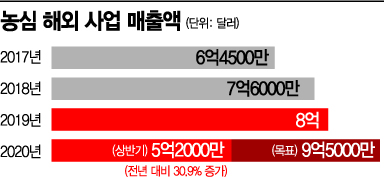
At the forefront of K-Ramen is the top company Nongshim. Nongshim's overseas sales target for this year is $950 million, about 20% more than last year. Overseas business sales in the first half reached $520 million, already achieving 65% of last year's $800 million sales. It is expected to easily meet the target. The rapid sales increase is thanks to success in the main market, the United States. The U.S. subsidiary's sales in the first half grew 35% year-on-year to $164 million, marking an all-time high. The top contributor is undoubtedly 'Shin Ramyun.' In June, Shin Ramyun was selected as the world's best ramen by Wirecutter, a product review site of The New York Times in the U.S.
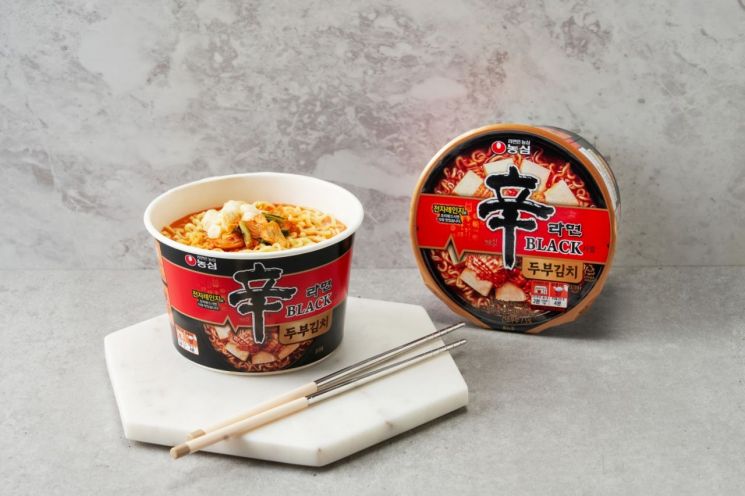
Shin Ramyun Black was ranked first, surpassing fierce candidates in the 'World's Best Ramen BEST 11' announced by seven experts including chefs, writers, and critics who conducted direct evaluations. The Best 11 ramen included four Korean ramens, six Japanese ramens, and one Singaporean ramen. Following Shin Ramyun Black were Chapaguri (Chapagetti + Neoguri, 3rd place), Shin Ramyun Noodle Soup (6th place), and Shin Ramyun Bowl (8th place), attracting attention. Among the 11 products, four Nongshim brands were the only Korean products to rank, establishing the pride of Korean ramen. Sales also rose together. Nongshim sold $48 million worth of Shin Ramyun and Shin Ramyun Black in the U.S. market in the first half, an increase of about 25% compared to the previous year.
"Korean taste is a global taste"
Shin Chun-ho, chairman of Nongshim, emphasized, when he first started exporting beef ramen in 1971, that "Korean taste will become the most global taste." Instead of catering to local overseas consumers' tastes, he adhered to the principle of preserving the 'Korean taste' as it is. As a result, after about 50 years, they created the outcome of the world's most delicious ramen.
Initially targeting mainly the Korean market, Nongshim established Nongshim America in Los Angeles (LA) in 1994 and began full-scale market penetration. Competing fiercely with Japanese ramen, they introduced popular domestic products such as Shin Ramyun and Yukgaejang Bowl Noodles to the local market. The early days were not smooth. Compared to Japanese ramen, which is based on chicken broth, the taste was excessively spicy. Therefore, Nongshim initially targeted Asian and Hispanic markets in the U.S., including Chinese, Vietnamese, and Japanese residents. As a result, by around 1998, Asians including Chinese, Vietnamese, and Japanese accounted for about 25%, and Hispanics from Central and South America accounted for about 10%, significantly increasing the consumer base beyond the Korean market. Accordingly, Nongshim's U.S. export performance grew rapidly from about $2 million in 1988 to $16.5 million in 1995 and $25 million in 1998.
$60 million investment in local U.S. production as a strategic move
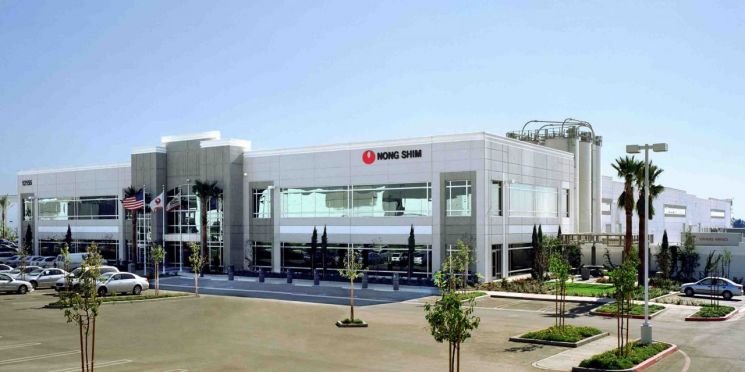
Chairman Shin judged that local production was necessary for the continuous growth of Nongshim America and invested a total of 60 billion won (approximately $60 million) to complete the LA factory in 2005. At that time, Chairman Shin said about the factory construction direction, "Nongshim's technology is not inferior to any food company in the U.S. Let's build a factory comparable to the best food companies in the U.S. and set a goal to become the best food company in the U.S. in the future."
With the LA factory starting operations, the product lineup diversified to include Shin Ramyun, Neoguri, Chapagetti, and Ansungtangmyun. Nongshim began supplying premium ramen compared to Japanese ramen. They judged that there was a limit to the strategy of just providing a cheap meal and aimed to elevate ramen to a gourmet food. Thanks to these efforts, the LA factory currently produces 500 million ramen units annually across six production lines. Nongshim is also preparing to build a second factory near the LA plant.
Shin Dong-yeop, head of Nongshim America, summarized the secret to success in the U.S. market with three keywords: quality, insistence on Korean taste, and step-by-step market penetration. Shin emphasized, "The reason Americans like Shin Ramyun is its unique spiciness that cannot be tasted anywhere else and its good quality, making it suitable as a meal. We entered the U.S. market step-by-step through successes such as the Korean market and entering all Walmart stores, and the competitiveness built this way made Nongshim America what it is today."
© The Asia Business Daily(www.asiae.co.kr). All rights reserved.



















