Economic and Fiscal National Audit Held at Government Sejong Complex
Controversies Expected Over Major Shareholder Criteria for Capital Gains and Fiscal Rules
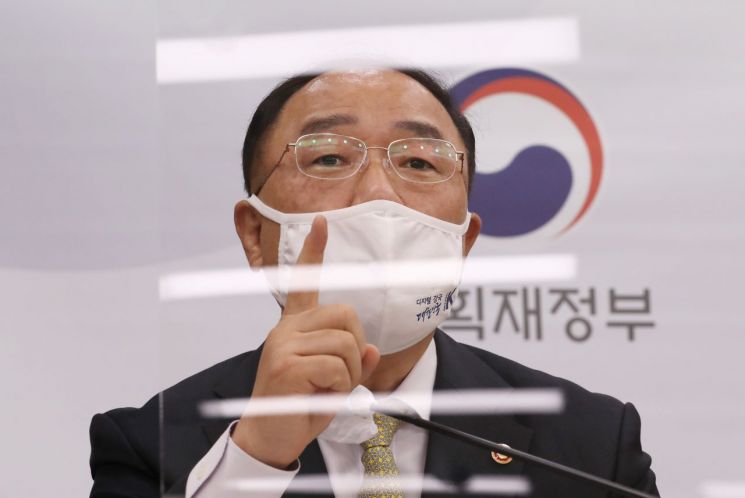 Hong Nam-ki, Deputy Prime Minister for Economy and Minister of Strategy and Finance. (File photo) [Image source=Yonhap News]
[Sejong=Asia Economy Reporter Ju Sang-don] On the 7th, a national audit of the Ministry of Economy and Finance will be conducted. Attention is focused on what stance the government will take regarding the recently controversial major shareholder requirements. In addition, the Korean-style fiscal rules announced by the government on the 5th are also expected to come under scrutiny.
A government official said, "On the first day of the Ministry of Economy and Finance audit, questions will mainly focus on economic and fiscal matters," adding, "If questions arise about the hot-button issue of major shareholder requirements, Deputy Prime Minister and Minister of Economy and Finance Hong Nam-ki is expected to respond in some way."
Under current law, a person holding 1 billion KRW or more in a single stock is defined as a major shareholder and is subject to capital gains tax of 22-33% (including local tax) on capital gains. According to the '2017 Tax Law Amendment,' the major shareholder criteria will be gradually expanded, and the capital gains tax standards will be strengthened. Accordingly, from April 2021, shareholders holding 300 million KRW or more in a single stock will have to pay capital gains tax on their gains.
In response, individual investors, so-called 'Donghak Ants,' are strongly opposing this. They argue that expanding the scope of major shareholders is unreasonable given the growing economic scale. There are also concerns that if individuals flood the market with sell orders to avoid taxes by the end of this year, the stock market could enter a downturn.
In fact, a petition titled "Major shareholder capital gains tax is now a bad law that must be abolished" posted on the Blue House petition board received 216,844 signatures within a month. Since more than 200,000 people agreed, a response from the Blue House is awaited. Furthermore, on the 5th, a post titled "Strongly request the dismissal of Minister of Economy and Finance Hong Nam-ki" was also uploaded on the board.
Voices calling for revision and supplementation are also emerging within the ruling party. On the 5th, Yang Hyang-ja, a Supreme Council member of the Democratic Party of Korea, said regarding the plan to lower the major shareholder criteria, "We need to carefully examine whether this contradicts the government's policy direction." This is interpreted as meaning some modifications are necessary. This aligns with the statement made the previous day by Kim Tae-nyeon, floor leader of the Democratic Party, who said, "We will adjust it to an appropriate level through party-government consultations."
During the Ministry of Economy and Finance audit on the same day, questions about the Korean-style fiscal rules are also expected to be concentrated. On the 5th, the government announced fiscal rules centered on managing the national debt ratio at 60% and the consolidated fiscal balance within -3% starting from the 2025 fiscal year. However, criticisms poured in that there are numerous exceptions to the rules, and that the national debt ratio limit of 60% of GDP is excessively lax. In response, Deputy Prime Minister Hong held an emergency additional briefing on the 6th to refute the negative public opinion raised about the fiscal rules one by one. He emphasized, "If the government’s fiscal role is hindered by such rules during a serious national crisis like COVID-19, it is questionable whether that is truly in the public interest," adding, "We will gather expert opinions and consult with the National Assembly to determine when to apply exceptions."
© The Asia Business Daily(www.asiae.co.kr). All rights reserved.

















