Elimination of Auction Stage from 2023 and 8% Reduction in Distribution Costs
Stable Agricultural Product Prices Ensure Fair Supply to Consumers
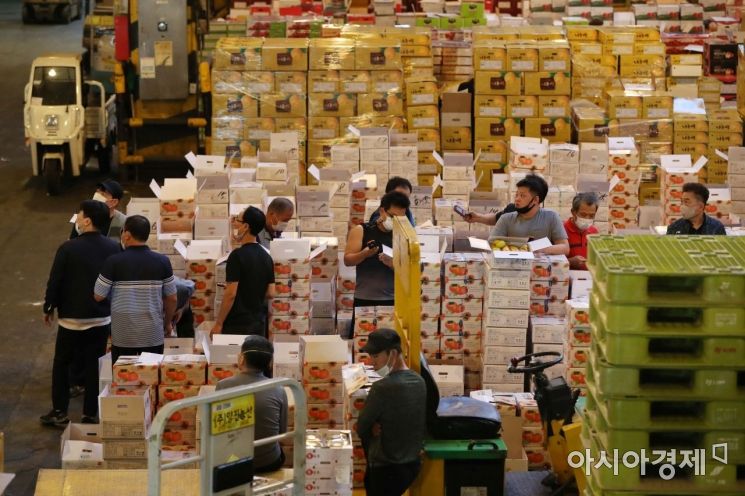 On the 18th, ahead of the Chuseok holiday, fruit auctions are taking place at the Garak-dong Agricultural and Marine Products Wholesale Market in Songpa-gu, Seoul. Photo by Mun Ho-nam munonam@
[Asia Economy Reporter Jo In-kyung] The Seoul Metropolitan Government is partnering with Jeollanam-do Province to introduce the 'Jeonnam-type Public Market Wholesaler' system at Seoul Garak Market in 2023.
On the afternoon of the 6th, Seoul announced that it will sign a 'Business Agreement for Distribution Innovation of Agricultural and Marine Products Wholesale Markets' with Jeonnam Province at City Hall, attended by Acting Mayor of Seoul Seo Jeong-hyeop, Governor of Jeollanam-do Kim Young-rok, and President of Seoul Agro-Fisheries & Food Corporation Kim Kyung-ho.
According to this agreement, Seoul will prepare a dedicated space for public market wholesalers involving Jeonnam Province and other producing local governments in Wholesale Zone 1 (Vegetable Building 2) of the Garak Market facility modernization project, scheduled for completion in 2023, and promote innovation in agricultural and marine product distribution.
The market wholesaler system is a wholesale market transaction system where producers and distributors (market wholesalers) negotiate directly without auction procedures. In this process, local governments (Jeonnam Province) participate by jointly investing in the establishment of a market wholesaler corporation to ensure public interest.
When market wholesalers receive agricultural products directly from production areas and sell them immediately to consumers, the auction stage, which mainly takes place in the existing Garak Market, is eliminated, expected to reduce distribution costs by about 8%. Additionally, there is a procedure to adjust shipment volumes between farmers and distributors, stabilizing agricultural product prices and enabling citizens to receive high-quality agricultural products at reasonable prices.
A producer protection function, which did not exist in the existing market wholesaler system, will also be newly established. All profits, excluding basic operating expenses, will be reserved and partially compensated to producers if agricultural product prices fall below a certain level.
Currently, 75% of all transactions at Garak Market are conducted through the auction system. Over the past 35 years since the market opened, the auction system has contributed to establishing fair and transparent transactions, but it has drawbacks such as price volatility depending on daily supply and demand and additional distribution costs for conducting auctions.
In particular, farmers, who are the actual parties to the transactions, have been excluded from the price determination process, causing so-called 'blind shipments.' When prices plummet, farmers bear the losses, which ultimately fall on consumers.
Seoul plans to expand the public market wholesaler system involving other local governments, starting with operating the market wholesaler system with Jeonnam Province. Additionally, Seoul will pursue ordinance revisions to introduce the market wholesaler system.
Acting Mayor of Seoul Seo Jeong-hyeop said, "With the introduction of the public market wholesaler system, producing farmers will directly participate in negotiations, protecting both farmers' 'production rights' and citizens' 'food rights,' and strengthening the public interest and public nature of the wholesale market." He added, "We will improve the problems of the outdated auction system in connection with the Garak Market modernization project and bring innovation and change to Garak Market."
© The Asia Business Daily(www.asiae.co.kr). All rights reserved.

















