46,195 Credit Delinquents Over 6 Months
94.6% Are General Repayment Student Loan Borrowers
[Asia Economy Reporter Hyunju Lee] Concerns have been raised that youth poverty, which begins with student loans, can lead to credit delinquency and bankruptcy.
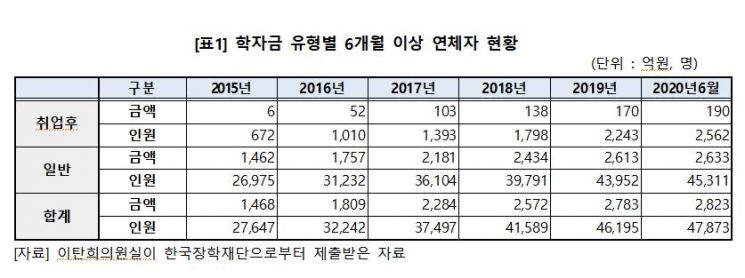
According to data submitted by the Korea Student Aid Foundation to Lee Tan-hee, a member of the National Assembly's Education Committee from the Democratic Party of Korea, the number of credit delinquents who have overdue interest payments for more than six months after taking out student loans reached 46,195 last year. Compared to 2015, the number of long-term delinquents and the amount overdue increased by 1.7 times and 1.9 times, respectively.
Assemblyman Lee Tan-hee views the increase in credit delinquents and bankruptcy filings among people in their 20s as largely related to student loans. As of June this year, there were 47,873 credit delinquents who had overdue interest payments for more than six months after taking out student loans, of which 94.6% were related to "general repayment student loans."
Student loans are broadly divided into income-contingent repayment student loans and general repayment student loans. Income-contingent repayment student loans are available interest-free until mandatory repayment begins for recipients of basic living subsidies, low-income groups, and those in the 4th income bracket or below eligible for student aid. However, general repayment student loans do not receive interest support. Unlike income-contingent repayment student loans, where repayment is deferred until income is generated and withheld at source by the National Tax Service, general repayment student loans require immediate repayment.
Recently, delayed employment has made it difficult to repay student loans, leading to an increase in 20-somethings taking out loans from secondary financial institutions. In particular, cases of young people entering high-interest loans have increased, worsening their credit ratings and leading to bankruptcy. According to Supreme Court data, bankruptcy cases among other age groups have generally decreased, but only those in their 20s have increased. Over the past five years, bankruptcy filings among people in their 20s increased by 1.2 times (from 691 to 833), while total bankruptcy applications decreased by 15.4% (from 53,801 to 54,490).
Assemblyman Lee emphasized, "Since youth poverty begins with student loans, it is necessary to expand the relatively less burdensome income-contingent repayment student loans to alleviate the burden on young people."
© The Asia Business Daily(www.asiae.co.kr). All rights reserved.
![User Who Sold Erroneously Deposited Bitcoins to Repay Debt and Fund Entertainment... What Did the Supreme Court Decide in 2021? [Legal Issue Check]](https://cwcontent.asiae.co.kr/asiaresize/183/2026020910431234020_1770601391.png)
















