Statistics Korea Announces September Consumer Price Trends
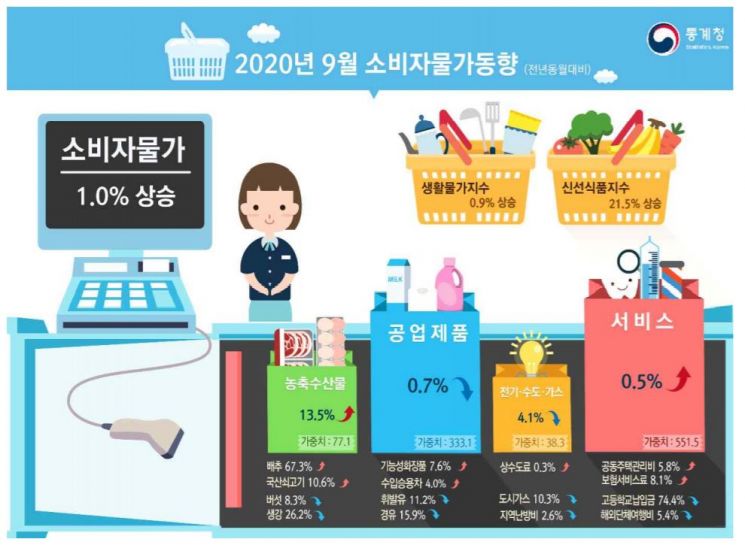
[Sejong=Asia Economy Reporter Kim Hyunjung] Last month, the Consumer Price Index (CPI) rose by 1.0% compared to the previous year, marking a 1% increase rate for the first time in six months. This is the first time since March, when the COVID-19 pandemic was spreading, that the CPI showed a 1.0% increase. The sharp price surge was mainly seen in food and non-alcoholic beverages, indicating a severe burden on grocery prices.
According to the Consumer Price Trends report by Statistics Korea on the 6th, the CPI for September was 106.20 (2015=100), up 1.0% from the same month last year. The CPI inflation rate was in the 1% range from January to March this year, then dropped to 0.1% in April and -0.3% in May, before showing an upward trend again from June. The rates were 0.0% in June, 0.3% in July, 0.7% in August, and expanded last month.
◆Sharp rise in agricultural, livestock, and fishery products drives upward trend= By category, goods rose 1.0% and services 0.5% compared to last year. Among goods, agricultural, livestock, and fishery products increased by 13.5%, marking the largest rise in 9 years and 6 months since March 2011 (14.6%).
Excluding seasonal factors and temporary shocks to identify long-term trends, the 'Core CPI excluding agricultural products and petroleum' rose 0.9% compared to a year ago. The OECD standard core CPI, 'Food and Energy Excluded Index,' increased by 0.6%.
To gauge perceived inflation, the 'Living CPI,' based on 141 frequently purchased items with high expenditure shares out of a total of 460 items, rose by 0.9%. The CPI including owner-occupied housing costs rose by 0.8%.
By expenditure purpose, the price increase rate for food and non-alcoholic beverages was 8.3% compared to the previous year, the highest since August 2011 (11.2%). This is interpreted as a result of increased demand due to more home cooking amid the COVID-19 pandemic.
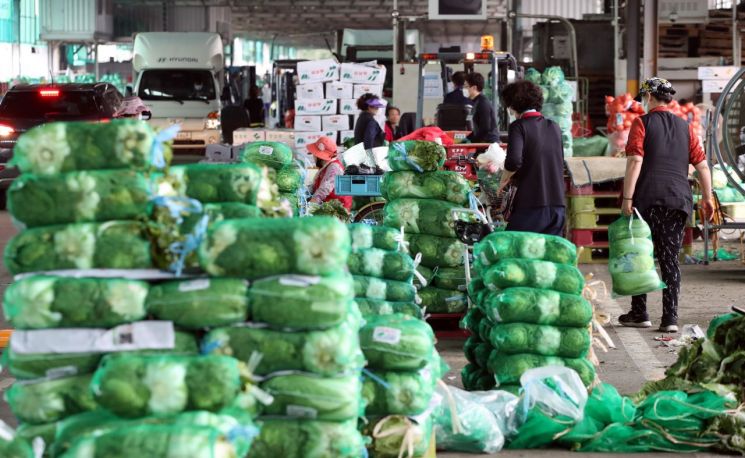
Looking at major fluctuating items, ahead of the kimchi-making season, prices of napa cabbage and radish surged sharply, burdening low-income households' grocery bills. Napa cabbage prices jumped 67.3% and radish prices 89.8% compared to the same month last year. Prices of apples (21.8%), tomatoes (54.7%), and green onions (40.1%) also rose significantly.
The 'Fresh Food Index,' calculated based on 50 items such as fish, shellfish, vegetables, and fruits that are highly sensitive to weather conditions, rose 21.5%, the highest increase since February 2011 (21.6%). Fresh vegetables, in particular, rose 34.9%.
◆Industrial products maintain downward trend... Rent prices remain high= Due to low oil prices, industrial products fell by 0.7%, and electricity, water, and gas prices dropped by 4.1%. Among services, personal services rose 1.3% compared to the same month last year. Public services decreased by 1.4% year-on-year due to strengthened policy support in the education sector.
Rent increased by 0.4%, the highest rise since August 2018 (0.5%). Jeonse (long-term deposit lease) rose 0.5%, the largest increase in 1 year and 7 months since February 2019 (0.6%), and monthly rent rose 0.3%, the largest increase in 3 years and 10 months since November 2016 (0.4%).
An Hyungjun, Economic Trend Statistics Officer at Statistics Korea, explained, "Overall, low inflation is maintained, but due to the unprecedentedly long rainy season, agricultural product prices rose this month (September)." However, he also noted strong downward pressure on prices, saying, "International oil prices fell further in September, and since it reflects with about a one-month lag, there is room for further decline. The communication fee support will be reflected in October service prices, which could contribute to a decrease in service inflation." Regarding concerns about rising napa cabbage prices ahead of the kimchi-making season, he predicted, "Autumn kimchi napa cabbage is expected to be available around the end of October, so prices should stabilize."
© The Asia Business Daily(www.asiae.co.kr). All rights reserved.


















