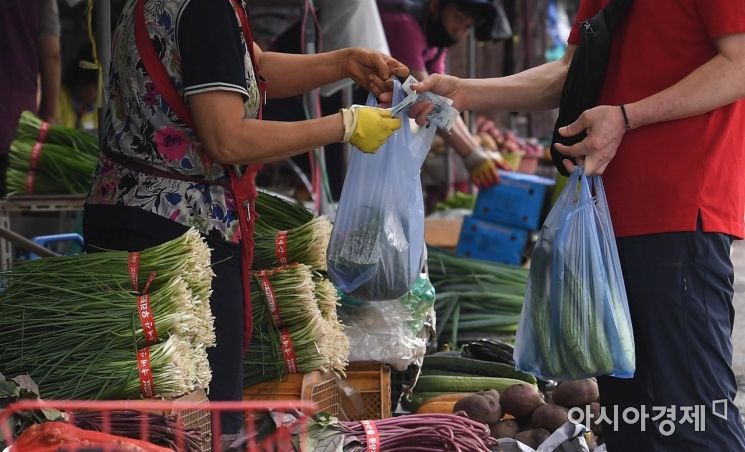
 A citizen visiting the vegetable market in Garak-dong, Songpa-gu, Seoul, is purchasing vegetables. The photo is unrelated to the article. Photo by Hyunmin Kim kimhyun81@
[Asia Economy (Hongseong) Reporter Jeong Il-woong] Chungnam Province is establishing a supply system that shortens the distribution stages of local agricultural products, enabling them to be supplied directly to supermarkets.
On the 5th, the province announced that it will operate the 'Chungnam Agricultural Products Local Mart Supply System,' which directly delivers agricultural products produced locally to in-province Hanaro Marts and Lotte Marts, utilizing the Chungnam Ogam Integrated Logistics System.
Currently, most local agricultural products go through a total of six distribution stages: from farms to local distributors, then to wholesale markets in the Seoul Garak-dong Market and other metropolitan area wholesale markets, followed by intermediate wholesalers, retailers, and finally to consumers.
During this process, Chungnam has endured the side effect where some agricultural products grown by neighboring farms cannot actually be purchased by local residents, and even if purchased, the products move once to the metropolitan area distribution hub and then return, resulting in consumers buying products at higher prices with relatively lower freshness.
For example, the province explained that logistics costs, wholesale market fees, and wholesale company sales profits are added to local agricultural products passing through the metropolitan area and other regions, forming prices more than 25% higher than the original farm prices. This created a distorted structure where farmers earn less income while local consumers pay more.
However, with the operation of the local mart supply system, the province expects to reduce the distribution process to four stages, thereby increasing local farmers' income and enabling consumers to make reasonable purchases.
First, the local mart supply system shortens the process to four stages: 'Farm → Nonghyup → Local Mart → Consumer.' The designated hub Nonghyups, Yesan Nonghyup and Geumsan Maninsan Nonghyup, supply agricultural products through 20 production-area Nonghyups to 30 Hanaro Marts within the province and 8 Lotte Marts in the Chungnam and Daejeon areas, representing the reduced distribution method.
Additionally, the province plans to temporarily support all logistics costs for local agricultural products, and the hub Nonghyups will supply agricultural products to each mart by receiving only a portion of the commission without sales profit, thereby reducing distribution costs.
Through this, the province expects that production areas will reduce costs due to shortened distribution stages, marts will receive fresh agricultural products directly without inventory burdens, and most importantly, consumers will have the opportunity to purchase local agricultural products at more reasonable prices due to the shortened distribution process.
Oh Se-woon, head of the Agricultural Food Distribution Division of the province, said, "Until now, most local agricultural products have passed through other regions such as the metropolitan area, resulting in a strange phenomenon where neither farmers nor consumers gained real benefits. However, with the improvement of the supply system, a foundation will be established for local food to be distributed and traded directly within the region, and producers, consumers, and sellers are all expected to gain real benefits."
© The Asia Business Daily(www.asiae.co.kr). All rights reserved.

















