2021 Economic and Financial Market Outlook Report Published
Recovery Limited Mainly to Consumption and Exports
Average Growth Expected at 0% Range Over 2 Years
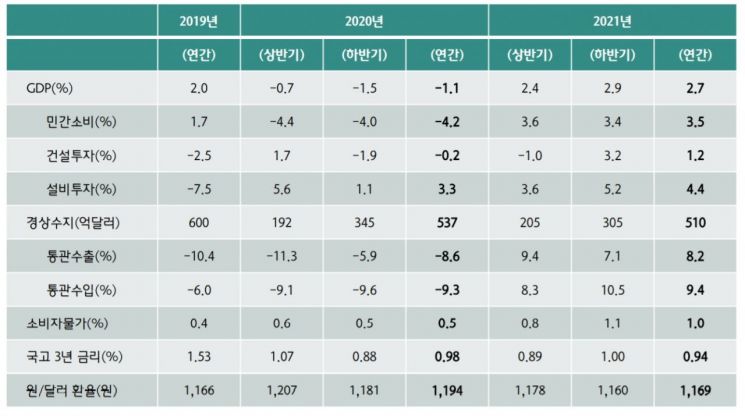 Major Macroeconomic Indicator Forecast Table / Source: Hana Bank Hana Financial Management Research Institute
[Asia Economy Reporter Kangwook Cho] Hana Financial Management Research Institute forecasted that the Korean economy will show a sluggish recovery next year, growing by only 2.7%.
On the 5th, the institute released its '2021 Economic and Financial Market Outlook' report, setting scenarios focused on the development and lockdown intensity of the novel coronavirus infection (COVID-19) situation, considering it as the most important variable for economic forecasts, and presented the 2021 outlook accordingly.
Scenario-based forecasts considering uncertainties in economic outlook depending on COVID-19 developments
First, under the 'Good' scenario where vaccine development progresses, the growth rate for next year was expected to be 3.6% (this year -0.9%). In the 'Base' scenario where the spread of COVID-19 eases (localized infections continue), the growth rate was projected at 2.7% (this year -1.1%).
On the other hand, in the 'Bad' scenario where a second large wave occurs this winter, the growth rate was forecasted at 0.2% (this year -1.8%).
Even with easing COVID-19 spread, economic recovery limited mainly to consumption and exports
Even in the base scenario, the institute expected a sluggish economic recovery centered on consumption and exports, with next year's growth rate remaining in the mid-to-high 2% range, which is below the average after the financial crisis (2.9% from 2011 to 2019), despite the base effect.
Considering this year's growth rate is in the -1% range, the average growth rate for this year and next is expected to be in the 0% range.
Research fellow Joo Tak Jung diagnosed, "With limited consumption recovery due to worsening income conditions and the spread of damage among vulnerable groups, and sluggish recovery in overseas demand, export improvement will also be insufficient."
Market interest rates rise mainly in long-term bonds... Won/Dollar exchange rate gradually stabilizes downward
The institute anticipated that with sluggish economic recovery, the base interest rate will remain on hold, limiting upward pressure on short-term interest rates. However, long-term interest rates are expected to rise due to increases in foreign interest rates and supply-demand burdens, leading to a prolonged steepening of the yield curve. (3-year government bond: 20.4Q 0.9% → 21.4Q 1.0%)
Also, influenced by a weak dollar and a strong yuan, the won/dollar exchange rate is expected to continue its downward trend. However, considering external uncertainties and the trend of expanding overseas investment, volatility will remain high, and the pace of exchange rate decline is expected to be somewhat gradual. (Won/Dollar: 20.4Q 1,175 won → 21.4Q 1,155 won)
Attention to sustainability of policy effects, deterioration of vulnerable groups, and potential decline in growth resilience
Research fellow Jung pointed out, "Although the government's active policy response has mitigated the shock caused by COVID-19, it is necessary to focus on whether the policy effects will continue and pay attention to the risk of deterioration among vulnerable groups who have been relatively severely affected, as well as the resulting imbalance in economic recovery."
He added, "It is also important to be aware of the potential additional decline in potential growth rate and weakening of growth resilience linked to structural changes in the economy after COVID-19."
© The Asia Business Daily(www.asiae.co.kr). All rights reserved.
![User Who Sold Erroneously Deposited Bitcoins to Repay Debt and Fund Entertainment... What Did the Supreme Court Decide in 2021? [Legal Issue Check]](https://cwcontent.asiae.co.kr/asiaresize/183/2026020910431234020_1770601391.png)















