2020 First Half Industrial Complex Performance Analysis
[Asia Economy Reporter Dongwoo Lee] Since the outbreak of the novel coronavirus infection (COVID-19), the performance of industrial complexes in the first half of this year recorded negative growth in both production and exports.
The Federation of Korean Industries announced on the 5th that, based on an analysis of the industrial complex trend statistics from the Korea Industrial Complex Corporation, the performance of industrial complexes in the first half of the year decreased by
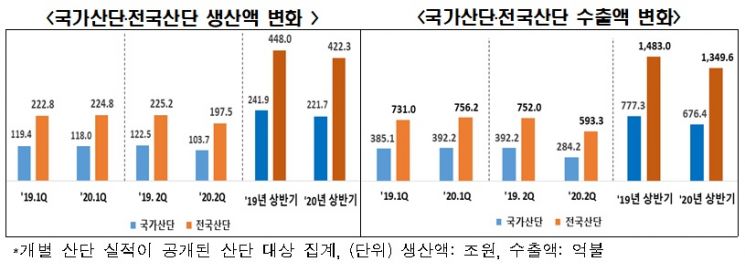
8.4% in production and 13.0% in exports compared to the same period last year.
In particular, the performance in the second quarter, when the COVID-19 impact became full-scale, showed a 15.3% decrease in production and a 27.5% decrease in exports, indicating a worsening compared to the first quarter. The nationwide industrial complexes (including national, general, urban high-tech, and agricultural-industrial complexes) also saw a 12.3% decrease in production and a 21.1% decrease in exports in the second quarter compared to the same period last year, suggesting that most industrial complexes nationwide were affected by the COVID-19 shock.
By region, in the second quarter, the Seoul metropolitan area recorded -6.8% in production and -10.4% in exports, whereas the provinces recorded -17.9% in production and -30.1% in exports, showing that the performance deterioration in provincial industrial complexes was more severe than in the metropolitan area.
The production value of national industrial complexes in the first half of this year was 221.7 trillion KRW, a decrease of 20.2 trillion KRW compared to the same period last year. Especially, the production decrease in the second quarter compared to the same period last year reached 18.8 trillion KRW, indicating that the poor performance in the second quarter had a significant impact. The nationwide industrial complex performance indicators also showed a large shock in the second quarter as COVID-19 became full-scale. Compared to the same period last year, production and export values in the first quarter increased by 0.9% and 3.4%, respectively, but in the second quarter, production decreased by 12.3% and exports by 21.1%.
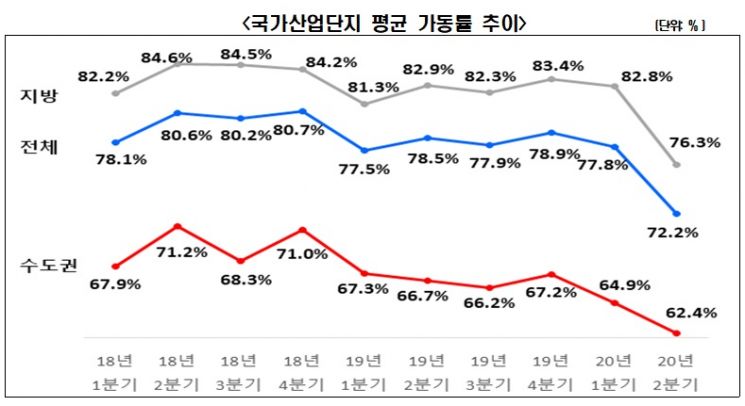
The average operating rate of national industrial complexes in the second quarter of 2020 was 72.2%, the lowest during the analysis period (Q1 2018 to Q2 2020). Since recording 80.7% in Q4 2018, the average operating rate has fallen below 80% for six consecutive quarters. In the second quarter of this year, the average operating rate of national industrial complexes in the Seoul metropolitan area was 62.4%, and in the provinces, it was 76.3%, also showing the lowest operating rates during the analysis period.
Comparing the production growth rates by industry for the second quarter of this year, which was severely affected by COVID-19, the petrochemical (-28.4%), textile and apparel (-20.8%), and transportation equipment (-11.3%) industries experienced significant downturns. During the same period, the export growth rates were analyzed as transportation equipment (-35.5%), petrochemical (-33.6%), and textile and apparel (-29.2%), indicating that these three industries were particularly hard hit by the COVID-19 shock.
By region, the performance decline of provincial national industrial complexes in the first half of 2020 was more severe than that of the Seoul metropolitan area. The production and export growth rates of provincial industrial complexes in the first half of this year recorded -9.4% and -14.0%, respectively, compared to the same period last year, showing poorer performance than the metropolitan area industrial complexes (production growth rate -4.9%, export growth rate -6.5%). Especially in the second quarter, the gap in performance growth rates widened further, with the production decrease rate in the provinces (-17.9%) being 2.6 times that of the metropolitan area (-6.8%), and the export decrease rate in the provinces (-30.1%) being 2.9 times that of the metropolitan area (-10.4%).
Despite the sharp decline in performance in the first half of the year, employment in national industrial complexes decreased by only 1.2%. The average number of employees in the first half of 2020 was 983,000, a decrease of 12,000 compared to the same period last year. The average employment in the first quarter decreased by 0.9% compared to the same period last year, and in the second quarter, it decreased by 1.6%. The Federation of Korean Industries analyzed that the slight decrease in employment despite the sharp decline in performance due to the COVID-19 shock was thanks to the efforts of Korean companies to maintain employment, as well as government policies such as the relaxation of employment retention subsidy requirements, and overall social efforts to minimize the employment shock caused by COVID-19.
Yoo Hwan-ik, Director of Corporate Policy at the Federation of Korean Industries, said, “Even listed companies including large corporations experienced a 6.9% decrease in sales and an 11.6% decrease in exports in the first half of the year, showing severe performance downturns due to COVID-19,” adding, “Since many companies in industrial complexes are relatively smaller, the COVID-19 impact was likely greater.” He emphasized, “Active support measures such as remodeling aging industrial complexes and supporting export consulting are necessary to overcome COVID-19 and restore the competitiveness of industrial complexes.”
© The Asia Business Daily(www.asiae.co.kr). All rights reserved.


















