Switzerland Revises Gender Equality Law... Companies to Disclose Gender Wage Gaps
OECD Data Shows Korea's Gender Wage Gap at 32.5%, Firmly in 1st Place
Ipjocho States "Employment Ministry's 'Wage Distribution by Business Characteristics' Differs from Intended Purpose"
[Asia Economy Reporter Kim Bo-kyung] The National Assembly Legislative Research Office has expressed the opinion that South Korea needs to introduce a wage distribution disclosure system similar to Switzerland. The wage distribution disclosure system refers to a system in which companies voluntarily analyze the wage gap between male and female workers and disclose the results to employees or shareholders.
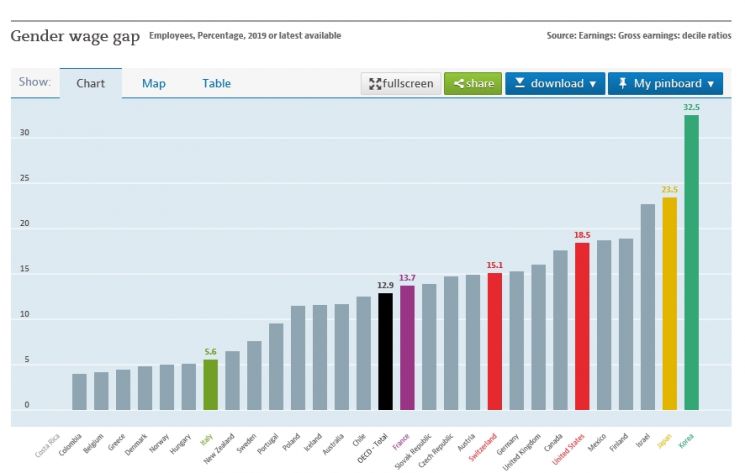
According to the recently published report "Introduction and Implications of Switzerland's Wage Distribution Disclosure System" by the Legislative Research Office, as of last year, South Korea's gender wage gap ratio was 32.5%, ranking first among OECD countries by a wide margin. The average gender wage gap ratio among OECD countries is 12.9%, with France at 13.7%, the United States at 18.5%, and Japan at 23.5%.
The gender wage gap ratio refers to the difference between the median income of men and women. In South Korea, women's wages are 32.5% lower than men's wages. In other words, women's wages are at 67.5% of men's wages, meaning that when men earn 1 million won, women earn 675,000 won.
To address the worst gender wage gap in the OECD, the Moon Jae-in administration announced at its launch that it would introduce a "gender-equal wage disclosure system" as part of its five-year national management plan. It also planned to implement a policy requiring companies above a certain size to submit the status of gender wage gaps and measures to resolve them.
In response, the Ministry of Employment and Labor announced the "Wage Distribution Status by Business Characteristics" in February, enabling the understanding of wage levels according to business size, industry, occupation, career, gender, and education.
However, it is uncertain whether these measures by the Ministry of Employment and Labor will effectively reduce the gender wage gap. The Legislative Research Office pointed out, "Since specific information such as the wage distribution of individual companies cannot be known, there is an aspect that differs from the purpose of the wage distribution disclosure system."
Switzerland amended the "Gender Equality Act" last July to require companies to voluntarily analyze and disclose the wage distribution between men and women. The wage distribution disclosure system applies to public and private sector employers with 100 or more regular employees.
Despite the Gender Equality Act being in effect since 1996, gender wage gaps still occur without objective grounds, prompting this new attempt to resolve the issue. As of 2019, Switzerland's gender wage gap ratio was 15.1%.
The Legislative Research Office explained, "Switzerland imposes an obligation to conduct 'equal pay analyses' to identify gender wage gaps. However, there are no sanctions or penalties if employers violate the obligation to conduct equal pay analyses or if gender wage gaps occur."
It added, "South Korea also needs to consider introducing a wage distribution disclosure system. While labor groups support it as necessary to eliminate the gender wage gap, the business community opposes it due to concerns over infringement on corporate management autonomy and potential labor-management conflicts, so sufficient consultation is required."
Furthermore, it suggested, "In-depth social discussions and agreements are necessary to ensure a reasonable balance of protected interests among stakeholders regarding the scope of application, disclosure methods, disclosure frequency, and disclosure items of wage distribution disclosure."
© The Asia Business Daily(www.asiae.co.kr). All rights reserved.

















