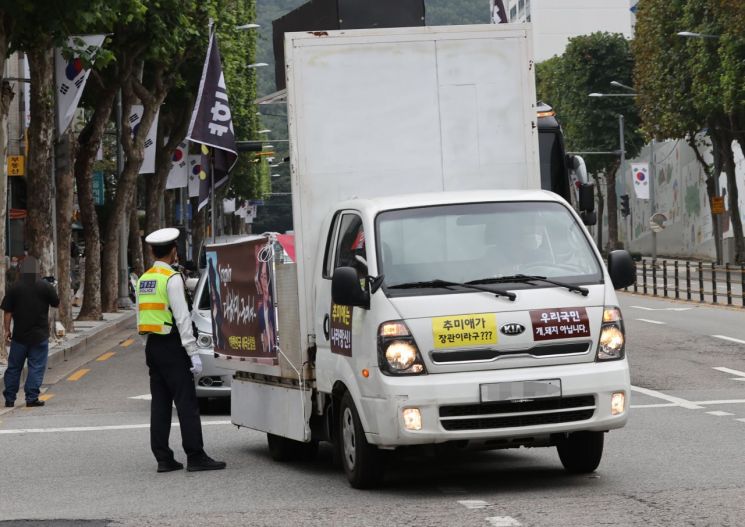
[Asia Economy reporters Kwanju Lee and Jungyoon Lee] On October 3rd, National Foundation Day, vehicle protests took place across Seoul. Although the police issued bans on all vehicle protests involving fewer than ten vehicles reported by conservative groups, some vehicle protests permitted by certain courts proceeded as scheduled.
Nine vehicles driven by members of the conservative group 'Patriotic Patrol Team' departed from Gyeonggi Provincial Office in the morning and held a press conference around noon in front of the Seoul Detention Center in Uiwang City, where Pastor Jeon Gwang-hoon of Sarang Jeil Church is incarcerated, condemning the government's quarantine measures.
The nine vehicles, including a broadcast vehicle, displayed banners criticizing Justice Minister Choo Mi-ae and Democratic Party lawmaker Yoon Mi-hyang, and conducted a vehicle protest from the residence of former Justice Minister Cho Kuk to an apartment in Guui-dong, Gwangjin-gu, where the Justice Minister's residence is located. Near the blocked entrance to former Minister Cho's home, dozens of citizens, YouTubers, and reporters gathered as the protest vehicles passed by honking their horns.
Former Minister Cho Kuk posted on social media that day, stating, "Freedom of assembly is a constitutional fundamental right, and the 'Patriotic Patrol Team' can also enjoy this fundamental right," adding, "As a public figure, I accept the court's decision. However, I apologize to my neighbors."
The conservative group 'People's Action for a New Korea' (Saehan-guk) also conducted a vehicle protest in the afternoon, starting from Gubeundari Station in Gangdong-gu, Seoul, and proceeding along the route to Gangdong Public Garage with nine vehicles. Participants attached flags calling for the resignation of Justice Minister Choo Mi-ae to their cars during the protest. Former Gyeonggi Province Governor Kim Moon-soo, who joined the vehicle protest, criticized, "Although this vehicle protest was a last resort, the restrictions were so severe that it felt more like an ordeal than a protest," adding, "I have experienced martial law and emergency measures in my life, but this feels like the most severe martial law state I've ever encountered."
Earlier, to prevent sudden rallies and protests in downtown areas such as Gwanghwamun Square, the police set up checkpoints at 90 entrances to Seoul and inspected vehicles entering the city. They mobilized about 800 personnel, including 21 companies of riot police, traffic police, and local police, to prepare for any emergencies.
Gwanghwamun Square was tightly surrounded by police vehicle barricades, making entry difficult, and fences were set up on the outer sidewalks allowing only one or two people to pass at a time. The subway also passed through Gwanghwamun Station, City Hall Station, and Gyeongbokgung Station without stopping in the morning.
The police stated they will respond strictly if vehicle protest participants fail to comply with the conditions set by the courts.
© The Asia Business Daily(www.asiae.co.kr). All rights reserved.

















