China calls Taiwan Strait median line a 'division line'; warns of forceful unification if 'One China' principle is broken
US plays Taiwan card as part of Indo-Pacific strategy and China's vulnerability
[Asia Economy Beijing=Special Correspondent Jo Young-shin] The 'median line,' which serves as the boundary and barrier between China and Taiwan, is expected to become the flashpoint of US-China conflicts.
The median line is an imaginary line crossing the middle of the Taiwan Strait between China and Taiwan. Taiwan has designated this line as its Air Defense Identification Zone (ADIZ), and when Chinese military aircraft violate it, Taiwan responds by scrambling fighter jets.
The US-China tensions are so intense that people say, "It would not be surprising if a war breaks out in the Taiwan Strait."
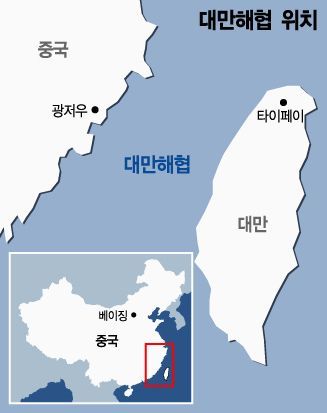
◇ China views the median line as a 'dividing line' = The median line in the Taiwan Strait was arbitrarily established as a 'non-aggression imaginary line' when the US signed a mutual defense treaty with Taiwan. It was created to avoid military clashes with China. Although there is no median line under international law, China and Taiwan tacitly agreed not to cross this line.
However, as the US began conducting military exercises in the Taiwan Strait under the name of 'freedom of navigation,' China started crossing this line. After visits to Taiwan by Alex Azar, US Secretary of Health and Human Services, and Keith Krach, US Under Secretary of State for Economic Growth, Energy, and the Environment, China changed its stance, stating that the median line never existed in the first place.
The Hong Kong South China Morning Post (SCMP) interpreted this as "China's crossing of the median line shows that it may break a convention maintained for over half a century."
China's state-run Global Times, after Taiwan's military publicly disclosed the Chinese military's crossing of the median line to foreign media, referred to the median line as a 'dividing line,' emphasizing the 'One China' principle.
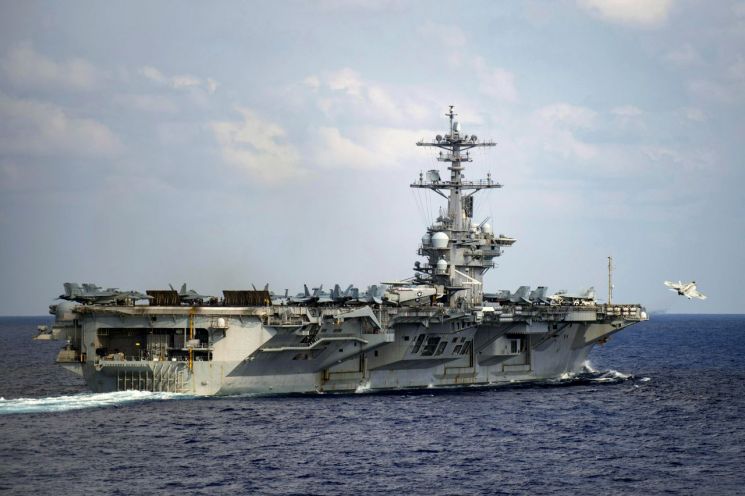
Professor Zhu Songling of the Taiwan Studies Institute at Beijing Union University warned, "There is no problem with the Chinese military operating within its territory," adding, "It is a disaster to think that the mainland will not carry out military unification."
Wang Jianming, a Taiwan expert at the Chinese Academy of Social Sciences, said, "China's refusal to recognize the median line is to defend sovereignty and territory against Taiwan separatist forces," warning, "If they continue to try to cross China's red line, military conflict will be unavoidable."
◇ Taiwan: China's Achilles' heel and 'reverse scale' = Taiwan is a critical point for the Chinese government, which advocates 'One China.' It differs from Hong Kong, which was returned, in terms of control and influence. The US is well aware of this and is pressuring China using the Taiwan card.
China's response has been very tough and aggressive. As the Taiwan issue is seriously discussed, the term 'military unification' has even appeared among Chinese state media.
Hu Xijin, editor-in-chief of China's state-run Global Times, warned on his Weibo (China's version of Twitter), "We will no longer tolerate the collusion between the US and Taiwan," adding, "The Chinese People's Liberation Army's fighter jets are on the verge of flying over Taiwan Island, and the moment China plays this card, the military situation in the Taiwan region will become a page in history."
Professor Moon Il-hyun of the China Political Science University said Taiwan is the most sensitive card the US holds.
Professor Moon expressed concern, saying, "From China's perspective, the US has already crossed the red line," and "Taiwan could become the flashpoint of war." He further explained, "If a military conflict occurs, political and diplomatic logic does not work. Only the logic of power operates," adding, "This is why China is showing a cautious mode despite the US crossing the red line."
◇ Taiwan is a key location in the Indo-Pacific strategy = Taiwan is a card that can pressure the Chinese leadership and is also connected to the US Indo-Pacific strategy. From the perspective of the US strategy to 'completely block China's sea routes,' Taiwan and the Taiwan Strait are both the starting and ending points. The Taiwan Strait connects to the South China Sea, which in turn borders the Indian Ocean.
The US Indo-Pacific strategy is actively supported not only by India, which has border disputes with China, but also by Australia and Japan. Taiwan is no exception. If the US, Australia, Japan, India, Taiwan, and some South China Sea coastal countries form alliances, China will lose its sea routes.
On the 6th, foreign ministers from the US, Australia, Japan, and India will hold a meeting in Tokyo, Japan, to realize a 'free and open Indo-Pacific.' There is a possibility that the launch of an 'Indo-Pacific NATO' will be concretized at this meeting.
Some express concerns that if Taiwan participates in the US strategy of an Indo-Pacific NATO, an irreversible situation could arise.
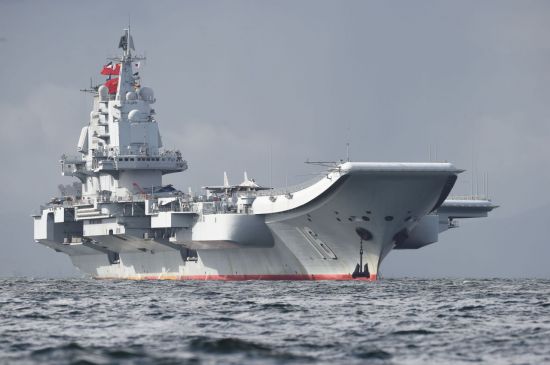 [Image source=Yonhap News]
China is also closely watching the US-led Indo-Pacific strategy.
Wang Yi, China's Foreign Minister, recently criticized the US in an interview with Xinhua News Agency, saying, "Some external forces are interfering in the affairs of countries in the region under various pretexts and even inciting color revolutions," adding, "Regional security is facing new threats and challenges."
He further expressed dissatisfaction, stating, "External forces, driven by the idea of maintaining hegemony, have suppressed emerging economies like China with various lies and even threatened other countries to side with them, attempting to create a new Cold War."
© The Asia Business Daily(www.asiae.co.kr). All rights reserved.


















