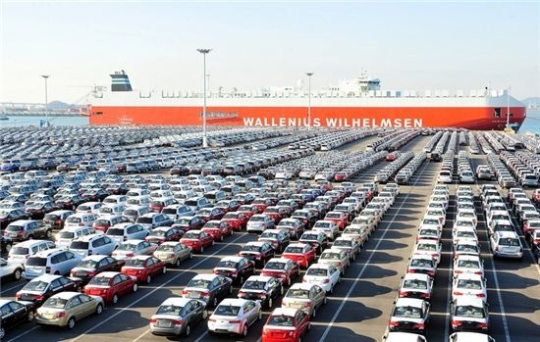
 (Photo by Asia Economy)
[Asia Economy Reporter Kiho Sung] A bill proposing to expand the individual consumption tax exemption range for automobiles to 1600cc has been introduced. The purpose is to reduce the burden on the public in a situation where car ownership has become widespread and to support the domestic automobile industry, which is experiencing a downturn due to the resurgence of COVID-19 and the reduction in the individual consumption tax exemption rate. However, since there are many hurdles to overcome before this can be realized, such as the Korea-US Free Trade Agreement (FTA), more in-depth discussions are needed in the National Assembly.
According to the National Assembly on the 2nd, Rep. Chaehik Lee of the People Power Party introduced the "Partial Amendment to the Individual Consumption Tax Act" containing this proposal on the 21st of last month. The amendment proposes expanding the individual consumption tax exemption range from passenger cars with engine displacement of 1000cc or less to those up to 1600cc. Under the current law, vehicles with engine displacement exceeding 1000cc but not exceeding 2000cc are subject to a 5% individual consumption tax on the price of the goods.
Rep. Lee explained the reason for the proposal, stating, "Passenger cars with an engine displacement of 1600cc or less correspond to small or compact cars, which are mainly purchased and used by ordinary citizens out of practical necessity," and added, "To alleviate the tax burden on ordinary citizens, individual consumption tax will not be imposed on passenger cars with engine displacement of 1600cc or less."
Earlier, the National Assembly Research Service also recommended in its "National Audit Issue Analysis" report published last month that it is necessary to consider abolishing or adjusting the individual consumption tax rate for passenger cars with engine displacement of 1600cc or less, which are mainly used by the middle and lower-income classes, considering their nature as essential living goods.
The problem is that for this bill to pass, an amendment to the Korea-US FTA is required. Article 2.12 of the Korea-US FTA agreement states that "vehicles with engine displacement between 1001cc and 2000cc shall be taxed at a single rate not exceeding 5%."
To overcome this, the individual consumption tax would need to be completely abolished, but securing the tax revenue, which amounted to 1 trillion won as of 2018, is an issue. A representative from the automobile industry said, "Since cars are increasingly becoming essential living goods, I support abolishing the individual consumption tax," but added, "However, I oppose any increase or transfer of other taxes to compensate for the lost revenue."
There is also a suggestion to reconsider the tax system based on engine displacement. Professor Hogun Lee of the Department of Automotive Studies at Daeduk University said, "With engine downsizing and hybrid technology combined, there are cases where high-priced vehicles have low engine displacement," and added, "It is necessary to consider introducing the vehicle price itself as a criterion along with engine displacement."
© The Asia Business Daily(www.asiae.co.kr). All rights reserved.
![Clutching a Stolen Dior Bag, Saying "I Hate Being Poor but Real"... The Grotesque Con of a "Human Knockoff" [Slate]](https://cwcontent.asiae.co.kr/asiaresize/183/2026021902243444107_1771435474.jpg)















