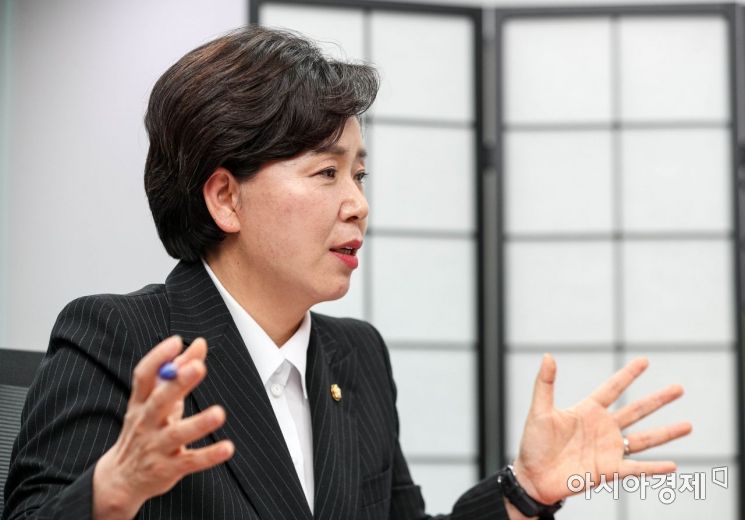
 Yang Hyang-ja, a member of the Democratic Party of Korea, is being interviewed on the 13th at the National Assembly Members' Office Building in Yeouido, Seoul. Photo by Kang Jin-hyung aymsdream@
[Asia Economy Reporter Kang Nahum] The average entertainment expenses reported by corporations in their corporate tax filings last year were found to be at their lowest level in the past decade. This trend has significantly decreased since the enactment of the Act on the Prohibition of Improper Solicitation and Graft, commonly known as the 'Kim Young-ran Act.'
According to an analysis of the 'Status of Entertainment Expenses of Corporations Filing Corporate Tax (2010~2019)' submitted by the National Tax Service to Yang Hyang-ja, a member of the National Assembly's Planning and Finance Committee from the Democratic Party of Korea, over the past 10 years, about 5.91 million corporations spent entertainment expenses totaling 96.5174 trillion KRW.
The average entertainment expenses of these corporations decreased by 3%, from 17.42 million KRW to 16.89 million KRW, between 2010 and 2016. However, after the implementation of the Kim Young-ran Act, the expenses dropped by 16% (from 16.89 million KRW to 15.31 million KRW) between 2016 and 2019.
It was found that larger corporations with higher revenue, which tend to spend more on entertainment, experienced a greater reduction in entertainment expenses. The average entertainment expenses of the top 1% of companies by revenue decreased by 26%, from 561.16 million KRW in 2016 to 414.74 million KRW in 2019. The top 10% of companies also saw a 20% decrease in average entertainment expenses during the same period.
This reduction in corporate entertainment expenses is analyzed to be influenced not only by the Kim Young-ran Act but also by changes in drinking culture. In fact, corporate card usage data over the past decade shows a steady decline in expenditures at entertainment establishments.
According to the 'Corporate Card Usage Status of Corporations Filing Corporate Tax (2010~2019)' data submitted by the National Tax Service to Assemblywoman Yang, the amount spent using corporate cards at entertainment establishments last year was 860.9 billion KRW, a 43.9% decrease from 1.5335 trillion KRW in 2010.
By type of entertainment establishment, spending at room salons decreased by 54.6%, from 996.3 billion KRW to 452.4 billion KRW, and at danranjumeok (Korean-style hostess bars) by 32.3%, from 243.6 billion KRW to 165 billion KRW during the same period.
In contrast, spending at golf courses has steadily increased, rising by 35.3% from 952.9 billion KRW in 2010 to 1.2892 trillion KRW in 2019.
© The Asia Business Daily(www.asiae.co.kr). All rights reserved.
![Clutching a Stolen Dior Bag, Saying "I Hate Being Poor but Real"... The Grotesque Con of a "Human Knockoff" [Slate]](https://cwcontent.asiae.co.kr/asiaresize/183/2026021902243444107_1771435474.jpg)











