[Asia Economy Honam Reporting Headquarters Reporter Park Seon-gang] As one year has passed since the commencement of construction for Gwangju Urban Railway Line 2, it is also playing a role in revitalizing the local economy, which has been stagnant due to COVID-19.
According to Gwangju Metropolitan City on the 1st, the Urban Railway Construction Headquarters began construction of the 17 km main line section of Phase 1 last September, and is currently carrying out underground utility relocation and demolition, excavation and ground reinforcement, and installation of earth retaining facilities. In June, construction of the vehicle depot also began.
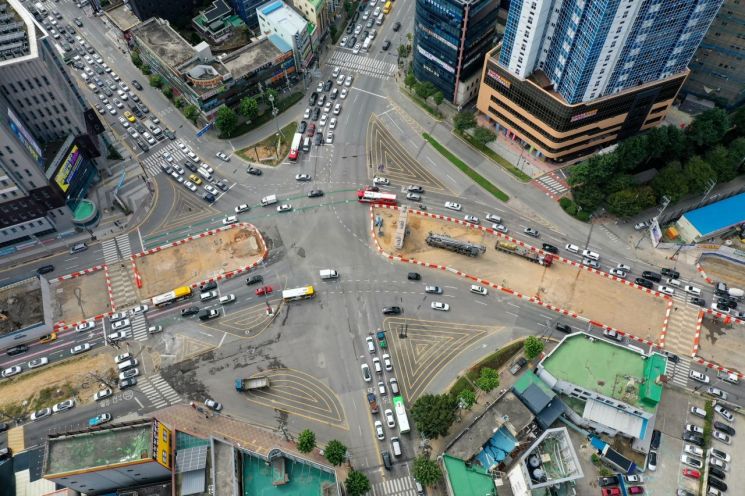
Baegun Overpass demolition started on June 4 and the demolition of the upper structure was safely completed on the 25th. To minimize inconvenience to citizens, the construction section will be partially occupied and the underground road and urban railway construction will be carried out simultaneously. Once completed, the urban landscape will improve, and with an increase in foot traffic around Baegun Square, it is expected to contribute to the revitalization of the surrounding commercial area.
The Phase 1 construction of Urban Railway Line 2 is expected to cost a total of 1.2 trillion KRW. To expedite the early execution of national funds, efforts such as setting weekly and monthly schedules, frequent site inspections, and expanding work zones by section have been made. As a result, 92% of the national funds, 76.4 billion KRW out of 83 billion KRW, were executed in the first half of this year, and it is expected to gain momentum in securing national funds for next year.
The Urban Railway Construction Headquarters is actively encouraging the employment of local residents, expanding subcontracting participation of local specialized construction companies, and the use of construction materials and equipment produced locally during the project implementation.
Among the total 14,938 person-times employed since the start of construction, 12,676 are local personnel, and 4,847 cases of local equipment use have been recorded, utilizing over 85% local manpower and equipment, thereby invigorating the local economy.
For the design of the 20 km section of Phase 2, to ensure economic feasibility, constructability, and quality assurance, all 10 selected specific construction methods and materials were chosen from local companies. Compared to the general design cost of 103.4 billion KRW, the proposed amount was 65.1 billion KRW, saving a budget of 32.1 billion KRW.
Special management is being conducted to ensure that on-site workers can spend the upcoming Chuseok holiday comfortably without worries about wage arrears, including the payment of wages and subcontracting fees. Efforts are also being made to actively support the local economy, which has been depressed due to COVID-19.
An Joo-hyun, Head of Construction at the Urban Railway Construction Headquarters, said, “Since next year’s budget will reach about 370 billion KRW, we plan to actively promote early budget execution starting from the fourth quarter of this year. We will do our best to ensure that local manpower, equipment, and materials are given priority to help revitalize the local economy amid the COVID-19 crisis.”
© The Asia Business Daily(www.asiae.co.kr). All rights reserved.

















