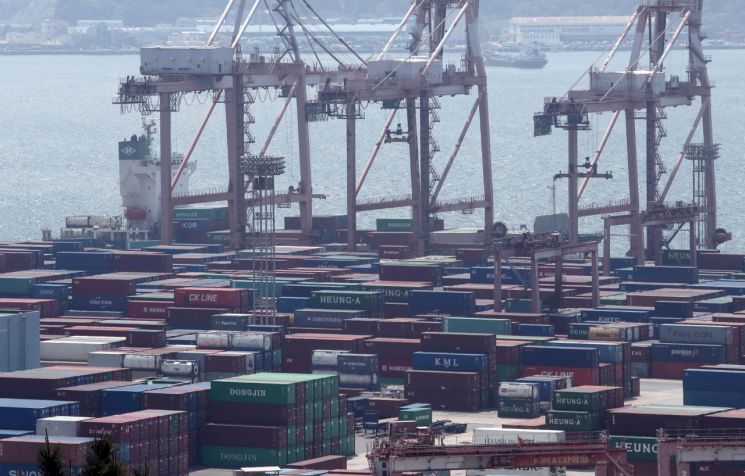
[Asia Economy Reporter Moon Chaeseok] Last month, South Korea's exports turned positive for the first time in seven months. The country simultaneously entered the 'total $40 billion range and daily average $2 billion range' as declared by the government, recording the highest total and daily average amounts this year.
The government places emphasis on the rebound in sectors sensitive to the economy such as semiconductors, automobiles, machinery, steel, and textiles. There are also forecasts that whether this rebound trend can continue depends on the spread of the novel coronavirus disease (COVID-19) in major overseas markets.
According to the 'September Export-Import Trends' announced by the Ministry of Trade, Industry and Energy on the 1st, last month's export amount was $48.05 billion, an increase of 7.7% compared to the same month last year. The 7.7% growth rate is the highest in 1 year and 11 months since October 2018.
The daily average export amount was $2.089 billion, a 4% decrease compared to the same month last year. This is the highest this year and the first recovery to the $2 billion range in eight months since January's $2.016 billion.
September Export Total and Daily Average Highest This Year... Simultaneous Entry into '400 Billion and 20 Billion Dollar Range'
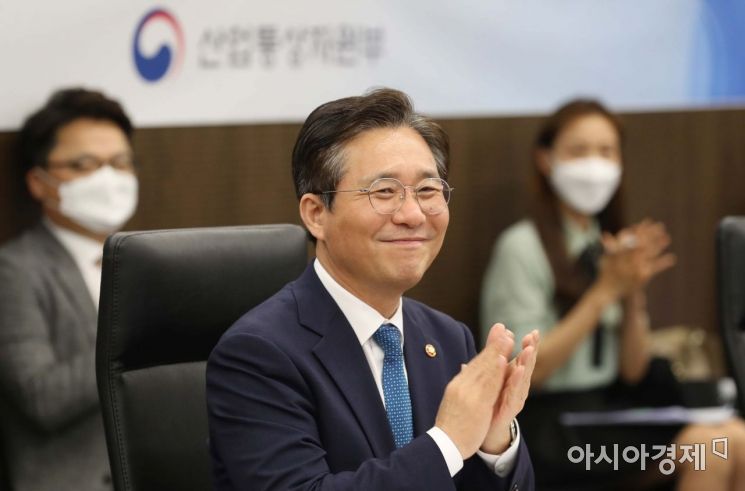 Minister Sung Yun-mo of the Ministry of Trade, Industry and Energy stated on the 29th of last month, "In September, our exports are expected to simultaneously reach the $40 billion mark in total export value and the $2 billion mark in average daily exports for the first time since the outbreak of COVID-19." / Photo by Moon Ho-nam munonam@
The Ministry of Trade, Industry and Energy emphasized that although the number of working days last month was 2.5 days more than the same month last year, the daily average performance also recorded a rebound. The 4% decrease in daily average exports compared to the same month last year is explained as a base effect caused by the very good performance of $2.18 billion last year.
The daily average export amount showed single-digit decreases for three consecutive months: -18.4% in June, -7.1% in July, -4% in August, and -4% last month.
Accordingly, the overall monthly performance was sluggish with -0.7% in March, -25.1% in April, -23.6% in May, -10.9% in June, -7.1% in July, and -10.1% in August, but rebounded last month.
Performance by item and market also showed a rebound. Looking at the major export items, semiconductors (+11.8%), home appliances (+30.2%), secondary batteries (+21.1%), automobiles (+23.2%), auto parts (+9.4%), general machinery (+0.8%), textiles (+11.4%), and steel (+1.8%) all increased.
Among these, automobiles (turned positive after 6 months), auto parts (6 months), general machinery (7 months), textiles (7 months), and steel (9 months) turned positive for the first time since COVID-19. Biohealth (+79.3%) and computers (+66.8%) have been positive for over a year.
However, ships (-3%), displays (-1.9%), petrochemicals (-5.3%), communication devices (-12.5%), and petroleum products (-44.2%) were negative.
Exports to China, the United States, the European Union (EU), and ASEAN (Association of Southeast Asian Nations), which account for 66% of South Korea's exports, all increased compared to the same month last year. It is the first time in 1 year and 11 months since October 2018 that all four markets recorded positive growth.
Specifically, exports increased to China (+8.2%), the United States (+23.2%), the EU (+15.4%), ASEAN (+4.3%), and India (+28.2%), while exports to Japan (-6%), the Middle East (-9.7%), Latin America (-27.6%), and the Commonwealth of Independent States (CIS, -16.6%) decreased.
Imports amounted to $39.17 billion, an increase of 1.1% compared to the same month last year. Accordingly, the trade balance recorded a surplus of $8.88 billion.
Government Highlights Rebound in Automobiles, Machinery, Steel, and Textiles... "Variable is the COVID-19 Pandemic"
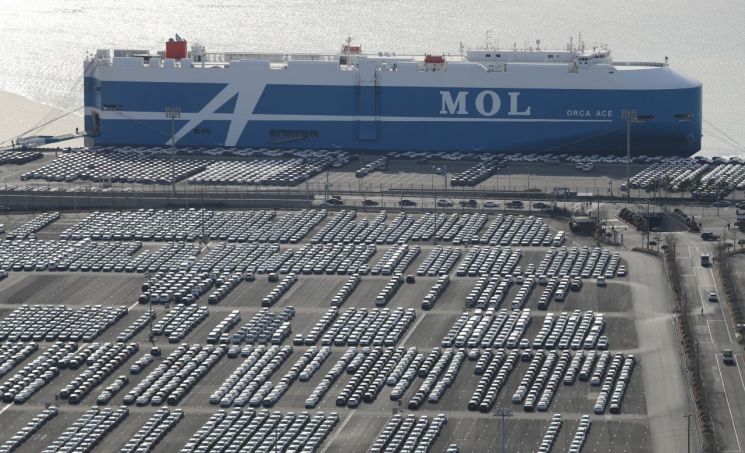
The Ministry of Trade, Industry and Energy emphasized the importance of noting that information and communication technology (ICT) items such as semiconductors, as well as economically sensitive sectors like automobiles, auto parts, machinery, textiles, and steel, rebounded for the first time since COVID-19. This can be interpreted as a sign that major markets such as China, the United States, the EU, and ASEAN are gradually increasing economic activities.
An official from the ministry said, "While semiconductors supported export performance, the fact that economically sensitive sectors such as automobiles, machinery, steel, and textiles also recorded positive growth was the cause of last month's export rebound. In particular, the increase in exports of automobiles, machinery, steel, and textiles is judged as a signal of the resumption of economic activities in major overseas markets, so it is necessary to keep an eye on this."
Experts explained that although last month's export performance increased, variables such as whether the global COVID-19 pandemic will resume and economic responses after the U.S. presidential election on November 3 (local time) still remain.
Professor Jung In-gyo of Inha University's Department of International Trade said, "Since the recovery from COVID-19 is insufficient, it is difficult to say that the global economy has recovered, and we need to observe further whether the export rebound will continue in the fourth quarter. Since it is difficult for the world to fully control COVID-19, it is important whether economic activities will be loosened despite risks or whether the lockdown policy will be maintained longer."
Professor Ha Jun-kyung of Hanyang University's Department of Economics said, "Although the worst phase seems to be over, uncertainty remains large about whether major overseas countries will resume economic activities despite the spread of COVID-19. The export performance may fluctuate within a certain range for a considerable period."
© The Asia Business Daily(www.asiae.co.kr). All rights reserved.
![From Hostess to Organ Seller to High Society... The Grotesque Scam of a "Human Counterfeit" Shaking the Korean Psyche [Slate]](https://cwcontent.asiae.co.kr/asiaresize/183/2026021902243444107_1771435474.jpg)


















