Professor Kim Dae-il of Seoul National University Department of Economics Paper
"Reevaluating the Common Perception That the Volunteer Military System Is an Unfair System Favoring Only the Wealthy"
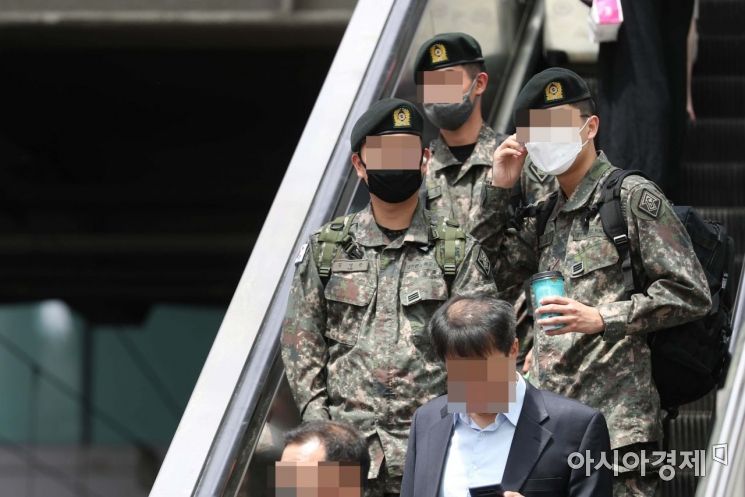 On the 8th, when the military leave that had been restricted to prevent the spread of the novel coronavirus infection (COVID-19) was resumed normally, soldiers heading on leave were making their way to the train at Seoul Station. Photo by Mun Ho-nam munonam@
[Sejong=Asia Economy Reporter Kim Hyun-jung] The current conscription system, which mandates military service upon reaching a certain age, may exacerbate income inequality, while the volunteer military system, maintained by professional soldiers, is argued to be a more efficient system. It is explained that the common perception that the volunteer military system is an unfair system favoring only the wealthy should be reevaluated.
According to the Korean Economic Association on the 1st, Professor Kim Dae-il of the Department of Economics at Seoul National University published a paper titled "Comparison of Income Equity between Volunteer Military and Conscription Systems" in the journal "Economic Studies" released the previous day. The paper compares the efficiency and income distribution derived from the volunteer and conscription systems and, considering the expected overhead costs associated with the volunteer system, concludes that "the volunteer military system can improve not only efficiency but also equity compared to the conscription system."
Professor Kim derived theoretical implications on the efficiency and equity of the volunteer and conscription systems when individual private productivity differs, assumed the distribution of private productivity to evaluate related model implications, and then compared total production and income distribution through simulation analysis by virtually applying each system to actual wage data. The derivation process utilized Lorenz curves and Gini coefficients.
Regarding the comparison results, Professor Kim explained, "Under the volunteer military system, efficient resource allocation is derived based on comparative advantages in the private sector and the military, and the effect of increased military pay in the volunteer system is concentrated on groups with lower private productivity." He added, "Especially, the greater the disutility of military service, the larger the compensatory wage included in military pay, making the volunteer system's effect on reducing inequality more pronounced." He further stated, "Simulations applying realistic assumptions to productivity distribution and actual wage data show that the volunteer military system can practically improve inequality."
According to the paper, analyzing the labor conditions survey by employment type, when the military proportion is set at 4% and the compensation for the disutility of military service is 1 million KRW (per month), it is estimated that the volunteer military system can operate with a salary of about 3 million KRW (per month). Since the current government budget expenditure per active-duty soldier is about 8 million KRW (per year), Professor Kim analyzed that the volunteer system could be feasible with an additional salary payment of 2.33 million KRW (per month) or 28 million KRW (per year). The current military personnel number is about 600,000, of which approximately 70%, or 420,000, are enlisted soldiers. Maintaining the same number of enlisted soldiers under the volunteer system would require an additional annual budget of about 12 trillion KRW.
Professor Kim emphasized, "This means about a 14% increase compared to this year's (2020) defense budget of 50.2 trillion KRW, and a 2.3% increase of the total budget of 512 trillion KRW, so it is not a small amount," but added, "However, 12 trillion KRW corresponds to 0.63% of the 2018 GDP of 1,893.5 trillion KRW, and considering the result that GDP would increase by 0.96% when adopting the volunteer system, it is an amount that can be sufficiently managed."
He continued, "Under the volunteer military system, the efficiency of human resource utilization is enhanced, and it is expected that youth unemployment issues can also be alleviated," emphasizing, "This means that policy budgets related to jobs can also be reduced accordingly, so the volunteer military system is a worthy alternative to consider."
© The Asia Business Daily(www.asiae.co.kr). All rights reserved.

















