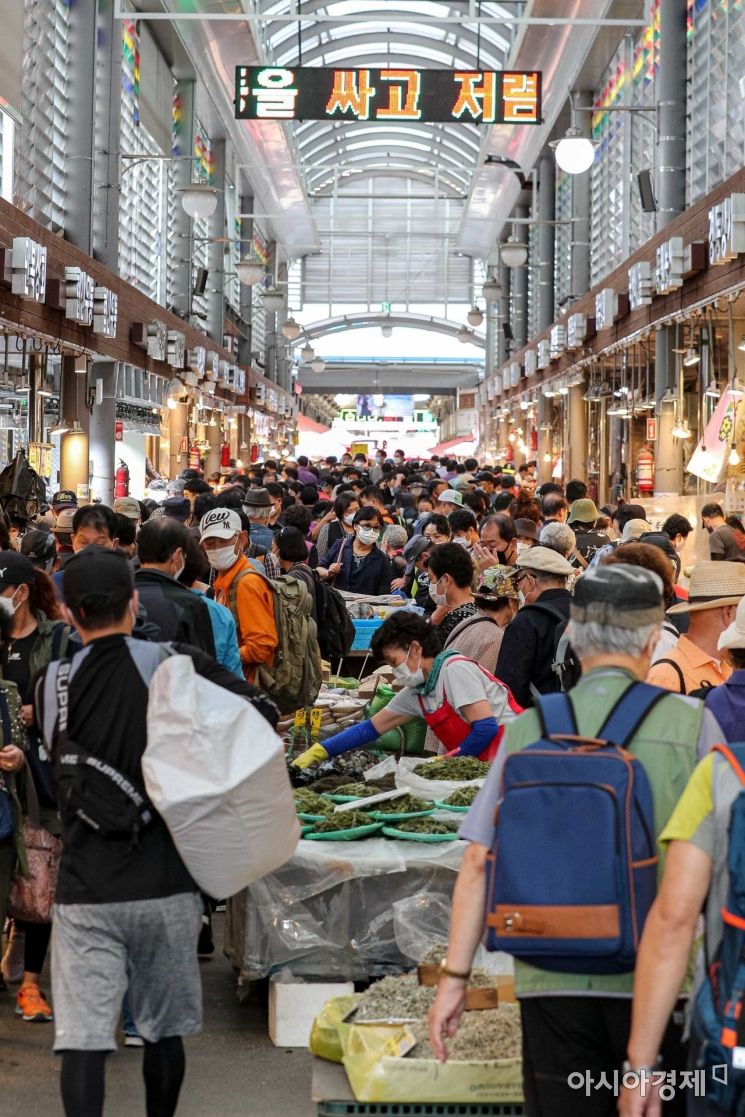
 Citizens are shopping at Cheongnyangni General Market in Dongdaemun-gu, Seoul, three days before Chuseok, the biggest traditional holiday of the Korean people. Photo by Jinhyung Kang aymsdream@
[Asia Economy Reporter Lee Seung-jin] As Chuseok approaches, grocery prices are soaring. Due to the prolonged rainy season and consecutive typhoons amid the aftermath of the novel coronavirus disease (COVID-19), prices of major food ingredients have risen simultaneously. However, since cheaper items are divided between large supermarkets and traditional markets, consumers who want to shop wisely need to carefully compare prices.
According to the Korea Agro-Fisheries & Food Trade Corporation (aT) and the distribution industry on the 30th, pork and beef are relatively cheaper in traditional markets, while vegetables and fruits are cheaper in large supermarkets.
As of the 29th, aT reported that the average price of pork ribs per 100g in traditional markets was 1,162 won, whereas in large supermarkets it was 1,475 won. The price of pork belly (domestic refrigerated) per 100g was 2,354 won in traditional markets and 2,428 won in large supermarkets. Most other pork cuts were also cheaper in traditional markets compared to large supermarkets.
During the same period, the price of Korean beef ribs (grade 1) per 100g was 5,514 won in traditional markets and 8,700 won in large supermarkets, making traditional markets more than 3,000 won cheaper. For Korean beef sirloin (1+ grade) per 100g, traditional markets charged 10,020 won, while large supermarkets charged 12,961 won, showing a difference of nearly 3,000 won. However, for imported beef such as Australian beef, large supermarkets were relatively cheaper.
Vegetables were relatively cheaper in large supermarkets than in traditional markets. The price of one head of napa cabbage (premium) was 12,288 won in traditional markets, exceeding 10,000 won, while large supermarkets sold it for 5,000 won, showing a price difference of more than twice. For radish (premium), which is widely used in kimchi and soups/stews, traditional markets priced it at 3,961 won each, while large supermarkets priced it at 3,465 won.
Additionally, according to the Small Enterprise and Market Service, apples (Busa variety, 500g) were sold for 13,334 won in traditional markets, whereas large supermarkets sold them for 10,541 won. For pears (Shingo variety), traditional markets priced them at 15,732 won, and large supermarkets at 15,075 won, making large supermarkets cheaper. As Chuseok approaches, large supermarkets are entering the final discount events simultaneously, which is expected to widen the price gap further.
Meanwhile, aT’s survey on the cost of Chuseok ancestral rites table setting about a week before the holiday showed that traditional markets cost 244,000 won, while large retail companies cost 342,000 won. Compared to last year, prices increased by 8.2% in traditional markets and 9.1% in large retail companies, respectively.
© The Asia Business Daily(www.asiae.co.kr). All rights reserved.

















