[Asia Economy Reporter Su-yeon Woo] As the global market contracts due to the novel coronavirus infection (COVID-19), automobile exports have decreased, but exports of eco-friendly vehicles have steadily increased. The surge in demand for eco-friendly vehicles in Europe, where emission regulations have been tightened, offset the overall decline in exports of domestically produced cars.
According to the Korea Automobile Manufacturers Association on the 2nd, exports of eco-friendly vehicles from January to August this year reached 171,584 units, a 9.9% increase compared to the same period last year. This figure includes four types of eco-friendly vehicles: hybrid (HEV), plug-in hybrid (PHEV), pure electric (EV), and hydrogen electric (FCEV) vehicles.
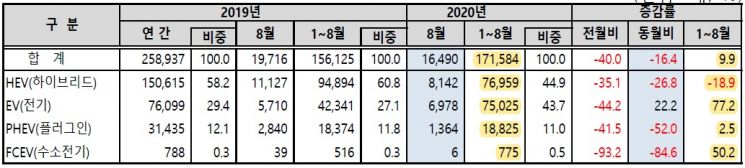 2020 Eco-friendly Vehicle Exports (Unit: Vehicles, %) / Photo by Korea Automobile Manufacturers Association
Compared to the overall automobile exports of 1,137,778 units during the same period, which decreased by 29.3% year-on-year, this is a relatively robust figure. In other words, while exports of domestically produced cars decreased by about 30% from January to August, exports of eco-friendly vehicles actually increased by 10%.
Breaking down by powertrain, hybrid exports were 76,959 units, down 18.9% year-on-year, but exports of pure electric vehicles (75,025 units) and hydrogen electric vehicles (775 units) increased significantly by 77.2% and 50.2%, respectively. Plug-in hybrid vehicles also saw a slight increase with 18,825 units exported.
By region, exports of eco-friendly vehicles decreased in most areas such as North America (-8%), the Middle East (-30%), Latin America (-38%), and Asia (-57%), but only European Union (EU) countries showed growth of 22%.
This is because from this year, the EU has strengthened its carbon dioxide (CO2) emission regulations, increasing the necessity for automakers to sell eco-friendly vehicles. The EU has set the CO2 emission limit for vehicles sold in Europe at 95g/km starting this year, and automakers that fail to meet the standard must pay a fine of 95 euros per vehicle.
Recently, the EU has continued its strong environmental regulatory policy by raising its greenhouse gas reduction target from 40% to 55% compared to 1990 levels. Because of this, it is expected that the electric vehicle era will accelerate, especially in Europe.
The EU’s strengthened environmental regulations are clearly favorable for domestic automakers’ exports of eco-friendly vehicles. However, increasing electric vehicle exports has not yet directly translated into profitability for automakers. The primary task remains to reduce the production cost of electric vehicles.
Kim Min-kyung, a researcher at Mirae Asset Daewoo, said, "In the case of Hyundai Motor Company, the breakeven point for pure electric vehicles was initially expected around 2023, but with the recent visible expansion of market share, the growth potential of the electric vehicle sector is expected to be reflected sooner."
© The Asia Business Daily(www.asiae.co.kr). All rights reserved.

















