"Seoul Taxi VS New York Taxi" Kakao Mobility Big Data Analysis
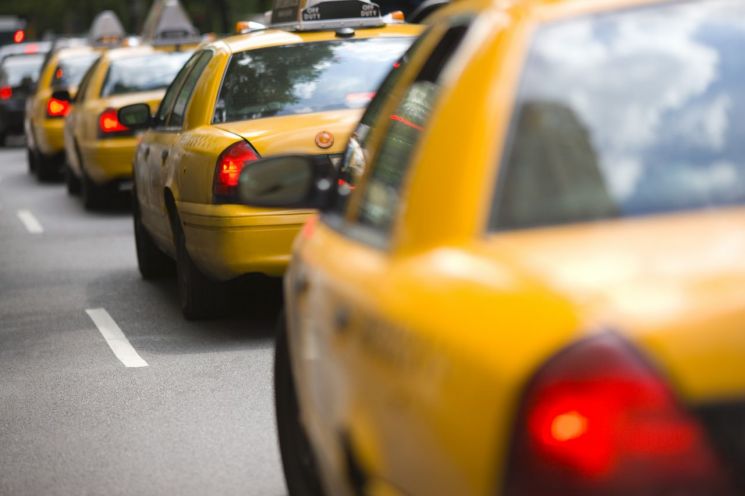
[Asia Economy Reporter Buaeri] When people think of New York in the United States, many recall the 'yellow taxi.' New York is the origin of the modern taxi market and one of the largest markets for ride-sharing companies like Uber and Lyft. How do the taxis in New York and Seoul differ when examined through mobility data?
Roaming Service and Hailing Culture Are Similar
According to the '2020 Kakao Mobility Report' on the 2nd, New York's taxi market is divided into general taxis and FHVs (For-hire vehicles). New York taxis, like Korea's mid-sized taxis, are equipped with meters and provide passenger transport services that allow 'roaming service.'
In particular, the 'Yellow Cab' has become a symbol of New York taxis. In 2013, the 'Boro Taxi,' also known as the Green Cab, was introduced, operating only in some northern parts of Manhattan and outer boroughs. As of last year, there were 13,587 Yellow Cabs and 3,004 Green Cabs in operation. New York taxis can also be hailed by phone or app, similar to taxis in Korea.
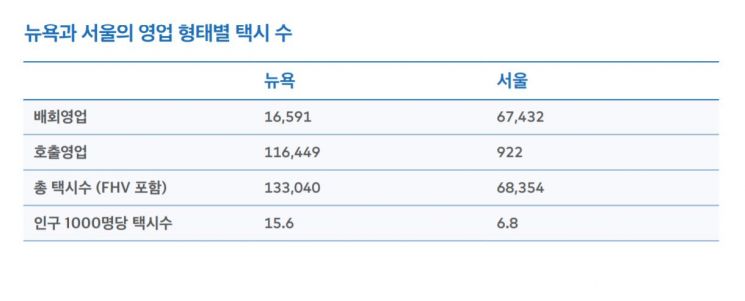
Most FHVs operating in New York are ride-sharing vehicles such as Uber. Their numbers increased from 40,000 in 2010 to 116,449 as of last year. Ride-sharing vehicles like Uber in New York belong to taxi franchises or taxi cooperatives. Ride-sharing service providers such as Uber and Lyft operate under the HVFHS (High Volume For-hire Services) license. This system was newly introduced by New York City in 2018. New York City, having received an exception under state law, incorporated ride-sharing services into the existing taxi regulatory framework.
New York is 'Ride-sharing,' Seoul is 'Roaming Service'
It was found that New York has overwhelmingly more ride-sharing vehicles than traditional taxis. This contrasts with Seoul, where mid-sized taxis focused on roaming service are predominant. The number of roaming taxis in New York is about 16,591 vehicles, roughly one-quarter of Seoul's combined mid-sized and deluxe taxis (67,432 vehicles).
However, including FHVs such as Uber and Lyft, the total number of hailed taxis operating in New York reaches 116,449 vehicles, which is 70 times more than Seoul's hailed taxis (922 vehicles). The total number of roaming and hailed taxis per 1,000 people is 15.6 in New York and 6.8 in Seoul, meaning New York has more than twice as many taxis per capita as Seoul.
'New York' Rides During the Day, 'Seoul' Rides at Night
Passenger usage patterns also differed. In Seoul, a relatively higher proportion of people use taxis during nighttime to early morning hours compared to New York. Conversely, New York sees more usage during daytime to evening hours.
In Seoul, peak taxi usage times are 8 a.m. on weekdays and 9 a.m. on weekends in the morning, and midnight on both weekdays and weekends at night. In New York, the highest usage time is 7 p.m. For Yellow Cabs, the peak time appears at 4 p.m., rather than during the morning rush hour, with the highest concentration of rides at 6 p.m., the evening rush hour.
Kakao Mobility analyzed, "Since New York is the global financial center, many people commute before the stock market opens, and around 4 p.m., right after market close, many Yellow Cab users roam intensively in central Manhattan. In contrast, in Seoul, relatively more people stay out late or work overtime compared to New York."
© The Asia Business Daily(www.asiae.co.kr). All rights reserved.



















