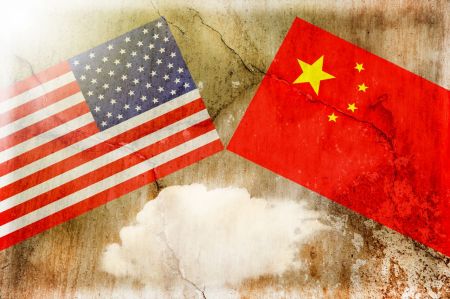
[Asia Economy Reporter Changhwan Lee] As the United States intensifies semiconductor sanctions against China, there are ongoing forecasts that South Korea could gain a windfall benefit.
According to industry sources on the 30th, the U.S. Department of Commerce recently imposed export restrictions on SMIC, China's largest foundry semiconductor company.
The Department of Commerce recently sent letters to U.S. computer chip manufacturers notifying them that they must obtain a license before exporting certain technologies to SMIC and its subsidiaries.
The Department of Commerce stated that exports to SMIC "pose an unacceptable risk of diversion for military use by the Chinese People's Liberation Army," and requires U.S. companies to submit license applications for each export case.
As a result, similar to the Huawei sanctions, SMIC will need prior approval from the U.S. administration to receive supplies of semiconductor equipment, components, and software using U.S. technology, making actual supply virtually impossible.
Therefore, with the U.S. export restrictions on SMIC becoming a reality, it is forecasted that China's semiconductor rise plan (aiming for 70% semiconductor self-sufficiency by 2025) will inevitably face significant setbacks.
KB Securities analyzed that based on global market share, China's foundry supply currently falls short of even half of its demand (China foundry demand 19% vs. China foundry supply 7%).
In such a tight foundry supply situation, they evaluated that the U.S. export restrictions on SMIC will further deepen China's foundry supply shortage.
Therefore, it is also estimated that Chinese smartphone, PC, and home appliance companies may place rush orders with Korean foundry companies in the future to secure inventory. As of the third quarter, SMIC's sales proportion to domestic Chinese companies is estimated to be about 70%, and its production lines are operating almost at full capacity (operating rate 98%).
This is because SMIC, recognized as the core of the Chinese government's semiconductor localization, is actively supplying camera image sensors (CIS), power management chips (PMIC), display driver ICs (DDI), fingerprint recognition, etc., in the Chinese domestic smartphone, display, and home appliance markets, expanding its market share.
KB Securities emphasized that clear windfall benefits are expected for Samsung Electronics and SK Hynix due to U.S. sanctions on SMIC. Researcher Dongwon Kim from the securities firm stated, "Exports of semiconductor equipment, components, and software using U.S. technology have become virtually impossible, which will definitely delay Chinese semiconductor companies' market entry."
He added, "In this context, benefits are expected for Samsung Electronics, which secured 7-nanometer (nm) production by restraining TSMC due to Huawei sanctions, and for SK Hynix System IC (100% owned by SK Hynix), which plans to fully operate its foundry plant in Wuxi, China, starting from the fourth quarter of this year, leading to improved operating rates and performance."
In particular, SK Hynix System IC is focusing on niche markets centered on Chinese customers (8-inch wafers), operating fully depreciated 8-inch fabs, and supplying camera image sensors (CIS), power management chips (PMIC), display driver ICs (DDI), etc., to local Chinese set companies using a multi-product small-lot production method, estimating that it can achieve an operating profit margin of 15-20% in the future.
© The Asia Business Daily(www.asiae.co.kr). All rights reserved.

















