Singapore Accelerates Robot Industry Amid Labor Shortage
Develops COVID Test Sample Collection Robot 'Swapbot'
Operates Social Distancing Monitoring Robots
Active in Various Fields Including Cleaning and Customer Service Robots
[Asia Economy Singapore Correspondent Seo Jumi] Since the outbreak of the novel coronavirus disease (COVID-19), the era of robots has rapidly approached Singapore. The Singapore government has been promoting unmanned and automated systems in various fields since 2016 due to labor shortages, and the recent emphasis on contactless (untact) interactions has accelerated the development of the robotics industry.
According to local media such as The Straits Times on the 28th, the National Cancer Centre Singapore (NCCS) and Singapore General Hospital (SGH) have developed a specimen collection robot called 'SwapBot' to safely conduct COVID-19 tests. Shaped like an ophthalmic vision tester, 'SwapBot' allows the person being tested to operate it themselves, reducing the testing time to about 20 seconds. It also minimizes human contact during the testing process, lowering the risk of infection. SingHealth, which oversees the specimen collection robot project, is working with its partner BioBot Surgical to file a patent application for the SwapBot technology.
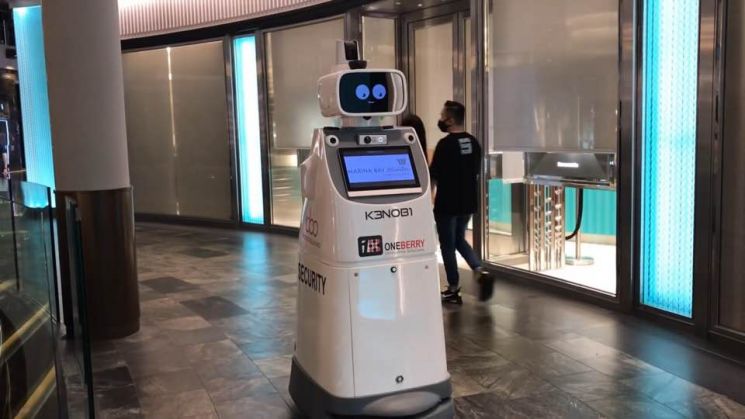
Earlier, during the strict lockdown period (April to early July), Singapore introduced Spot robots for pilot operation to monitor social distancing among citizens. Spot robots installed in various city parks can record and transmit data in real time.
When concerns arose that the robots might collect and identify personal information, Singaporean authorities clarified that they would not be used for administrative enforcement. Additionally, Spot robots are deployed to perform simple medical tasks or assist with duties for people under self-quarantine or treatment, preventing healthcare and administrative workers from being exposed to the virus.
The role of robots has also expanded in tasks such as floor cleaning and pest monitoring to maintain cleanliness in crowded restaurants and shopping facilities. Since the spread of COVID-19, the demand for cleaning robots has increased as disinfection and hygiene have become more important. At Changi Airport, Singapore’s gateway, 47 robots are currently active, including cleaning and garbage collection robots, as well as robots that distribute souvenirs and assist visitors.
These robots are widely regarded as meaningful because they reduce repetitive tasks and enable existing workers to handle new technologies like robot operation, allowing them to perform higher-value roles. However, there are concerns that excessive unmanned automation could lead to significant job losses.
The Singapore government has announced an investment of 450 million Singapore dollars (approximately 366 billion Korean won) to support small and medium-sized enterprises and mid-sized companies in adopting robotics.
According to recent data from the International Federation of Robotics, Singapore has the highest robot density in the manufacturing sector, with over 918 robots installed per 10,000 workers, surpassing second-ranked South Korea (855 robots) and third-ranked Japan (364 robots).
© The Asia Business Daily(www.asiae.co.kr). All rights reserved.
![Clutching a Stolen Dior Bag, Saying "I Hate Being Poor but Real"... The Grotesque Con of a "Human Knockoff" [Slate]](https://cwcontent.asiae.co.kr/asiaresize/183/2026021902243444107_1771435474.jpg)
















