Identification of Pain Mechanisms Due to Pathological Brain Malfunction
Observation of Persistent Activation in the Pain Modulation Area PAG
Confirmation of Causal Relationship with Chronic Neuropathic Pain

[Asia Economy Reporter Junho Hwang] Domestic researchers have discovered a molecular switch in the human body that exerts analgesic effects. It is expected to contribute to the treatment of patients suffering from neuropathic pain caused by nerve damage.
The National Research Foundation of Korea announced on the 29th that Professor Jihoon Jeong of Kyung Hee University and Professor Sangjeong Kim of Seoul National University’s research team elucidated the mechanism by which pathological pain becomes chronic due to changes in brain function. The related research results were published online on the 24th in the international journal Current Biology.
Induced by Inactivation of Midbrain RAG in Neuropathic Pain

The research team revealed that the brain has a system that self-regulates pain, and neuropathic pain occurs when this system malfunctions, causing even normal sensations to be perceived as severe pain.
The team obtained these results using a mouse model induced with neuropathic pain through spinal nerve ligation surgery. They first identified decreased activity in specific areas such as the periaqueductal gray (PAG) of the midbrain in these mice. The periaqueductal gray area surrounding the cerebral aqueduct in the midbrain is a core part of the endogenous analgesic system that regulates pain signals.
Additionally, the team electrophysiologically measured PAG neurons and discovered a new property related to the metabotropic glutamate receptor 5 (mGluR5). They found that in normal mice, mGluR5 in the midbrain PAG is continuously activated, maintaining neuronal excitability. They further confirmed that for normal pain regulation in the brain, this receptor must maintain continuous activation.
In the mouse model of pathological pain, the activity of metabotropic glutamate receptor 5 was reduced in the PAG. Conversely, artificially activating this receptor produced a strong analgesic effect.
The research team stated, "Activating mGluR5 in the PAG through drugs can exert analgesic effects, and genetically manipulating to prevent the expression of Homer1a in the PAG can prevent the chronicization of pain."
A New Clue for Neuropathic Pain Treatment
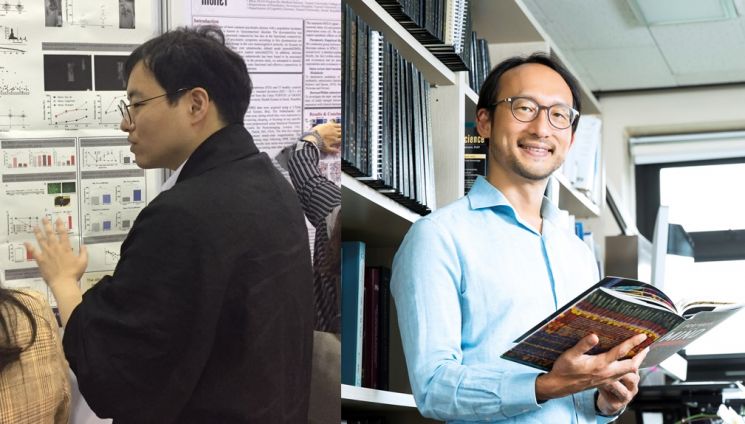 Professor Jeong Ji-hoon of Kyung Hee University (left), Professor Kim Sang-jung of Seoul National University (right)
Moreover, the team found that Homer1a, a homeostatic regulatory molecule in vivo, is involved in the sustained activation changes of this receptor.
The research team said, "By enhancing understanding of pathological pain states, this provides a clue for new therapeutic research on neuropathic pain and is expected to help understand the mechanisms of other neurological disorders beyond pain."
Meanwhile, patients suffering from neuropathic pain due to nerve damage can perceive even normal sensations as severe pain. Although various coping methods have been devised, they are effective only in a few patients and only alleviate pain to some extent, highlighting the need for new approaches based on understanding the mechanisms of pain processing.
© The Asia Business Daily(www.asiae.co.kr). All rights reserved.



















