Division of Proponents for Hannam 1 District in Pilot Project Site Contest
Conflict Between Original Residents and New Villa Owners in Seongbuk 1 District Scheduled for Redevelopment
Opposition to Development Centered on Merchants in Heukseok 2 District
Seoul City "Selecting Sites with Smooth Promotion"
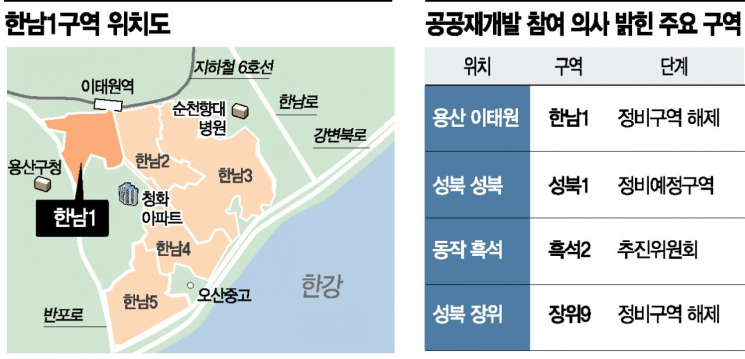
[Asia Economy Reporter Onyu Lim] Interest in the public redevelopment projects promoted by the government is rising, but "resident conflicts" are emerging as a major obstacle to smooth project implementation. As the target areas now include previously deregulated zones and the resident consent rate requirement has been lowered to 50%, disputes over the project promoters are occurring, and conflicts between residents of newly built housing and merchants are surfacing.
According to Yongsan District Office in Seoul on the 29th, since the call for applications for the public redevelopment pilot project candidates began on the 21st, two applications have been submitted for Hannam 1 District alone. Different entities within the same district have stepped forward to promote public redevelopment. One is the Itaewon Mixed-Use Public Redevelopment Promotion Preparation Committee, and the other is a promotion committee centered around the urban maintenance company Namje C&D.
Hannam 1 District, considered the most valuable among the public redevelopment candidates, is the only district in Hannam New Town where the project was canceled. Although it received approval for the redevelopment promotion committee in 2011, it was deregulated from the maintenance zone in 2017. Since the government decided to include deregulated areas in the public redevelopment target zones, this district has been mentioned as a strong candidate. The enthusiasm of residents was high enough to submit the application first in Seoul.
However, the division of project promoters into two groups has created difficulties. The Yongsan District Office, which received the applications, evaluates basic redevelopment requirements, residential maintenance indices, and resident consent rates to ultimately recommend candidates to Seoul City, but the promoter must be a single entity at this stage. Residents are anxious that this situation might become an obstacle to candidate selection.
A Yongsan District Office official said, "There are no guidelines for situations where two promoters emerge in one district, so we cannot confirm any results at this time," adding, "We are reviewing various possibilities, such as selecting one of the two promoters or mediating differences between them."
In Seongbuk 1 District, a planned maintenance zone in Seongbuk District, conflicts between existing residents and owners of newly built villas are problematic. This district received approval for the promotion committee in July 2004 but has not been designated as a maintenance zone for 16 years. Eventually, construction restrictions were lifted in 2015, and since then, more than 100 newly built villas have been constructed rapidly. A Seongbuk 1 District official explained, "Many residents are concerned that the presence of new villas might prevent meeting the aging criteria." In fact, banners stating "Strongly Oppose New Construction Permits" are posted throughout Seongbuk 1 District.
Meanwhile, as Seoul City designated the rights assessment date as the 21st, when the public redevelopment call for applications began to prevent share splitting, opposition from those who purchased newly built villas has also emerged. A representative from B Real Estate Agency in Seongbuk-dong said, "There are many villas under construction in Seongbuk 1 District, but it is unclear whether the residents will obtain move-in rights," adding, "If new buyers do not receive move-in rights, there is a possibility of project delays due to lawsuits."
In Heukseok 2 District, a maintenance zone in Dongjak District, Seoul, conflicts with residents opposing redevelopment are ongoing. Heukseok 2 District received approval for the promotion committee in 2009 but failed to establish a union for 11 years. The district submitted a letter of intent to participate in public redevelopment, which has a lower resident consent rate requirement (66.7%, or 50% for promotion zones and union-established areas) compared to general redevelopment (75%). While the likelihood of project advancement has increased, concerns have been raised that resident conflicts may intensify. A representative from A Real Estate Agency in Heukseok-dong said, "About 20% of residents in Heukseok 2 District are merchants skeptical of redevelopment," adding, "With recent talks about public redevelopment, concerns have grown that opposing voices might be ignored."
Seoul City holds the position that districts capable of rapid housing supply are advantageous in the selection process. A Seoul City official said, "The city's goal is to smoothly complete projects, so there is no reason to select districts that show signs of trouble from the start," adding, "Review committee members will select districts by comprehensively considering not only project feasibility but also such situations."
Some critics argue that the government and Seoul City are inadequately prepared. A redevelopment consulting industry official said, "Many districts wishing to participate in public redevelopment have failed in general redevelopment not only due to lack of feasibility but also conflicts with opposing residents," adding, "Solutions on how the public sector will resolve these issues must be presented first."
© The Asia Business Daily(www.asiae.co.kr). All rights reserved.
![Clutching a Stolen Dior Bag, Saying "I Hate Being Poor but Real"... The Grotesque Con of a "Human Knockoff" [Slate]](https://cwcontent.asiae.co.kr/asiaresize/183/2026021902243444107_1771435474.jpg)
















